Could conditioning help an aging shingle roof, or would it postpone a repair the roof already needs? That’s the decision behind asphalt shingle conditioning Cambridge homeowners are considering. Treatment may suit some roofs, but it isn’t a fix for leaks, damaged shingles, or underlying problems.
It’s reasonable to be cautious. Paying for treatment before understanding the roof’s condition can mean unnecessary work, while replacing shingles that may still be serviceable could be premature. The right next step is an assessment, not a one-size-fits-all recommendation.
This article explains how spray-applied shingle conditioning works, what an inspection should check, and which roofs may be candidates. You’ll also learn when repair or replacement may make more sense, and what to ask a Cambridge-area provider about application conditions, exclusions, maintenance, and possible warranty implications. That gives you a practical basis for comparing claims and choosing a next step without assuming your roof qualifies.
Key Takeaways
- Roof age alone can’t determine whether conditioning is suitable. The shingles’ condition and inspection findings matter.
- Learn what asphalt shingle conditioning Cambridge providers offer, and what details to verify before considering treatment.
- Compare conditioning, repair, and replacement based on the roof’s condition, not treatment claims alone.
- Ask for written recommendations and clarify exclusions, preparation, weather limitations, aftercare, and possible warranty implications.
- When requesting an assessment, share the roof’s age, known damage or leaks, and any recent repairs to help guide the discussion.
Asphalt shingle conditioning Cambridge homeowners should consider: what it does and who may be a candidate
Roof age can raise a useful question, but it can’t answer it: is the roof still suitable for treatment? Asphalt shingle conditioning is intended for eligible aging shingles. An inspection must establish whether the roof’s actual condition makes treatment a reasonable option.
Shingle conditioning is a spray-applied treatment intended to support eligible aging asphalt shingles. It is not a repair for roof damage or a replacement for new shingles. That distinction matters. Conditioning, repair, and replacement address different roof conditions, so a general promise of longer roof life shouldn’t determine the recommendation.
What does asphalt shingle conditioning mean?
Asphalt shingles are layered roofing materials. The neutral overview of asphalt shingles can help explain the basic terminology. In roof rejuvenation, a treatment is sprayed onto shingles that have first been assessed for suitability. The intended role may include supporting shingle flexibility, but ask the provider to explain the specific treatment’s evidence and limits rather than assuming a particular result.
Conditioning isn’t cleaning, patching, or installing new shingles. It doesn’t fix a leak, replace a missing or damaged shingle, or resolve an underlying roof problem. Those conditions need professional evaluation and, where appropriate, repair or replacement.
Which Cambridge roofs may be worth assessing?
Aging asphalt shingles can be a reason to request an assessment, not proof that conditioning is appropriate. Roof age alone doesn’t show whether the shingles remain suitable. An assessor should consider visible wear and damage, as well as reported leaks or concerns beneath the roofing, before recommending a next step.
Visible damage, active leaks, or signs of structural concern call for professional evaluation. Don’t treat conditioning as a substitute for diagnosing those issues. Ask the provider to explain what they observed and whether repair, replacement, or another option better fits the findings.
Granule loss can be one visible change to discuss during an assessment. For more background, consult the supplied guide on roof shingle granule loss, then ask the assessor how any observed wear affects your roof’s suitability. For Cambridge homeowners considering asphalt shingle conditioning Cambridge, the practical first step is a roof-specific assessment, not a decision based on age or marketing claims alone.
How asphalt shingle conditioning works, and what it cannot fix
A conditioning service should begin with a decision, not a spray: does the roof qualify, and are there problems that need a different solution? NanoTech Exteriors describes its roof rejuvenation treatment as spray-applied. Before booking, confirm the inspection criteria, preparation, application conditions, and follow-up process with the provider.
A maintenance treatment is intended to condition eligible shingles. Structural roof repair addresses damage and underlying problems. The purposes aren’t interchangeable. Treatment results depend on the roof’s existing condition and eligibility. Conditioning shouldn’t be presented as a way to fix leaks, damaged shingles, or installation defects.
What happens during a conditioning service?
Ask the provider to explain each step for your roof. A clear process should describe how the roof is assessed before treatment, what preparation is needed, how the spray-applied treatment is carried out, and what follow-up or aftercare is recommended. Don’t assume every provider follows the same procedure or that treatment is appropriate just because the shingles are asphalt.
Scheduling details matter too. Before agreeing to a date, ask what access, weather, and site conditions could affect application, and what would happen if those conditions aren’t suitable. Request the treatment’s exclusions and any warranty implications in writing. This is especially important because industry guidance from ARMA advises against applying coatings or rejuvenators to installed asphalt shingles, citing potential damage and a lack of proven benefits. Ask the provider how its treatment differs, what evidence supports its claims, and how the guidance relates to your roof.
What conditioning should not be expected to solve
An application isn’t a leak repair. If water is entering the home, shingles are cracked, missing, or otherwise damaged, or there are concerns about the roof’s structure, those issues need separate professional assessment. Applying treatment without diagnosing the cause can leave the underlying problem unresolved. If the findings point to repair or replacement, conditioning isn’t a substitute.
For another decision-making reference, consult the supplied Ontario checklist for deciding whether a roof needs replacement and compare its considerations with a qualified assessment of your own roof. The right choice depends on inspection findings, not a broad treatment promise.
Cambridge homeowners considering asphalt shingle conditioning Cambridge can use an assessment to compare roof rejuvenation with repair or replacement. Ask for a clear explanation of the observed condition and the recommended option. To discuss an assessment and roof rejuvenation services, share any known leaks, visible damage, or previous repairs.
Conditioning, roof repair, or replacement: how Cambridge homeowners can compare
There isn’t one right option for every aging roof. The decision should follow an on-site inspection of the shingles and the roof’s overall condition, not a treatment advertisement or a roof-age estimate. Use this comparison as a starting point, then ask the assessor to explain how the findings support the recommendation.
| Roof condition | Possible next step | Questions to confirm |
|---|---|---|
| Aging asphalt shingles that appear broadly serviceable, with no known active leaks or widespread damage | Request an assessment to see whether conditioning may be appropriate | Has the shingle type and condition been checked? Does the roof meet the treatment’s eligibility criteria and application conditions? |
| Specific damaged or missing shingles, or a leak that needs investigation | Have the problem evaluated for roof repair | What is causing the issue? Will the recommended repair address the observed damage? |
| Widespread deterioration, recurring problems, or concerns about underlying roof condition | Ask whether replacement should be considered | What findings support replacement? Are there repair or conditioning options, and why are they less suitable? |
When conditioning may be worth discussing
A roof that’s aging but appears broadly intact may be worth assessing for conditioning. That’s a reason to ask, not a sign that the shingles qualify. A professional should confirm the roofing material, examine its condition, and explain any treatment exclusions before making a recommendation. If a provider cites a lifespan extension, treat it as conditional. Ask what evidence supports the claim, and don’t assume it predicts your roof’s individual outcome. For broader context, the Burlington-focused rejuvenation guide discusses the topic from that local perspective. Conditions and recommendations may differ in Cambridge.
If a provider describes a treatment as plant-based or bio-based, ask what that means and what documentation supports it. The U.S. USDA BioPreferred Program relates to products’ bio-based content. That is not, by itself, evidence that a treatment is effective or suitable for a particular roof.
When repair or replacement may need priority
Active leaks, widespread shingle damage, or concerns about underlying roof components call for further evaluation before conditioning is considered. A photo or homeowner description can help explain a concern, but it can’t establish the roof’s full condition. Ask the provider to document what they inspected, what they found, and why repair, replacement, or conditioning best fits those findings.
For asphalt shingle conditioning Cambridge homeowners, the practical choice is the one supported by a clear assessment. If a roof-life extension is mentioned, ask for current substantiation and an explanation of what factors could affect the result. No general claim can set a fixed lifespan for an individual roof.
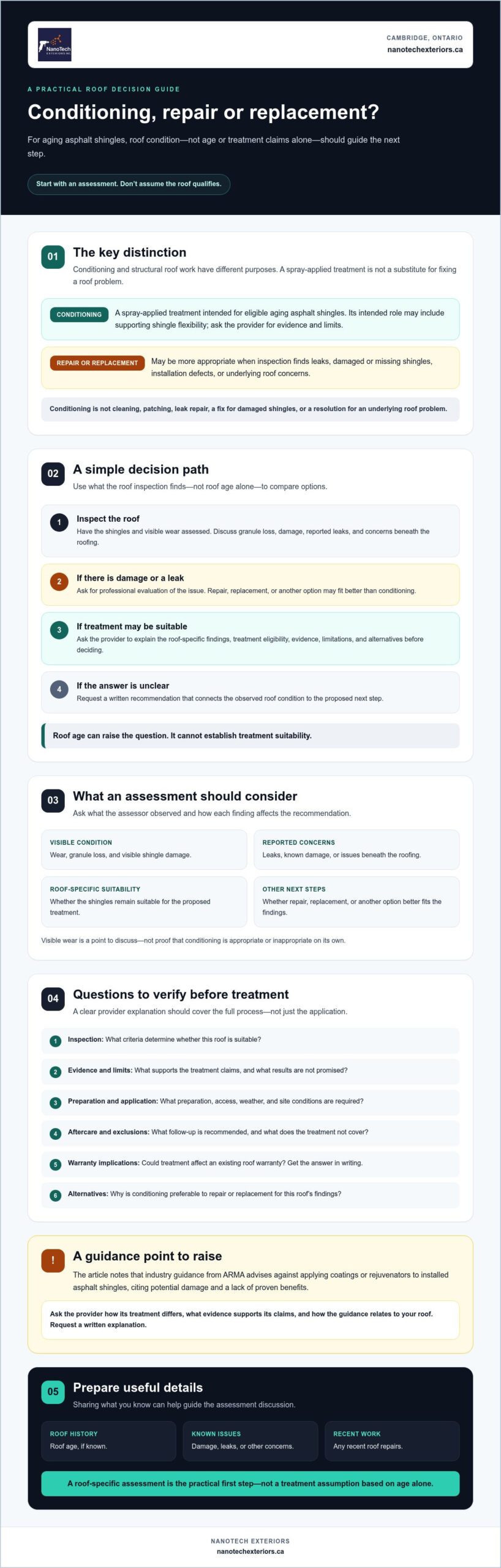
What to ask a Cambridge asphalt shingle conditioning provider
A clear recommendation should be based on what the provider finds on your roof, not pressure to book or a broad promise about treatment results. Use this checklist to compare answers and request important details in writing.
Questions that clarify eligibility and expected results
- What did you find during the inspection? Ask which areas and shingles were assessed, and what findings make this particular roof suitable or unsuitable for treatment.
- What outcome should I reasonably expect? Request written details of the treatment’s intended benefits, limitations, and exclusions. Ask how results can vary with the roof’s existing condition.
- What supports any roof-life extension claim? Ask for current evidence, how the claim applies to your roof, and what factors could affect the outcome. A general claim isn’t a forecast for an individual home.
Questions about the provider and service process
- Who will perform the work, and what authorization do they hold? Confirm who is responsible for the assessment and application, and whether the provider is authorized for the specific treatment being proposed.
- What preparation and access are needed? Ask how the site should be prepared, what access the crew needs, and which weather or site conditions could change the application schedule.
- What happens after application? Confirm any follow-up, maintenance, or aftercare instructions, and ask what to do if you notice a concern later.
- Can I review the terms before deciding? Request written treatment details, exclusions, and an explanation of any possible effect on existing roof coverage. Check with your roof or shingle warranty provider if you’re unsure how treatment could affect coverage.
Compare providers by matching each recommendation to documented roof findings. A useful written assessment should explain what was observed, why the proposed option fits, and why alternatives such as roof repair or replacement were not recommended. If an answer relies mainly on a broad promise or leaves the roof’s condition unclear, ask for clarification before agreeing to work.
For Cambridge homeowners researching asphalt shingle conditioning Cambridge, NanoTech Exteriors is an authorized service provider for GoNano treatments and offers roof rejuvenation alongside roof repair and replacement. Share your roof’s age, any known leaks or damage, and previous work when requesting an assessment. Request a Cambridge roof rejuvenation assessment and ask for the inspection findings and recommendation in writing.
Book an asphalt shingle conditioning assessment in Cambridge
The sound next step isn’t to book treatment before you know what your roof needs. Start with an assessment, compare the recommendation with the observed condition, and consider conditioning only if a professional confirms the roof is eligible. If the findings point to repair or replacement, those options should be discussed instead.
Prepare for a useful roof assessment
You don’t need to diagnose the roof yourself. Share what you know and let the assessor inspect it. Helpful details include:
- The roof’s approximate age, if known, and whether the shingles are asphalt.
- Past repairs or replacement work, including any records you have.
- Leak history, such as where you’ve noticed water inside and when it occurs.
- Visible changes from the ground, such as missing or curled shingles, or granules collecting near downspouts. Don’t climb onto the roof to check.
Ask what the inspection will cover and what findings you’ll receive. A clear explanation should connect observed roof conditions to the recommendation, note any limitations, and distinguish issues requiring repair from areas that may be considered for conditioning.
Choose the next step based on the findings
Compare the proposed option with the documented condition. If conditioning is recommended, ask how the roof meets the treatment’s eligibility criteria and what the treatment can and cannot address. If a leak or damaged shingles were identified, confirm how the proposed plan deals with those concerns. If replacement is recommended, ask which findings make repair or conditioning unsuitable. You can request clarification before deciding.
NanoTech Exteriors serves Cambridge and offers roof rejuvenation, roof repair, and residential roofing, including replacement. The company also serves Burlington, Hamilton, Oakville, Niagara, Kitchener, and Guelph. These services are options to consider after an assessment, not automatic recommendations. The appropriate next step depends on the roof’s condition.
If you’re considering asphalt shingle conditioning Cambridge, gather the details above and discuss what an inspection can establish. Contact NanoTech Exteriors to talk through your roof’s condition and suitable next steps. There’s no need to assume treatment is right before the assessment.
Make your next roofing decision with confidence
The right choice for your roof starts with a clear understanding of its condition. For homeowners considering asphalt shingle conditioning Cambridge, treatment is one option, and an inspection should establish whether it’s suitable or whether repair or replacement deserves priority.
Look for recommendations that explain the findings, the reasoning behind the proposed work, and any important limitations. A roof-specific assessment helps you weigh your options without treating age or marketing claims as a diagnosis.
NanoTech Exteriors lists Cambridge among its service areas and offers roof rejuvenation, roof repair, refurbishment, and replacement. These are options to discuss, not automatic recommendations. Share what you know about your roof, including its approximate age, past work, and any leaks or visible changes.
Request a Cambridge roof assessment with NanoTech Exteriors to discuss your roof’s condition and possible next steps. A thoughtful assessment can help you move forward with greater confidence, whatever your roof needs.
Frequently Asked Questions
What is asphalt shingle conditioning?
Asphalt shingle conditioning is a spray-applied treatment intended for eligible aging asphalt shingles. NanoTech Exteriors describes its roof rejuvenation service as designed to restore shingle flexibility, but treatment claims and suitability should be confirmed for the specific roof. Conditioning isn’t cleaning, patching, or installing new shingles, and it doesn’t repair leaks or damaged roofing. Ask the provider to explain the treatment’s evidence, limitations, preparation, and application requirements before deciding.
Does asphalt shingle conditioning work on every roof?
No. Roof age or shingle material alone can’t establish eligibility. A professional should assess the shingle type and condition, look for damage and signs of underlying concerns, and explain why the roof does or doesn’t qualify. Active leaks, widespread deterioration, or structural concerns need separate evaluation. For asphalt shingle conditioning Cambridge homeowners, an inspection is the practical way to compare treatment with repair or replacement without assuming a particular option is right.
How long can conditioning extend an asphalt shingle roof’s life?
There’s no fixed extension that can be promised for an individual roof. NanoTech Exteriors states that its rejuvenation treatment may extend roof life by up to 15 years, but this is a company claim, not a guaranteed outcome. Ask what current evidence supports the claim, how it applies to your roof’s condition, and what factors may affect results. A provider should explain the limits clearly and avoid presenting a general figure as a prediction.
Can shingle conditioning fix a roof leak?
No. Conditioning isn’t a leak repair and shouldn’t be used to cover up water entry, damaged shingles, or an installation problem. A leak needs a professional assessment to identify its source and determine whether roof repair or another solution is needed. Share where you’ve noticed water inside and any relevant history, but don’t climb onto the roof to investigate. Treatment should only be considered after necessary issues have been properly evaluated.
Is asphalt shingle conditioning better than roof replacement?
Neither option is automatically better. The roof’s condition should guide the decision. Conditioning may be worth discussing if aging shingles remain suitable, while damaged areas may call for repair and extensive deterioration may make replacement more appropriate. Ask for inspection findings and a clear explanation of why the recommended option fits. Don’t compare a treatment promise with replacement in the abstract, since conditioning cannot correct damage or underlying roof problems.
How do I choose a roof-conditioning provider in Cambridge?
Choose a provider that assesses the roof before recommending treatment, explains eligibility and exclusions, and puts its findings and recommendations in writing. Ask who will perform the work, whether the provider is authorized for the treatment, what evidence supports any lifespan claim, and how preparation, weather, aftercare, and warranty implications are handled. NanoTech Exteriors lists Cambridge among its service areas and is an authorized service provider for GoNano treatments. Verify current service availability directly.
What should I expect during a roof-conditioning assessment?
Expect the provider to assess the roof’s material and visible condition before discussing whether treatment may be suitable. Share the approximate roof age, past repairs, leak history, and changes you’ve noticed from the ground. Ask what the inspection covers and what findings you’ll receive. A useful recommendation should explain the observed condition, treatment eligibility or reasons it’s unsuitable, and whether repair or replacement should be considered instead.
Does roof conditioning affect an existing shingle warranty?
It may, depending on the shingle warranty and the proposed treatment, so don’t assume coverage remains unchanged. Before authorizing work, ask the provider for written information about possible warranty implications and review your warranty terms. If anything is unclear, contact the shingle manufacturer or warranty provider for guidance specific to your roof. Also ask for the treatment’s exclusions and application details in writing, so you can consider them alongside the inspection findings.