What if the best way to discuss roof rejuvenation is to stop trying to win the argument? If “convincing my spouse to try roof rejuvenation” is on your mind, start with the roof’s actual condition, not a pitch for a particular treatment. A clear assessment gives you both something practical to consider.
It’s reasonable to question whether the roof needs attention now, whether rejuvenation is suitable, and whether the money would be better spent on replacement. Roof rejuvenation may be worth evaluating for some aging, sound shingles, but it isn’t right for every roof. If repairs or replacement better fit the condition, that should guide the decision too.
This guide will help you have a calm, informed conversation without pressuring your spouse or minimizing their concerns. You’ll learn how to weigh evidence about the roof, understand when rejuvenation may or may not make sense, and agree on a useful next step together. The goal isn’t a rushed yes. It’s a decision you both understand.
Key Takeaways
- Keep the conversation focused on your shared goal: a sound roof, not winning an argument about the solution.
- Understand what roof rejuvenation may do for aging shingles and why it can’t fix every type of roof damage.
- Compare rejuvenation, repair, and replacement according to the roof’s condition and each option’s limitations.
- Make “convincing my spouse to try roof rejuvenation” a joint decision by sharing concerns, gathering information, and weighing options together.
- Use a roof-condition assessment to gather information, then agree on a next step without feeling pushed.
How to Discuss Roof Rejuvenation Without Turning It Into an Argument
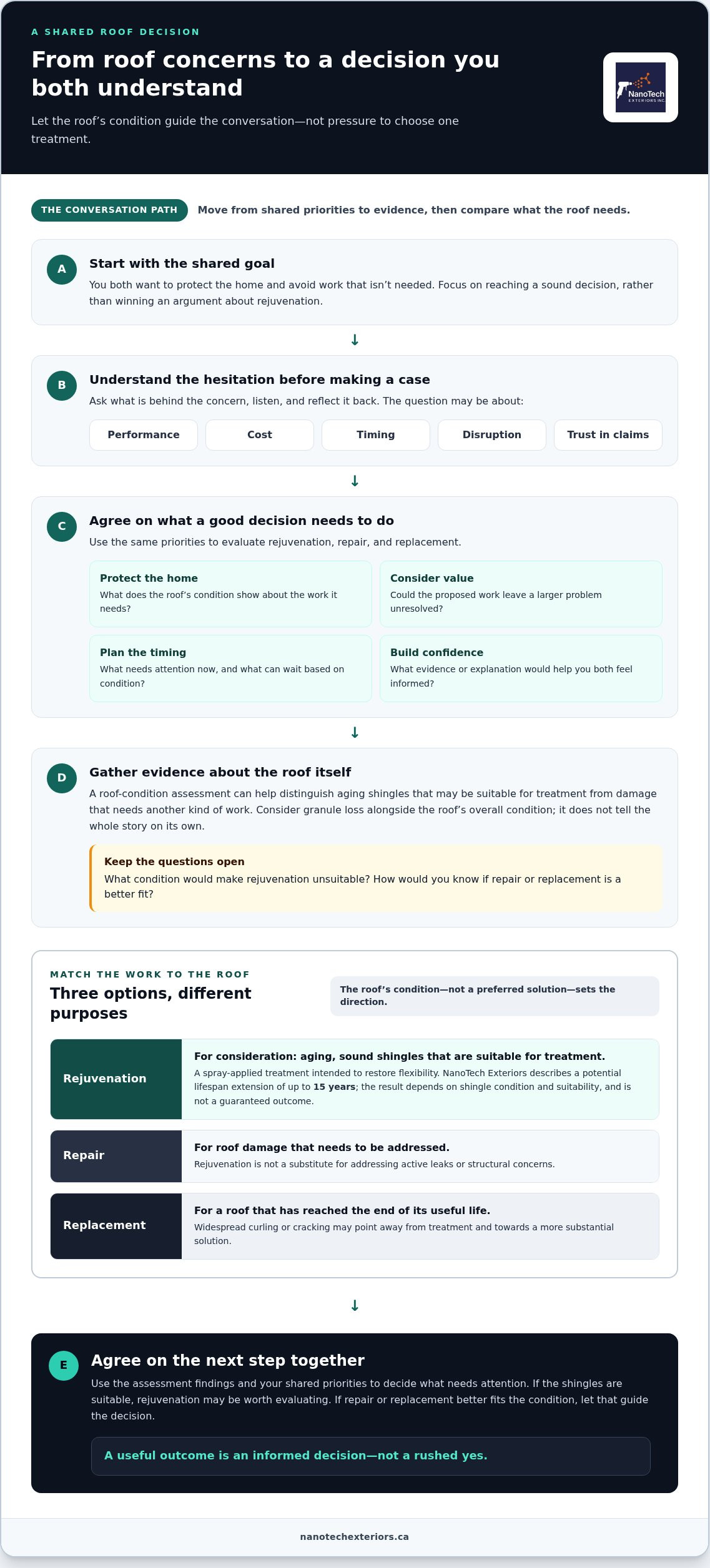
A roof decision has two valid priorities: protecting your home and avoiding work that isn’t needed. The disagreement may be about timing or the preferred solution, not about whether you both want a sound roof. Start with that shared goal. Rather than building a case for rejuvenation, work towards a decision you can both feel confident about.
Start with the concern behind your spouse’s hesitation
Ask what’s driving their hesitation before offering reasons to consider treatment. Is it performance, cost, timing, disruption, or trust in the claims? Listen to the answer, then reflect it back: “You want to know this will address the roof’s actual needs before we spend money.” That shows you’ve heard the concern instead of treating caution as resistance.
Roofing terms can make a conversation feel technical quickly. If your spouse wants to understand why shingles age, the Asphalt shingle overview provides basic background on their composition and lifecycle. Use it as context, not proof that a particular treatment will suit your roof. Let the unanswered questions guide what information you gather next.
Agree on what a good decision needs to accomplish
Before comparing options, decide what matters to both of you. You might prioritize protecting the home, getting value from the existing roof, choosing an appropriate time for work, and understanding the recommendation. Write down your priorities. A shared list makes it easier to compare rejuvenation, repair, and replacement using the same criteria.
- Protect the home: What does the roof’s condition show about the work it needs?
- Consider value: Is the proposed work suited to the roof, or could it leave a larger problem unresolved?
- Plan the timing: What needs attention now, and what can wait based on the roof’s condition?
- Build confidence: What evidence or explanation would help both of you feel informed?
Keep questions on the table before discussing treatment benefits or company claims. For example, ask, “What condition would make rejuvenation unsuitable?” and “How would we know if repair or replacement is a better fit?” This keeps the discussion open to more than one outcome.
If you’re thinking about convincing my spouse to try roof rejuvenation, use this article as a conversation aid, not proof that treatment is automatically right. A roof-condition assessment can help you understand what’s happening above you. Let the findings, not persuasion, guide the next step. If the shingles are suitable, rejuvenation may be worth evaluating. If they need repair or replacement, that should shape the decision instead.
What Roof Rejuvenation Can, and Cannot, Do for Aging Shingles
Roof rejuvenation is a spray-applied treatment intended to restore flexibility to aging asphalt shingles. That describes its purpose, not a guaranteed outcome. Whether it makes sense depends on the roof’s condition and suitability for treatment. An assessment can help distinguish shingles that may benefit from rejuvenation from problems that call for another kind of work.
Explain the potential benefits without promising a result
NanoTech Exteriors offers a treatment designed to restore flexibility to aging shingles and extend a roof’s lifespan by up to 15 years. The result depends on the shingles’ condition and whether the roof is an appropriate candidate, so that potential extension isn’t a fixed outcome every household can count on. Ask what the roof assessment shows, what the treatment is intended to address, and what limitations apply to your roof. Those specifics are more useful than treating a general claim as a prediction.
Rejuvenation aims to restore aging shingles; repair addresses roof damage, and replacement renews a roof that has reached the end of its useful life. Keeping these purposes separate makes it easier to compare options without assuming treatment can solve every problem.
Name the limits that help build trust
Rejuvenation isn’t a substitute for addressing active leaks or structural concerns. A roof can look aged but still be sound, or it can show damage that needs repair or replacement. Widespread curling or cracking, for example, may point away from treatment and towards a more substantial solution. The right recommendation should follow the roof’s condition, not a desire to make one option fit.
Granule loss is another condition homeowners may notice on asphalt shingles. It doesn’t tell the whole story on its own, so consider it alongside the roof’s overall condition. For a related explanation, read about roof shingle granule loss solutions.
If you’re convincing my spouse to try roof rejuvenation, shift the conversation from “Will this work?” to “What does the roof need, and what evidence supports that option?” Write down the benefits you hope for and the concerns you still need answered. If the roof has suitable aging shingles, rejuvenation may be worth considering. If it has damage that needs repair or is nearing the end of its life, treatment may not be the right fit.
For a low-pressure next step, explore roof rejuvenation information and use the roof’s condition to guide a shared decision.
Compare Roof Rejuvenation, Repair, and Replacement Fairly
A fair comparison starts with the roof’s needs, not a preferred solution. Roof rejuvenation is one option to assess for aging shingles, not the default choice for every older roof. Repair and replacement serve different purposes, so compare all three against the same evidence: the shingles’ condition, any damage, and the work needed to protect the home.
| Option | Purpose | May be appropriate when | Key limitation |
|---|---|---|---|
| Rejuvenation | A spray-applied treatment intended to restore flexibility to aging shingles. | Shingles are aging, and an assessment finds the roof suitable for treatment. | It doesn’t repair leaks, structural concerns, or damage beyond its restorative purpose. |
| Repair | Addresses specific damage or a localized problem. | A repair can resolve the identified issue without replacing the entire roof. | It won’t restore every aging shingle or address widespread deterioration by itself. |
| Replacement | Removes the existing roofing and installs a new roof. | The roof’s overall condition indicates it’s beyond treatment or repairs alone. | It involves a larger scope of work, so it may be unnecessary if a less extensive option suits the roof. |
When rejuvenation may belong in the discussion
Shingles that look worn or have lost some of their appearance may prompt questions, but appearance alone can’t establish whether rejuvenation is suitable. An assessment helps clarify whether the roof is sound enough for treatment, needs a repair first, or has broader issues that point elsewhere. Ask what condition was observed and why the recommended option fits, so you can both weigh the same information.
NanoTech Exteriors describes its rejuvenation treatment as a cost-effective alternative to replacement that can cost up to 85% less than a new roof. This potential saving is not a household-specific quote or a guaranteed result. Suitability and value depend on the roof and the work it needs. Consider cost alongside the purpose and limitations of each option.
When repair or replacement may be the better route
Active leaks, significant damage, or structural concerns need appropriate attention. Rejuvenation isn’t designed to correct those problems. If an issue is localized, repair may address it. If the roof’s overall condition is beyond treatment, replacement may be the more suitable path. Explore the 2026 Ontario roof replacement checklist for signs that replacement may need consideration.
If the conversation is focused on convincing my spouse to try roof rejuvenation, return to the comparison: which option best matches the roof’s observed condition? The answer may support treatment, repair, or replacement. That’s a stronger basis for agreement than choosing a solution first and looking for reasons to defend it.
Use This Conversation Plan to Make a Roof Decision Together
A useful conversation doesn’t need to end with an immediate yes or no. It needs to turn different concerns into a shared plan for finding out what the roof needs. Before discussing treatment claims, each of you can write down unanswered questions. That keeps the discussion focused on the information you still need, rather than who has the stronger argument.
Bring evidence into the discussion
Use what you’ve noticed as a starting point: shingles that look worn, signs of a leak, or what you know about the roof’s history. These are observations, not a diagnosis. Separate what you can verify from what you suspect, what you’ve read online, and what you prefer as a household. For example, “We’ve seen a water stain” is a concrete observation. It doesn’t establish the cause or which roofing option is appropriate.
Treatment suitability depends on the roof’s actual condition, not simply its age or appearance. A roof-condition assessment can help clarify whether rejuvenation is worth considering, whether a repair is needed, or whether replacement deserves attention. For broader background, read the Burlington roof rejuvenation homeowner guide.
Make room for a second opinion within the household
Ask each other, “What information would help you feel comfortable with a decision?” One spouse may want a clear explanation of the roof’s condition; the other may want to understand the options and their limitations. Both questions belong in the conversation. Compare treatment, repair, and replacement against the priorities you’ve agreed on, rather than treating one option as the goal.
- Share concerns: Each person names their main question without interruption.
- Gather roof information: Record visible observations and arrange an assessment to understand the condition.
- Compare options: Discuss what each option is intended to address and where its limits lie.
- Agree on a next step: Decide whether to seek more information, address a repair, or consider a suitable treatment or replacement.
Keep the pace calm. A maximum lifespan claim or a sense of urgency shouldn’t push you into a decision before you understand whether the roof is suitable. If you’re thinking about convincing my spouse to try roof rejuvenation, aim instead to identify what evidence would make the option reasonable for both of you. The outcome may be treatment, another roofing solution, or simply a clearer picture of what needs attention.
For a practical next step, arrange a roof-condition assessment so you can discuss the roof’s needs with the same information in hand.
Choose a Low-Pressure Next Step for Roof Rejuvenation
A roof-condition assessment can move the conversation forward without committing you to treatment. Its purpose is to help you understand what’s happening on the roof and which options fit, not to make the decision for your household. Review the findings together, compare them with your priorities, and choose what to do when you’re both ready.
What a useful assessment should help clarify
Look for practical answers about the roof’s visible condition and any concerns that need attention. The discussion should help you understand whether rejuvenation is a reasonable option for the shingles, whether a repair may address a specific problem, or whether replacement better suits the roof’s overall condition. A clear explanation in plain language makes it easier for both homeowners to take part, even if one of you isn’t familiar with roofing terms.
Before the assessment, write down the questions you both want answered. You might ask about the shingles’ condition, signs of damage or leaks, and why a particular option is being considered. Afterward, note the key findings and proposed next step. If an important concern remains unresolved, discuss it before agreeing to any work.
Make the decision at a pace that feels right
NanoTech Exteriors provides roof rejuvenation, roof repair, and replacement services. The right recommendation depends on the roof’s condition, rather than assuming one service fits every home. Use the findings to compare each option with your shared priorities, including protection, value, timing, and confidence in the work.
If convincing my spouse to try roof rejuvenation has become the focus, pause before turning the assessment into a sales argument. Share the information, give each other time to consider it, and agree on whether to proceed, ask further questions, or consider another roofing option. A treatment claim or a desire to avoid replacement shouldn’t override what the roof’s condition indicates.
You don’t need to settle the whole decision in one conversation. An assessment is a practical first step; choosing the work can come later, once you’ve both had time to understand the findings. For a calm starting point, speak with NanoTech Exteriors about roof rejuvenation and explore the next step together.
Make Your Next Roof Decision Together
Roof decisions are easier to discuss when you start with the condition of the shingles, not a preferred outcome. Rejuvenation may suit some aging roofs, while a specific problem may call for repair or replacement. A shared assessment gives you both information to compare against your priorities before deciding what work, if any, makes sense.
If you’re looking for a better approach to convincing my spouse to try roof rejuvenation, focus on understanding the roof together rather than persuading them to say yes. NanoTech Exteriors is an authorized service provider for GoNano nanotechnology roofing treatments and offers roof rejuvenation, repair, refurbishment, and replacement. The right next step depends on what the roof needs.
NanoTech Exteriors serves homeowners in Burlington, Hamilton, Oakville, Niagara, Kitchener, Guelph, and Cambridge. Explore the options together, bring your questions, and take the time you need to feel comfortable with the decision. Explore roof rejuvenation with NanoTech Exteriors as a practical starting point for a more informed conversation.
Frequently Asked Questions
Is roof rejuvenation a good idea for every aging roof?
No. Roof rejuvenation is intended for suitable aging shingles, but it isn’t a universal fix. Active leaks, significant damage, or structural concerns may call for repair or replacement instead. Age or appearance alone can’t establish whether treatment is appropriate. A roof assessment can clarify the condition and help you compare suitable options. Discuss the findings together so your decision reflects what the roof needs, not assumptions about its age.
Can roof rejuvenation replace a new roof?
Sometimes rejuvenation may be considered instead of replacement for a roof with suitable aging shingles, but it can’t correct every type of damage or serve every purpose of a new roof. The right option depends on the roof’s condition and needs. Compare rejuvenation, repair, and replacement using the same priorities, such as protection and value. Treat any potential lifespan extension as a qualified claim, not a guaranteed result for your home.
How do I convince my spouse to try roof rejuvenation?
Start by asking what concerns your spouse, then listen before sharing possible benefits. If you’re thinking about “convincing my spouse to try roof rejuvenation,” focus on reaching a decision together rather than winning an argument. Agree on shared priorities, gather information about the roof’s condition, and compare treatment with repair or replacement. An assessment can give you both a clearer basis for deciding whether rejuvenation is worth considering.
What if my spouse thinks roof rejuvenation is a temporary fix?
Acknowledge that concern. Roof rejuvenation is a treatment intended to restore flexibility to aging shingles, not a solution for every roofing problem. Discuss what the roof’s condition shows, what the treatment is intended to do, and where its limits are. Consider any outcome claims with their qualifications, not as promises. If the evidence points to a leak, significant damage, or structural concerns, include repair or replacement in the discussion.
Is roof rejuvenation less expensive than replacing a roof?
NanoTech Exteriors states that its rejuvenation treatment can cost up to 85% less than a new roof, but that isn’t a guaranteed saving for every home. The comparison depends on the roof’s condition and the work required. Don’t assume the stated maximum will apply to your household. Compare the options based on the roof’s needs and scope of work, as well as the potential value of each solution.
What should we do before deciding on roof rejuvenation?
Write down each homeowner’s main questions and priorities, then gather information about the roof’s condition, including known leaks or damage. A professional assessment can help explain whether rejuvenation, repair, or replacement is appropriate. Review the findings together before choosing work. NanoTech Exteriors serves homeowners in Burlington, Hamilton, Oakville, Niagara, Kitchener, Guelph, and Cambridge. An assessment is an information-gathering step, not a commitment to treatment.