A roof can have a drain and still hold water if the slope, roof edges, or route away from the house aren’t working together. If pooling or recurring leaks have you concerned, comparing flat roof drainage solutions Niagara homeowners can use starts with tracing the complete water path, not simply adding another outlet.
Niagara’s snow, ice, and freeze-thaw cycles can make drainage harder to assess, and the terminology can be confusing. This guide explains how flat-roof drainage works, compares internal drains, scuppers, eavestroughs, and tapered insulation, and outlines the roof conditions that help determine which approach may suit your property.
You’ll also learn what a roof assessment can reveal, from where water collects to how it leaves the roof and moves away from the building. NanoTech Exteriors provides residential flat roofing and roof repair in Niagara, connecting drainage concerns with the condition of the roof itself. The same services are available to homeowners in Burlington, Hamilton, Oakville, Kitchener, Guelph, and Cambridge.
Key Takeaways
- Learn why a low-slope roof still needs a planned route for water, and how to distinguish recurring ponding from water that remains briefly after rain.
- Compare flat roof drainage solutions Niagara homeowners may consider, including internal drains, scuppers, eavestrough routes, and tapered insulation.
- Use roof shape, outlet location, membrane condition, and the discharge destination to narrow down practical options.
- Understand how Niagara’s snow, ice, and freeze-thaw conditions can affect water movement and roof maintenance.
- See what a professional assessment can reveal about roof condition, water flow, and appropriate flat roofing or repair work.
Flat Roof Drainage in Niagara: Why Standing Water Needs Attention
A flat roof isn’t truly level. It’s a low-slope roof, designed to guide water towards an outlet and safely away from the building. Without a clear route, rain and melting snow can collect in low areas instead of draining off. The Flat Roof Drainage Overview outlines common flat-roof characteristics and why drainage matters. The right solution for a home, however, depends on its roof layout and condition.
Some water may remain visible shortly after rainfall while the roof drains. Persistent ponding is different: water stays gathered in a low spot or repeatedly collects in the same area. That doesn’t prove a particular defect, but it’s a reason to investigate. Ponding water is water that remains collected in a roof depression, where continued exposure may contribute to deterioration of roofing materials over time.
For homeowners comparing flat roof drainage solutions Niagara, the key is to treat standing water as a reason to examine the full drainage path, not as proof that a specific drain or component has failed.
How to recognize a flat-roof drainage problem
Look for pooling after rainfall, debris or ice around an outlet, water marks on exterior walls, or recurring stains and leaks indoors. Note where and when you see them. A ceiling stain signals that water has entered the building, but it doesn’t show where it entered the roof. Water can travel before it appears inside, so visible signs are clues, not a diagnosis.
Observe from the ground or another safe location. Don’t walk onto the roof to inspect a puddle or clear a blocked outlet. Low-slope surfaces can be slippery, and it may not be obvious whether the roof can support a person. Photos taken from a safe vantage point can help you track whether pooling or staining returns.
Why Niagara weather changes the drainage conversation
Niagara’s winter conditions add another factor. Snow can accumulate on a roof, then melt as temperatures shift. Meltwater reaching a cold area or outlet can refreeze and complicate the route water takes. Lake-effect snow is also a regional consideration, though its effect on an individual roof depends on the roof’s exposure, shape, and condition.
Freeze-thaw cycles bring changing water conditions to the same roof, but they don’t mean every home needs the same drainage layout. Low points, outlet placement, membrane condition, nearby walls, and exposure all influence how water moves and where it can safely discharge. Consider these details before choosing a remedy. Tracing the full route helps distinguish a recurring concern from a one-time weather effect and gives a professional assessment a useful starting point.
How Flat-Roof Drainage Works: From Roof Surface to Safe Discharge
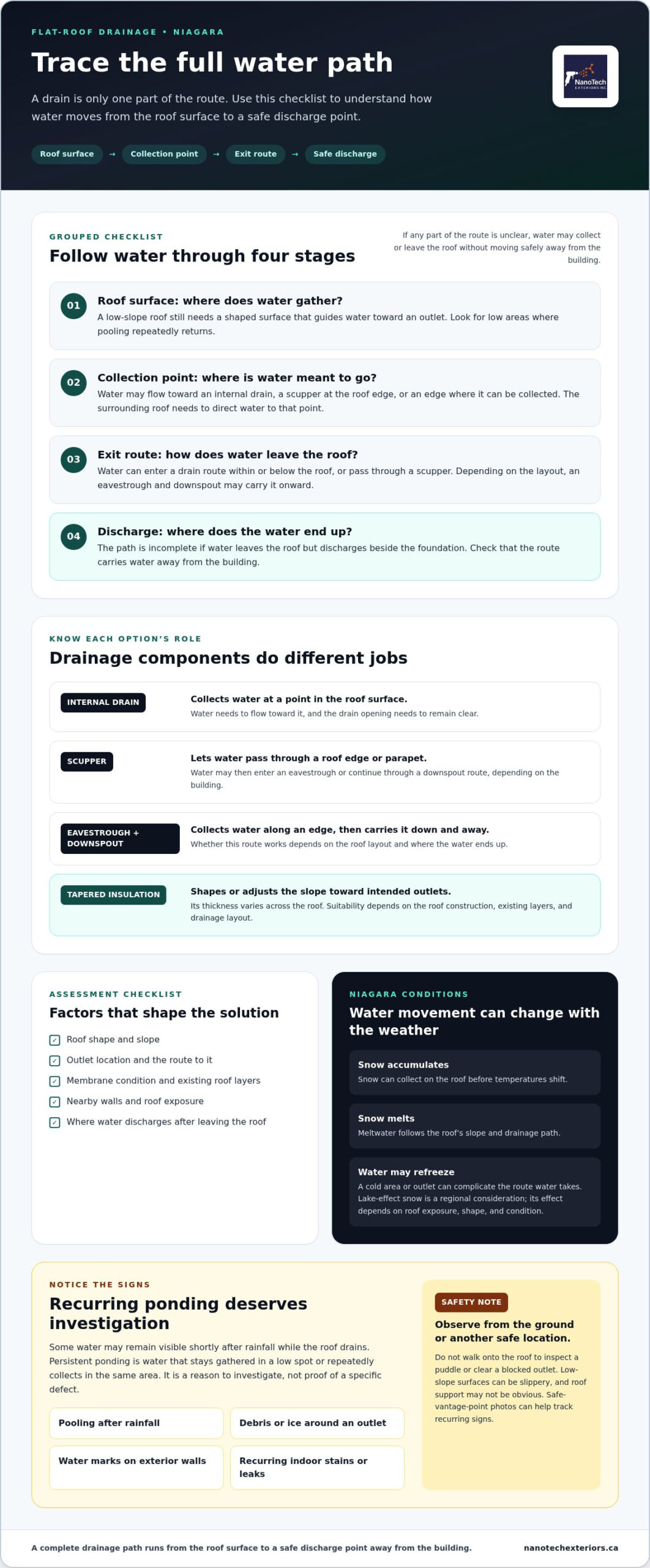
Effective drainage is a sequence, not a single fitting. Water lands on the roof, follows the slope towards a collection point, enters a drain or exits over an edge, then travels through a discharge route away from the building. Each part has a job. If the outlet is clear but the surrounding roof doesn’t guide water towards it, water may still collect. If water leaves the roof but discharges beside the foundation, the route is incomplete.
Flat-roof drainage performs only as well as its full water path, from the roof surface to a safe discharge point away from the building. That’s the useful principle for comparing drainage options. The appropriate setup depends on the roof’s shape, outlet locations, construction, and where water can go once it leaves the roof.
Roof drains, scuppers, and eavestroughs: what each does
An internal roof drain is a collection point set into the roof surface. Water flows towards it and enters a drainage route within or below the roof structure. Its position matters: the surrounding roof needs to direct water there, and the drain opening needs to remain clear.
A scupper is an opening through a roof edge or parapet that lets water flow out. Depending on the building, water may then enter an eavestrough or pass through a downspout route. Eavestroughs collect water along an edge, while downspouts carry it down and away. These components can form part of a flat-roof discharge path, but their usefulness depends on the roof layout and where the water ends up.
What roof slope and tapered insulation contribute
A low-slope roof still needs a shaped surface. Its gradual pitch guides water towards drains, scuppers, or an edge where it can be collected. Think of a shallow tray tilted towards one corner: the tilt gives water direction, while the outlet provides a way off the surface. If the slope and collection point don’t work together, some areas can remain wet.
Tapered insulation is one way to shape drainage planes. Its thickness varies across the roof to create or adjust the slope towards intended outlets. It isn’t a universal fix: the roof’s construction, existing layers, and drainage layout affect whether this approach suits the project. An assessment should consider these factors together rather than treating a puddle or outlet as an isolated issue.
If pooling keeps returning, trace the complete route: where water gathers, how it leaves the roof, and where it discharges. NanoTech Exteriors’ residential flat roofing services connect drainage concerns with roof condition and suitable roofing work.
Comparing Flat-Roof Drainage Solutions for Niagara Properties
No single drainage arrangement suits every roof. Internal drains, scuppers, eavestrough routes, and tapered insulation each play a different role in moving water. This comparison of flat roof drainage solutions Niagara homeowners may encounter is an orientation tool, not a substitute for assessing the roof structure, membrane, and discharge route.
| Approach | Water path | Layout suitability | Access and maintenance considerations |
|---|---|---|---|
| Internal drain | Water flows across the roof to a drain, then into a drainage route within or below the building. | Fits roofs designed to direct water towards interior collection points. | The drain opening and connected route need to remain clear; access depends on the roof and drainage design. |
| Scupper | Water exits through an opening in a roof edge or parapet, sometimes into an eavestrough. | Suited to roof edges and parapet configurations that allow water to pass through. | The opening and any connected trough need to be accessible for inspection and kept clear of debris. |
| Eavestrough route | Water reaches the roof edge, enters an eavestrough, and travels down through a downspout. | May form part of the drainage path where the roof edge and collection arrangement support it. | Troughs and downspouts need attention so blockages don’t interrupt discharge. |
| Tapered insulation | Varied insulation thickness shapes the roof plane to guide water towards intended collection points. | May suit projects where the roof design can accommodate a shaped drainage plane. | It influences water movement but isn’t an outlet; its suitability depends on roof construction. |
Adding an outlet alone doesn’t necessarily solve poor drainage. If the roof surface doesn’t guide water towards it, or the discharge ends beside a wall or entrance, the underlying water-path concern remains.
Which drainage approach fits which roof layout?
An internal drain works only where the roof’s shape and intended low points direct water towards it. A scupper needs an appropriate roof edge or parapet, plus a discharge route that carries water away without directing it towards walls or entrances. Eavestroughs and downspouts can complete an edge-drainage path when the layout allows. The destination matters as much as the outlet.
Repair, upgrade, or broader flat-roof work?
If a drainage issue is localized, targeted roof repair may address the affected area or component. Recurring pooling, repeated leaks, or broader signs of deterioration call for a wider assessment of roof condition and water movement before deciding on the scope of work. For more context about roof-condition decisions, the guide How to Tell if Your Roof Needs Replacing can help you consider whether the concern appears isolated or more widespread.
Choosing a Flat-Roof Drainage Solution: A Niagara Decision Checklist
A practical choice starts with evidence, not guesswork. Use these steps to organize what you’ve noticed and identify the factors that shape a suitable drainage plan.
- Observe the symptoms. Note where water appears to collect, whether leaks return, and what you can see around roof edges or outlets from the ground. A recurring pattern is more useful than one observation after a storm.
- Map the water route. Identify the roof’s shape and apparent low areas, then note where drains, scuppers, or eavestroughs are located. Consider where water goes after it leaves the roof. A discharge point beside a wall or entrance may need attention as part of the overall route.
- Assess roof condition. The existing membrane, seams, edges, and areas around outlets can affect which work is suitable. Drainage concerns may relate to a localized issue, the roof’s layout, or broader deterioration. Don’t assume a new outlet alone will address the cause.
- Compare practical options. Consider whether the roof is designed to collect water at interior drains, direct it through scuppers, or move it towards an edge and eavestrough route. If the roof plane isn’t guiding water as intended, tapered insulation may be worth assessing in the context of the roof’s construction.
- Plan maintenance. Niagara snow and freeze-thaw exposure can change how water moves through the seasons. Include seasonal observation of visible outlets and discharge routes in your plan, and watch for recurring pooling or leaks after changing weather.
This checklist helps frame the decision, but it doesn’t replace an assessment of the roof structure and water path. NanoTech Exteriors’ flat roofing services connect drainage concerns with roof condition and suitable roofing work.
What to document before a professional assessment
Keep a simple record of where pooling or interior leaks appear and whether they return after rain, snowmelt, or a freeze-thaw period. Photograph visible concerns from an accessible ground-level location; don’t climb onto the roof. Note nearby features such as vents, roof edges, and drainage outlets so their locations can be understood in context.
Questions a useful drainage assessment should resolve
A clear assessment should trace where water collects, how it currently leaves the roof, and where it discharges. It should distinguish a blocked outlet from a layout concern or broader membrane issue, then explain what work addresses the identified cause and what maintenance can support continued drainage performance. That gives you a practical basis for comparing flat roof drainage solutions Niagara homeowners may consider.
To connect your roof’s condition with a practical drainage plan, explore NanoTech Exteriors’ flat roofing services.
Flat-Roof Drainage Help in Niagara: Assessment, Repair, and Next Steps
Recurring pooling or a leak can make it tempting to focus on the nearest outlet. A more useful next step is to understand how the roof is performing as a whole: its condition, the route water takes, and where it discharges. NanoTech Exteriors provides residential flat roofing and roof repair in Niagara, connecting drainage concerns with appropriate roofing work based on the conditions observed.
What happens when drainage concerns are assessed
An assessment looks beyond the visible symptom. It considers the roof surface and membrane, areas where water appears to collect, nearby drains or roof edges, and the route water follows towards its discharge point. The goal is to distinguish an issue at an outlet from a concern with the drainage layout or the broader roof condition.
Those findings help guide the next step. If the concern is localized, roof repair may be appropriate. If there’s more extensive deterioration or a drainage layout that isn’t serving the roof well, broader flat-roof work may need to be considered. Recommendations should reflect the roof and the conditions observed, rather than assume every home needs the same component or scope of work.
Keeping drainage performance in view after the work
Once the work is complete, keep an eye on visible outlets and water movement from a safe ground-level location. Notice whether pooling or interior leaks return, especially after rain, snowmelt, or changing winter conditions. A recurring symptom deserves follow-up to understand its cause; repeating a guessed repair can leave the underlying concern unresolved.
For related local roof-care guidance, the Roof Repair Niagara Falls resource can help you consider repair concerns alongside drainage. Keep notes about when symptoms reappear and where you see them. That information can help describe what has changed and connect the visible sign with the roof’s condition.
Choosing among flat roof drainage solutions Niagara homeowners may consider is a property-specific decision. An assessment should make the water route understandable, identify the roof’s condition, and explain how proposed roofing work relates to the concern. It should also clarify what ongoing observation can help you notice after the work, without treating a single outlet as the whole solution.
If pooling or leaks have you concerned, discuss your Niagara flat-roof needs with NanoTech Exteriors and take a practical next step towards understanding your roof.
Make Your Next Roof Decision with Confidence
A recurring leak can make every rainfall feel like a test. Replace guesswork with a clear next step: keep track of what you observe and use it to guide an assessment of the roof’s condition. That gives you a grounded starting point for deciding whether the issue calls for repair or broader flat-roof work.
Choosing among flat roof drainage solutions Niagara homeowners can consider isn’t about adding components at random. It’s about matching the work to the roof and its water path. NanoTech Exteriors serves Niagara, Burlington, Hamilton, Oakville, Kitchener, Guelph, and Cambridge with residential flat roofing and roof repair, helping homeowners move from concern towards a practical plan.
You don’t need every technical answer before taking that step. Start with what you’ve noticed, then build from there. Take the next step with NanoTech Exteriors and give your roof concerns a clear path forward.
Frequently Asked Questions
Do flat roofs need drainage in Niagara?
Yes. A low-slope roof still needs a planned way to carry rain and meltwater away. In Niagara, snow can cover an outlet, while thawing weather can send water towards it later, so drainage needs to function through changing conditions. If you see water collecting repeatedly or a leak after wet weather, note the location and timing. Those details can help distinguish a recurring concern from a one-off event.
What is the difference between a roof drain and a scupper?
A roof drain collects water through an opening in the roof surface, while a scupper lets water exit through a roof edge or parapet. A homeowner may see a scupper from outside, but an internal drain’s connected route is less visible. If water emerges at an edge, note where it lands and whether it reaches a suitable discharge area. The outlet type alone doesn’t show whether the whole route is working.
Can standing water damage a flat roof?
Yes, persistent standing water can contribute to roof deterioration, particularly if the membrane or nearby details already have weak spots. Water may also enter through a vulnerable area and show up indoors some distance from where it got in. A ceiling stain is therefore a reason to investigate, not proof of the exact entry point. Record whether the stain changes after rain or snowmelt, and avoid probing the roof yourself.
How does tapered insulation help flat-roof drainage?
Tapered insulation can create a gradual change in roof height that guides water towards a planned collection point. It shapes the drainage plane rather than acting as a drain itself. For example, if an area repeatedly holds water, a design may use tapered layers to redirect flow, but the roof’s existing construction and edges affect what’s practical. Changes in height also need to work with the roof’s other details.
Are scuppers enough to drain a flat roof?
Sometimes, but a scupper isn’t automatically sufficient just because water can pass through it. The roof needs to direct water towards the opening, and the water needs a suitable route after leaving the edge. Debris or ice can also obstruct an exposed opening. If pooling continues despite a scupper, the issue may involve the roof’s shape, outlet location, or discharge route rather than the absence of an outlet.
When should a Niagara homeowner have flat-roof drainage assessed?
Arrange an assessment if pooling keeps returning, a leak recurs, or water appears to be collecting in a new area. It’s also sensible to seek a closer look after roofing work changes the surface or drainage layout. For homeowners comparing flat roof drainage solutions Niagara, an assessment can connect visible symptoms to roof condition and water movement, rather than treating each stain or puddle as an isolated problem.
Can a drainage problem be repaired without replacing the whole flat roof?
Yes, a localized drainage issue may be repairable without replacing the entire roof, depending on the membrane’s condition and the cause of the problem. If deterioration extends beyond one area, broader flat-roof work may be appropriate. NanoTech Exteriors provides roof repair and flat roofing in Niagara, Burlington, Hamilton, Oakville, Kitchener, Guelph, and Cambridge. An assessment helps determine which type of work suits the roof’s observed condition.