A ceiling stain can point you in the wrong direction. Water may travel through a flat-roof assembly before it appears indoors, so a repair aimed only at the visible damage can leave the source untouched. If you’re comparing flat roof leak detection specialists, look for more than a quick inspection and a patch recommendation.
It’s understandable to want a clear answer, especially if temporary repairs haven’t stopped the leak. The right specialist should explain how they’ll investigate, show you what they find, and connect the evidence to a practical recommendation. This guide covers inspection methods, reports, comparisons, and useful questions to ask before booking. NanoTech Exteriors is based in Burlington and lists flat roofing and roof repair among its services. Ask whether its services fit your needs, and confirm whether it provides dedicated leak detection and what its assessment includes.
Key Takeaways
- Tell the inspector when the leak appears and what weather or drainage conditions may be connected to it.
- Ask a flat roof leak detection specialist how they’ll investigate suspected water pathways and document their findings.
- Compare recommendations by checking whether the proposed repair is tied to specific inspection findings and a clearly defined scope.
- If water appears indoors, protect belongings and record the symptoms. Don’t walk on a wet, icy, damaged, or inaccessible roof.
- NanoTech Exteriors is a Burlington-based option with flat roofing and roof repair listed. Confirm whether its services fit your needs and ask about its assessment process before booking.
Why a flat roof leak detection specialist should trace the source, not just the stain
A water stain that returns after a repair is frustrating, especially if you’ve already paid to address the visible damage. Before deciding what to fix, establish how water may be getting in. Leak detection involves investigating the symptoms, locating the likely entry path, and assessing the roof so any repair responds to evidence rather than guesswork.
Flat roofs use different assemblies and materials, and their details affect how water moves and where problems can develop. This overview of flat roof design can help explain why a roof is a system of layers and connections, not simply one uninterrupted sheet. Diagnosis and repair are related, but they’re separate steps. A patch below a ceiling stain may not address the opening that let water in.
What does a flat roof leak detection specialist do?
A flat roof leak detection specialist considers the reported symptoms alongside the roof’s details and possible water pathways. The investigation may include reviewing when the leak appears, looking at accessible roof surfaces, and checking relevant details such as seams, penetrations, edges, and drainage areas. The goal is to develop a reasoned explanation before recommending work, rather than assuming the nearest visible damage is the cause.
Methods depend on the roof assembly, site access, weather, and the provider’s capabilities. Ask which inspection methods the contractor uses, what they can assess, and what findings they’ll share with you. A clear explanation helps you understand what the investigation can and can’t establish.
Why the leak stain may not identify the entry point
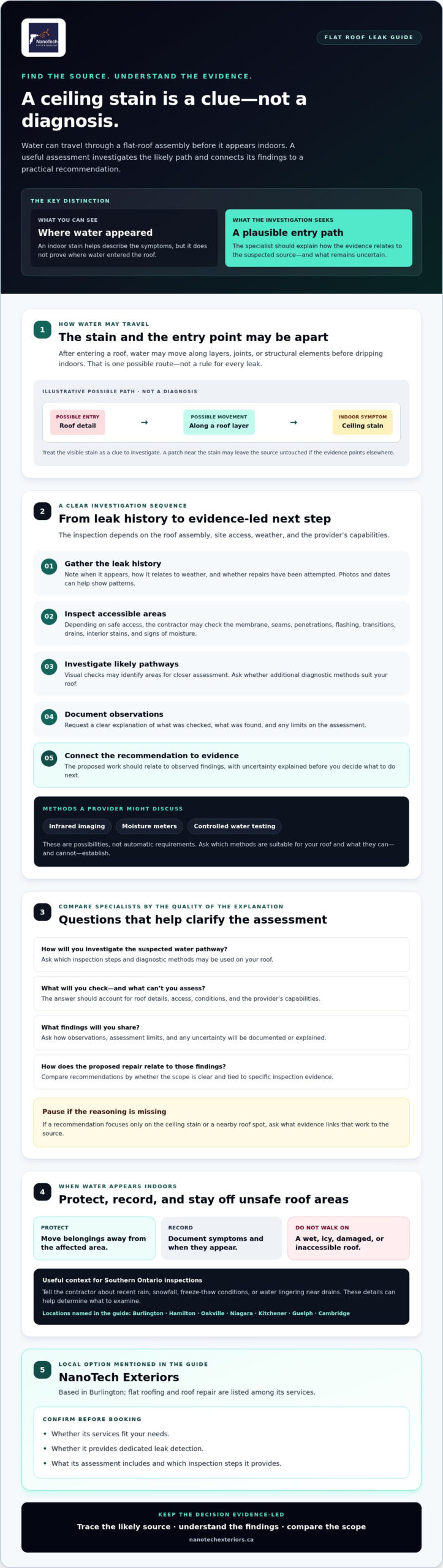
After entering the roof, water can travel along layers, joints, or structural elements before appearing on an interior ceiling. For example, it might pass through a vulnerable roof detail, move along a layer, and then drip into a room some distance away. That’s one possible route, not a rule for every leak. Treat the visible stain as a clue to investigate, not proof of where water entered.
The indoor stain shows where water appeared, not necessarily where it entered the roof. A useful assessment connects the symptoms to a plausible water path and explains any uncertainty. If the proposed work focuses only on the stained ceiling or a nearby roof spot, ask what evidence links that repair to the source. A sound diagnosis should make the reasoning clear before you decide what to do next.
How specialists investigate flat roof leaks in Southern Ontario
A sound investigation follows a sequence. It starts with the leak’s history, then checks the roof and interior, investigates likely pathways where appropriate, records observations, and uses the findings to guide a recommendation. For a property in Burlington, Hamilton, Oakville, Niagara, Kitchener, Guelph, or Cambridge, details about recent rain, snowfall, freeze-thaw conditions, or water lingering near drains can help a contractor decide what to examine.
- Gather the history. Note when the leak appears, whether it changes with the weather, and whether repairs have already been attempted. Photos and dates can help the contractor spot patterns.
- Inspect accessible areas. Depending on the roof and safe access, the contractor may look at the membrane, seams, penetrations, flashing, transitions, and drains, as well as interior stains or signs of moisture.
- Investigate likely pathways. Visual checks may point to areas that need closer assessment. Ask whether additional diagnostic methods are suitable for your roof.
- Document observations. Request a clear explanation of what was checked, what was found, and any limits on the assessment.
- Recommend a next step. The proposed work should relate to observed evidence, with any uncertainty explained.
What happens during a careful roof and interior inspection?
A careful inspection connects what’s visible indoors with relevant roof details. A stain or damp area is a clue, not automatic proof of the entry point. What can be inspected depends on the roof assembly, site access, and conditions on the day. The National Roofing Contractors Association (NRCA) offers roofing industry information, but your contractor should explain the steps they’ll take on your specific roof. NanoTech Exteriors lists flat roofing and roof repair. Ask which inspection steps it provides and whether they suit your situation.
Which diagnostic methods might a contractor use?
Depending on the roof, a provider might discuss infrared imaging, moisture meters, or controlled water testing. These aren’t automatic requirements, and no single tool or test can be assumed to find every leak. Suitability depends on the roof assembly, weather, access, and the technician’s ability to interpret the results.
Tools support diagnosis, but they don’t replace informed interpretation. Before booking, ask what a proposed method can establish, how findings will be recorded, and what happens if the source remains uncertain. If you’re considering NanoTech Exteriors for flat roofing or roof repair in Hamilton, you can ask about its roof assessment options and confirm the service fit before arranging a visit.
How to compare flat roof leak detection specialists before hiring
Compare the process, not just the promise. A specialist who explains the inspection scope and how findings support a repair gives you a stronger basis for deciding than a broad assurance that the leak will be found. Ask each contractor to describe a comparable scope so you can evaluate what’s included, what isn’t, and what happens after the inspection.
| What to compare | Questions to ask | What to look for |
|---|---|---|
| Diagnostic process | Which roof areas and details will you inspect? Could access or weather limit the assessment? | A clear scope suited to your roof, not a one-size-fits-all promise. |
| Written findings | How will you document and explain the observations? | Findings that distinguish what was seen from what remains a possibility. |
| Repair scope | How does the recommended work relate to the inspection evidence? Is repair separate from inspection? | A defined repair proposal linked to specific observations, with applicable terms clarified directly. |
| Follow-up | What should I do if the leak returns or the source remains uncertain? | A straightforward explanation of next steps and any follow-up process. |
Questions to ask before booking a roof leak inspection
Ask what the inspection covers, including relevant roof details and interior areas, and whether access constraints could limit the assessment. Find out how the contractor will record and explain the results before proposing repairs. Clarify whether inspection and repair are separate scopes, what each includes, and any terms that apply. These questions help you compare similar services instead of relying on headline claims.
For a broader building-envelope perspective, the Whole Building Design Guide offers information on building design, construction, and maintenance. Use it as background, then ask the contractor to explain how their findings apply to your roof.
What useful inspection findings should include
A helpful report should identify the suspected entry area, describe observed conditions, and explain how those observations may connect to the interior symptoms. It should separate confirmed findings from possibilities that need more investigation. A recommendation is easier to assess when it names the condition being addressed and explains why the proposed work is relevant, rather than simply repeating the location of a stain.
If you’re reviewing local options, NanoTech Exteriors’ flat roofing services guide and roof inspection Burlington guide may help you prepare questions. Confirm directly whether its services fit your needs and what its inspection includes. A flat roof leak detection specialist should be able to explain the scope, evidence, and proposed next step in plain language.
What to do when a flat roof leak appears
Respond to the indoor symptoms first, then arrange a professional assessment. Move belongings away from the water and, if it’s safe, place a container beneath an active drip. Keep people clear of wet floors and any ceiling area that appears to be bulging or damaged. If water is near electrical fixtures, don’t touch them or the surrounding area. Keep clear and contact appropriate qualified help.
Don’t climb onto the roof to investigate. Wet, icy, damaged, or inaccessible surfaces can be dangerous, and an improvised patch may hide clues without resolving the source. A flat roof leak detection specialist can assess the roof and symptoms with appropriate access and methods. Your role is to protect the interior and provide useful information.
What information should you share with the contractor?
Keep a simple record to help the contractor understand the pattern. Note when the leak began, when it worsens, and whether it follows rain, snowfall, or changing temperatures. Record which rooms are affected and whether the stain is growing, changing colour, or appearing in a new place. Take photos of the interior symptoms over time. Include exterior observations only if they’re visible from a safe location, such as the ground.
Share details of previous repairs or roof work, drainage concerns you’ve noticed, and whether water entry returned after earlier work. These details can help shape the inspection, though they don’t prove where water is entering.
When should you request a roof repair assessment?
Contact a roofing provider promptly if water is actively entering, damage is spreading, or the leak keeps returning. While arranging an assessment, continue protecting belongings and note any changes. Don’t remove roof materials, apply a patch, or direct water across the roof yourself. Those steps can create safety risks or make the leak pathway harder to assess.
For a related overview, see roof repair options in Hamilton. NanoTech Exteriors lists roof repair and flat roofing among its services. If you’re considering the company, ask about roof repair for your flat roof and confirm whether its assessment process suits your situation before booking.
Choosing a local flat roof leak specialist: next steps with NanoTech Exteriors
Use a simple decision rule: choose a provider who can explain what they’ll investigate, distinguish observations from assumptions, and connect any repair recommendation to the findings. A confident promise isn’t a substitute for a clear process. Before booking, make sure the provider’s services match what your roof needs and that you understand what the assessment will include.
Is NanoTech Exteriors the right fit for your flat roof leak?
NanoTech Exteriors is based in Burlington and lists flat roofing and roof repair among its services. Its listed communities include Burlington, Hamilton, Oakville, Niagara, Kitchener, Guelph, and Cambridge. The company is a local option to ask about your situation, but dedicated leak detection, specific inspection methods, and specialist credentials aren’t specified. Confirm the scope directly before arranging an assessment.
If replacement may be needed, you can also review this 2026 roof replacement checklist as a separate planning resource. An inspection and repair recommendation can help clarify whether replacement is relevant, but don’t assume it’s necessary before the roof’s condition has been assessed.
What to confirm before arranging an assessment
Ask whether the company can assess the suspected leak, document its findings, and recommend repairs based on what it observes. Clarify which areas and roof details the visit covers, whether access or weather could limit the inspection, and whether assessment and repair are separate scopes. You can also ask about timing and what to prepare, such as photos, a brief leak history, and details of previous repairs.
- What inspection steps do you provide for this type of flat roof?
- How will you explain the findings, including anything that remains uncertain?
- What repair work, if any, do the findings support?
- What site access is needed, and what information should I have ready?
A flat roof leak detection specialist should explain the assessment and its limits in plain language. If you’re considering NanoTech Exteriors, contact NanoTech Exteriors to discuss your flat roof and ask about assessment options, service availability, and next steps. You don’t need to commit to a repair before you understand the proposed scope and what supports it.
Take the next step towards a clear roof diagnosis
A recurring stain is a reason to investigate, not assume. Choose a flat roof leak detection specialist who explains the inspection, documents observations, and connects any repair recommendation to those findings. Comparing the inspection scope and written information can help you make a practical decision rather than repeat a temporary fix.
NanoTech Exteriors is a Burlington-based roofing company with listed service coverage in Burlington, Hamilton, Oakville, Niagara, Kitchener, Guelph, and Cambridge. Flat roofing and roof repair are listed services, but confirm directly whether the company assesses flat-roof leaks, what its assessment includes, and what next steps it recommends for your roof.
Have the leak history and any photos ready, then contact NanoTech Exteriors to discuss your flat roof. Ask about service availability and how the company approaches your concerns before arranging an assessment. Clear questions and evidence-led guidance can help you make a more informed repair decision.
Frequently Asked Questions
How do I find a flat roof leak detection specialist?
Choose a contractor who can explain the inspection scope, document observations, and connect any repair recommendation to the evidence. Ask which roof areas they’ll check, which methods they use, and how they’ll report their findings. Compare providers on equivalent scopes, not just promises. If you’re in Burlington, Hamilton, Oakville, Niagara, Kitchener, Guelph, or Cambridge, confirm that the contractor serves your location and that their services suit your roof.
Can a roof leak appear far from where water enters?
Yes. Water can move through or along roof layers, joints, and structural elements before reaching an interior ceiling, so the stain may be some distance from the entry point. For example, water entering near a roof transition could travel along a layer before dripping into a room. That’s only one possible path. Treat the stain as a useful clue, not proof of where the roof is leaking.
What happens during a flat roof leak inspection?
A contractor will usually ask when the leak appears, review any earlier repairs, and examine relevant roof and interior areas, subject to access and conditions. The inspection may include visible seams, penetrations, flashing, transitions, and drainage details. Additional methods may be considered if they suit the roof assembly. Ask what the contractor will check, what they’ll document, and whether the findings will explain the proposed repair scope.
Is infrared imaging enough to find a flat roof leak?
Not necessarily. Infrared imaging may help identify temperature patterns that suggest areas for closer assessment, but it doesn’t automatically confirm the source of water entry. Suitability depends on roof construction, weather, access, and how the results are interpreted. Ask what the scan can establish for your roof and whether other observations or checks are needed. No single tool should be treated as a guarantee of a complete diagnosis.
What should I do if my flat roof is leaking during a storm?
Protect people and belongings indoors, move items away from the water, and use a container to catch drips if it’s safe. Photograph the affected area and note the time and weather. Don’t climb onto a wet, icy, damaged, or inaccessible roof, or try a temporary roof patch during the storm. If water is near electrical fixtures or a ceiling looks unstable, keep clear and contact appropriate qualified help.
How can I tell whether a contractor has identified the source of the leak?
Ask for an explanation that links the suspected entry area to observed roof conditions and the interior symptoms. Useful findings distinguish direct observations from possibilities that need more investigation. The proposed work should address a condition identified during the assessment, not simply the location of the ceiling stain. If the reasoning or repair scope is unclear, ask what evidence supports it and what remains uncertain before approving the work.
Does NanoTech Exteriors offer flat roof leak detection in Burlington?
NanoTech Exteriors lists flat roofing and roof repair, but dedicated flat-roof leak detection isn’t specified as a distinct service. The company is based in Burlington and lists service coverage in Burlington, Hamilton, Oakville, Niagara, Kitchener, Guelph, and Cambridge. Contact the company to confirm whether it can assess your suspected leak, what inspection steps it provides, how findings are documented, and whether its services fit your needs.