Most homeowners in the Halton Region treat their flat roof like a ticking time bomb, waiting for the inevitable pool of water to find its way into the living room. However, the truth is that flat roofing in Burlington, Ontario, doesn’t have to be a source of constant anxiety or a drain on your savings. If you’ve been told that a total replacement is your only option for a leaking roof, you’re likely receiving outdated advice that ignores modern restoration technology.
It’s understandable to feel overwhelmed by technical jargon like TPO versus EPDM, especially while navigating the 5.35 percent increase in Burlington building permit fees that took effect this April. You want a home that stays dry and a roofing strategy that makes long-term financial sense. This guide provides the clarity you need to navigate the 2026 market. We’ll break down which materials actually survive our local freeze-thaw cycles, reveal maintenance secrets that extend your roof’s life, and show you how to find an expert who prioritizes smart restoration over unnecessary, high-priced demolition.
Key Takeaways
- Evaluate the performance of TPO and EPDM membranes to choose the most durable, heat-reflective system for your specific property.
- Understand the restoration-first philosophy to avoid the high cost and disruption of a total tear-off when maintaining your flat roofing Burlington Ontario.
- Master the “ponding” test to distinguish between harmless temporary moisture and structural water threats that require immediate attention.
- Extend your roof’s lifespan by identifying early signs of membrane fatigue and blistering before they lead to interior damage.
- Learn which specialized qualifications a local contractor must possess to ensure your project complies with the latest 2026 Ontario Building Code requirements.
Understanding Residential Flat Roofing Systems in Burlington
A flat roof is technically a low-slope system, typically featuring a pitch of less than 10 degrees. In Burlington, these systems have evolved from industrial necessities into architectural assets for modern residential designs. Whether it’s a sleek addition in Aldershot or a rooftop patio overlooking Lake Ontario, flat roofing Burlington Ontario offers a level of utility that traditional shingles cannot match. Many homeowners hesitate because of a historical reputation for leaks, but this stigma is rooted in the failures of old tar and gravel systems. Modern membrane technology has transformed the landscape, turning the flat roof into a reliable, long-term solution for the modern home.
Success in our region depends heavily on adherence to the Ontario Building Code. This regulatory framework ensures that every installation can withstand our specific environmental stressors, from high wind uplift to significant structural weight. It’s not just about keeping water out; it’s about ensuring the entire assembly, including insulation and vapour barriers, works as a cohesive unit to protect your home’s structural integrity.
Why Flat Roofs Require a Different Approach
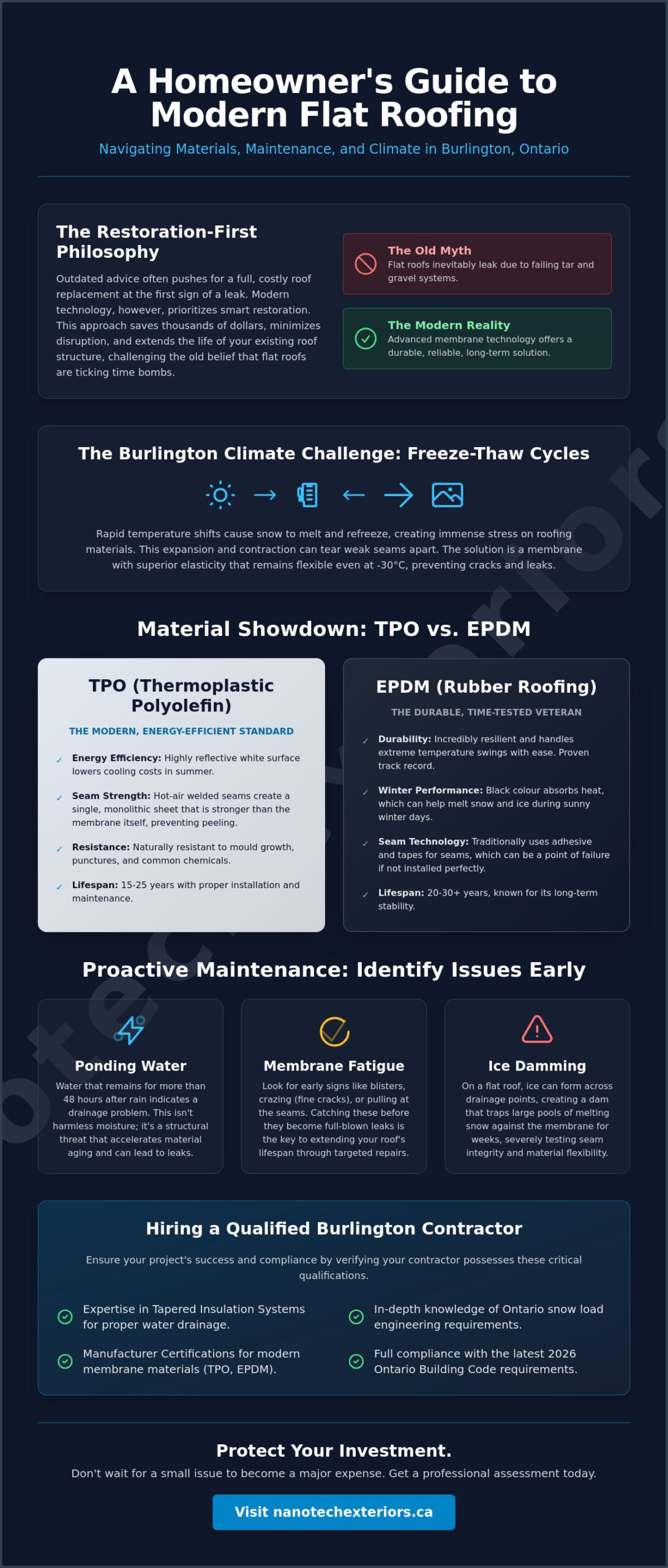
Physics works differently when you remove the steep pitch of a traditional gable roof. On a sloped surface, water sheds instantly. On a flat system, the design must proactively manage water through a deliberate network of scuppers, gutters, or internal drains. This requires a specialized understanding of tapered insulation systems that create a subtle, invisible slope toward drainage points. Without this precise engineering, water will linger, leading to the “ponding” issues that plague poorly installed roofs.
Structural support is another critical variable. Ontario snow loads can be immense. A residential flat roof must be engineered to hold the weight of heavy, wet snow without bowing or compromising the interior ceiling. When integrating these systems into existing homes, the transition between the old structure and the new membrane must be seamless. This is why flat roofing Burlington Ontario requires a different toolkit and mindset than standard shingle work. It is an exercise in precision engineering rather than just overlapping materials.
The Burlington Climate Factor: Freeze-Thaw Cycles
Burlington’s proximity to Lake Ontario creates a microclimate characterized by high humidity and rapid temperature shifts. These conditions are the primary enemy of roofing materials. During a typical winter day, snow melts in the sun and refreezes as the temperature drops at night. This cycle of expansion and contraction can tear low-quality materials apart at the seams.
Ice damming presents a unique challenge here. On a sloped roof, ice blocks the eaves; on a flat roof, ice can create “ponds” of trapped water that sit against the membrane for weeks. This is why membrane elasticity is non-negotiable. We prioritize materials that remain flexible at minus thirty degrees, ensuring the roof stretches and contracts without developing the hairline fractures that lead to interior damage.
Comparing Flat Roof Materials: TPO vs. EPDM vs. Modified Bitumen
Selecting the right material for flat roofing Burlington Ontario is a decision that impacts your home’s energy bills and maintenance schedule for decades. It’s not a one-size-fits-all industry. Your choice depends on how you use the space, your budget for future repairs, and your local sun exposure. We primarily see three contenders in the residential market: TPO, EPDM, and Modified Bitumen. Each has distinct chemical properties and installation requirements that dictate their long-term performance.
TPO Roofing: The Modern Standard
TPO (Thermoplastic Polyolefin) has quickly become the preferred choice for modern homeowners. It’s a single-ply reflective membrane that excels at keeping your home cool during those humid Ontario summers. The seams are hot-air welded. This creates a monolithic surface that won’t peel apart like glued systems. TPO is naturally resistant to mould growth and common punctures. You can expect a well-installed residential TPO roof to last between 15 and 25 years. It’s the ideal solution if you’re looking to lower your cooling costs while ensuring a leak-free environment.
EPDM and Modified Bitumen: Durability and Tradition
EPDM is the veteran of the industry. Often called “rubber roofing,” this black membrane is incredibly resilient. It handles the extreme temperature swings of the Halton region with ease. Because it’s black, it absorbs heat, which can be a benefit during our long winters by helping melt snow faster. Many local homeowners favour EPDM for its proven track record in the Canadian climate. However, EPDM relies on adhesive for its seams, which can be a weak point if not maintained regularly.
Modified Bitumen, or “Mod-Bit,” is the modern evolution of the old built-up roof. It uses layers of asphalt modified with plastic or rubber polymers. It’s tough. For homeowners investing in flat roofing Burlington Ontario for a rooftop patio, Mod-Bit is often the superior choice due to its thickness and multi-layered protection. You’ll choose between “torch-down” methods, which use a flame to melt the layers together, or “cold-applied” adhesives for tighter spaces where open flames are a risk.
To choose the best system for your home, consider this framework:
- Energy Efficiency: Choose TPO for its high solar reflectance and cooling benefits.
- Extreme Durability: Opt for EPDM if you want a material that remains flexible in -30°C weather.
- High Foot Traffic: Select Modified Bitumen for its puncture-resistant, multi-ply layers.
- Eco-Friendly: EPDM is often highly compatible with green roof installations.
If you’re unsure which membrane currently protects your home, a professional assessment of your residential roofing can prevent costly surprises and help you plan for the future.
Maintenance vs. Replacement: Extending Your Flat Roof’s Life
Most roofing companies in the GTA will tell you that a leak is a sign you need a full tear-off. This is often a premature and expensive conclusion. We advocate for a smarter, more pragmatic approach. If your structural deck is sound and the insulation remains dry, your system is likely a prime candidate for refurbishment rather than a total replacement. Proactive maintenance for flat roofing Burlington Ontario is not just about patching holes; it is about fortifying the existing membrane to stop degradation before it starts.
The logic is simple. A full replacement involves massive labour costs, disposal fees, and material expenses. Restoration, however, uses advanced molecular science to renew the protective qualities of your roof at a fraction of the cost. By treating the existing surface, we can effectively reset the clock on UV damage and environmental wear.
When to Choose Refurbishment
Deciding between a minor fix and a major overhaul requires a logical assessment of three factors: seam integrity, membrane age, and the condition of the substrate. If your seams are mostly intact but the surface shows signs of sun-bleaching or minor surface cracking, a professional restoration can add 5 to 10 years of life to the system. This avoids the disruption of a major construction site while maintaining your home’s protection. For a deeper look at how this process works, explore our Roof Rejuvenation pillar.
Modern nanotechnology treatments penetrate the existing membrane to restore the elasticity lost during Burlington’s harsh freeze-thaw cycles. This isn’t a temporary patch. It is a scientific renewal of the material’s ability to stretch and contract without failing. If your roof is between 10 and 15 years old, this is the optimal window to act before the material becomes too brittle to save.
The Real Cost of Neglect
Ignoring a small issue is the fastest way to turn a simple repair into a massive financial burden. When a seam fails, water doesn’t just sit on the surface; it migrates into the insulation. This creates the “wet insulation trap.” Once insulation becomes saturated, it loses its thermal resistance and begins to rot the wooden deck underneath. At this point, the structural integrity is compromised and restoration is no longer an option.
To protect your investment, every homeowner with flat roofing Burlington Ontario should perform an annual health check. Use this checklist to stay ahead of the curve:
- Inspect the Perimeter: Look for any pulling or gaps where the membrane meets the flashing.
- Verify Drainage: Ensure scuppers and gutters are clear of debris to prevent water from sitting.
- Check for Soft Spots: Walk the roof carefully to feel for “spongy” areas that indicate trapped moisture.
- Examine Seams: Look for any visible lifting or “fish-mouthing” at the membrane joints.
A small investment in sealing and professional maintenance today prevents a catastrophic structural failure tomorrow. It’s about peace of mind and long-term value, a concept familiar to vehicle owners who trust MTX Performance for the monitoring systems that keep their automotive assets in top condition.
Common Flat Roof Problems and Solutions in Ontario
Burlington’s climate serves as a rigorous stress test for any low-slope membrane. While some issues are merely aesthetic, others signal a looming structural failure. Understanding the difference between incidental moisture and a genuine threat is the first step toward protecting your home. For homeowners managing flat roofing Burlington Ontario, the most frequent concern is “ponding” or standing water. If water evaporates within 48 hours of a rainfall, it is generally considered incidental. However, if pools remain longer, they become a significant threat. In our region, standing water undergoes a destructive freeze-thaw cycle; it turns to ice, expands, and creates micro-tears in the membrane that eventually allow water to bypass the seal entirely.
Blistering is another common sight on older roofs. These bubbles occur when air or moisture becomes trapped between the membrane layers or the substrate. During a hot Ontario summer, this trapped air expands. You should never pop these blisters yourself. Popping them introduces an immediate entry point for rain. Instead, they require professional venting and resealing to restore the membrane’s “breathability” and structural integrity. Most of these issues originate at the flashing, the metal transition at the roof’s edge. This remains the number one cause of residential leaks because metal and roofing membranes expand at different rates, eventually pulling the seal apart.
Solving the Drainage Dilemma
Effective drainage is the lifeblood of a healthy flat roof. Most residential systems rely on scuppers, which are openings in the perimeter wall, or internal drains that move water through the house’s interior. If your roof is prone to pooling, you don’t necessarily need a new deck. We often retroactively improve the slope using tapered insulation. This creates a subtle, engineered grade that directs water toward the eavestroughs without the need for major structural changes.
You can manage much of this yourself with a simple annual inspection. Clear debris from your drainage points every November after the leaves have fallen and again in early April. A single handful of maple seeds can block a scupper, leading to hundreds of kilograms of unnecessary water weight sitting on your rafters.
This type of proactive maintenance is essential for all exterior surfaces; for those managing properties in other areas, services like professional window cleaning Winnipeg can further protect your investment by preventing long-term damage to window seals and glass.
Managing Seams and Penetrations
Every protrusion through your roof, including skylights, plumbing vents, and HVAC units, is a potential failure point. These areas require high-performance sealants that remain flexible in minus thirty-degree weather. Avoid the temptation of “quick fix” asphalt tars found in hardware stores; these products often dry out and crack within a single season. Professional-grade polymers are required to maintain a chemical bond with modern TPO or EPDM membranes. For those in the neighbouring Greater Hamilton Area, our specialized Roof Repair in Hamilton provides the same high-standard solutions for these complex penetration leaks.
If you have noticed soft spots or visible bubbles on your membrane, acting now is the only way to avoid a full tear-off. Contact us for a professional flat roof assessment to identify and seal these vulnerabilities before the next storm cycle begins.
Hiring a Flat Roofing Contractor in Burlington
Choosing a partner for flat roofing Burlington Ontario is a decision that carries significant weight. Unlike traditional shingle roofs, where gravity handles most of the work, a flat system relies entirely on the technical precision of the installer. It is a specialised trade. While many general contractors claim to handle low-slope systems, the technical requirements for heat-welded seams and tapered drainage demand a level of precision that standard shingle installers rarely possess. You aren’t just hiring someone to lay material; you’re hiring an expert to engineer a waterproof seal that must withstand decades of Ontario’s environmental pressure.
Before signing a contract, verify that the company carries comprehensive liability insurance and up-to-date WSIB coverage. Specifically, if they use torch-down methods, their insurance must explicitly cover open-flame work. Beyond the paperwork, look for a contractor who understands the 2026 Ontario Building Code requirements for insulation and vapour barriers. A failure to meet these standards doesn’t just risk a leak; it can complicate future home insurance claims or property sales. To find a truly qualified expert, ask these hard questions during the consultation:
- How will you ensure the new system achieves a positive slope toward existing drains?
- What specific membrane thickness do you recommend for our local UV exposure?
- Do you prioritise mechanical fasteners or adhesives, and why?
- Can you provide a detailed plan for flashing around our specific roof penetrations?
The NanoTech Exteriors Difference: Scientific Protection
We approach flat roofing Burlington Ontario through the lens of material science and structural integrity. Our team doesn’t start with a sales pitch; we start with a diagnostic assessment. We evaluate the load-bearing capacity of your deck and the current state of your insulation before recommending a path forward. This pragmatic approach ensures you only pay for what your home actually needs.
Our commitment to the Golden Horseshoe climate means we select high-grade materials specifically engineered for high humidity and rapid freeze-thaw cycles. We focus on longevity and value. By educating homeowners on the benefits of restoration over demolition, we help the Burlington community maintain safe, efficient homes without the stress of unnecessary expenses. We believe a well-informed homeowner is our best partner.
Next Steps for Your Burlington Home
A professional flat roof inspection is a methodical process. It involves checking seam elasticity, probing for moisture under the membrane, and verifying that all drainage paths are unobstructed. This data-driven approach removes the guesswork from home maintenance. If you’ve discovered a drip, don’t assume the worst. Many leaks are the result of simple flashing failures or blocked scuppers that can be resolved through targeted repair or rejuvenation.
The goal is a leak-free home and total peace of mind. Book a free assessment with NanoTech Exteriors today. We’ll provide a clear, honest evaluation of your roof’s condition and show you how modern restoration technology can protect your investment for years to come.
Secure Your Home’s Future with Smarter Roofing Solutions
Managing a flat roof in the Golden Horseshoe doesn’t have to be a source of financial anxiety. By choosing modern membranes like TPO or EPDM and prioritizing proactive restoration over premature demolition, you can significantly extend your system’s lifespan. The right drainage strategy and yearly health checks prevent minor seam issues from becoming structural failures. Expert care for flat roofing Burlington Ontario ensures your home remains a dry, energy-efficient sanctuary regardless of the season.
As an authorized GoNano dealer with over a decade of experience serving Burlington, Hamilton, and Oakville, NanoTech Exteriors specializes in both high-precision restoration and total replacement. We focus on scientific fortification that respects your budget and the environment. Take the guesswork out of your home maintenance and invest in protection that lasts. Get a Professional Flat Roof Assessment in Burlington today to ensure your property is ready for whatever the 2026 climate brings.
Frequently Asked Questions
How long does a typical residential flat roof last in Burlington?
A standard residential system typically lasts between 15 and 25 years. Environmental factors like Lake Ontario’s humidity and the local freeze-thaw cycle play a major role in this timeline. Regular maintenance and professional restoration can often extend this lifespan toward the higher end of that range, while neglect leads to premature failure.
Can I walk on my flat roof or use it as a deck?
Most flat roofs are designed for limited maintenance traffic only and cannot support the weight of regular social use. If you intend to use the surface as a patio, the structure must be specifically engineered to support live loads. Installing a pedestal deck system over the membrane is the standard way to create a functional outdoor space without damaging the waterproofing layer.
What is the best material for a flat roof in the Ontario climate?
TPO and EPDM are the top performers for flat roofing Burlington Ontario. TPO offers superior heat reflection for summer cooling, while EPDM remains highly flexible during extreme winter cold. Your choice should depend on whether you prioritize energy efficiency or long-term puncture resistance for areas with high tree coverage.
How much does it cost to repair a flat roof leak in Burlington?
Repair costs depend on the extent of the damage and the accessibility of the leak. Factors such as the type of membrane, the condition of the underlying insulation, and whether structural deck repair is needed will influence the final investment. Localized repairs are significantly more affordable than addressing widespread saturation that has migrated into the home’s structure.
Is it possible to install a flat roof over an existing one?
You can often install a new membrane over an existing one, provided the current roof isn’t already a second layer. This process is only viable if the original insulation and wood deck are completely dry. If moisture is trapped between layers, it will cause rapid rot and structural failure, making a full tear-off mandatory.
How do I stop water from pooling on my flat roof after a storm?
The most effective way to eliminate ponding is to ensure all drains and scuppers remain clear of debris. For roofs with structural low spots, installing tapered insulation during a refurbishment can create the necessary slope to guide water toward the edges. This prevents the standing water that leads to membrane degradation and ice damage.
Does my flat roof need special snow removal during Ontario winters?
Professional snow removal is only necessary after exceptionally heavy storms that exceed the roof’s structural weight capacity. If you choose to clear snow yourself, use a plastic shovel and leave a thin layer of snow on the surface. Metal tools can easily puncture the membrane, leading to immediate leaks once the remaining ice melts in the spring.
What are the signs that my flat roof needs a full replacement instead of a repair?
Full replacement is required when the underlying insulation becomes saturated or the structural deck shows signs of rot. If more than 25 percent of the roof area is compromised by moisture, a repair is no longer a pragmatic solution. Widespread seam failure across the entire surface also indicates that the material has reached the end of its functional life.