What if the most effective way to keep old shingles out of landfill is to delay replacing them? That’s how roof rejuvenation saves on landfill waste: when an asphalt roof is suitable for restoration, extending its service life can postpone tear-off and the disposal of its shingles. The environmental benefit depends on the roof’s condition, not just the treatment.
It’s reasonable to ask whether rejuvenation can reduce waste when a roof is aging and replacement may still be necessary. A spray-applied treatment is designed to restore flexibility to suitable aging shingles. NanoTech Exteriors’ roof rejuvenation can extend roof life by up to 15 years. It isn’t suitable for every roof, and it doesn’t avoid replacement indefinitely.
This article explains how delaying tear-off affects the amount of roofing material removed, which roof conditions can make rejuvenation a sensible option, and where its environmental benefits have limits. It also covers how to estimate potential material kept in place and why local disposal and recycling options matter.
Key Takeaways
- See how roof rejuvenation saves on landfill waste by delaying tear-off when asphalt shingles are suitable for restoration.
- Learn why rejuvenation can defer removal, but doesn’t guarantee that replacement will never be needed.
- Compare the immediate material pathways of rejuvenation and full roof replacement, including factors that affect disposal.
- Estimate potential tear-off deferred using roof area, shingle layers, and actual removal weights rather than a generic waste figure.
- Discover how NanoTech Exteriors’ spray-applied treatment is designed to restore flexibility to aging shingles.
How roof rejuvenation can reduce shingle waste in Ontario
A full roof replacement can remove shingles that may still have useful service life left. For homeowners weighing necessary repairs against avoidable tear-off, roof rejuvenation offers another option for suitable asphalt shingle roofs. The spray-applied treatment is designed to restore flexibility to aging shingles, rather than removing and replacing them right away.
The waste benefit comes from timing. If rejuvenation helps keep a suitable roof in service longer, it can delay tear-off and the need to manage the removed material. That reduces the amount of roofing waste generated now, but doesn’t mean the shingles will never need to be removed. Rejuvenation isn’t suitable for every roof, and future replacement may still be required.
Material diversion means postponing or preventing material from entering a disposal stream by keeping it in use or directing it to another suitable route. For a rejuvenated roof, the practical claim is narrower: existing shingles remain in place longer, so tear-off is deferred. The amount of material affected depends on the roof’s area and layers, not on a universal estimate.
What happens to shingles during a full roof replacement?
During a replacement, the existing roofing material is torn off before the new roof is installed. The volume removed depends partly on the roof’s surface area and the number of shingle layers. The roof’s condition also affects what must be removed as part of the work. Removed shingles then need a disposal or recovery route. Not all necessarily go to landfill: options vary by location and facility, so don’t assume a single outcome for every Ontario project.
What does roof rejuvenation change?
Rejuvenation changes the immediate plan for a suitable roof. Instead of replacing its shingles at once, a spray-applied treatment is used with the aim of restoring their flexibility. The asphalt shingle’s composition and general service life help explain why flexibility matters; see Asphalt Shingle Composition and Lifespan for background. Treatment keeps the existing shingles in place rather than creating tear-off material right away. For a closer look at the process and homeowner considerations, explore the roof rejuvenation homeowner’s guide.
In short, roof rejuvenation can save on landfill waste by potentially delaying removal when a roof is suitable for treatment. First consider whether the existing material can remain in service, then account for what may eventually happen at replacement. This keeps the environmental benefit grounded without promising that future roofing waste disappears.
How the treatment may keep usable asphalt shingles on the roof longer
Asphalt shingles can lose flexibility as they age. A spray-applied roof rejuvenation treatment is designed to restore flexibility to aging shingles, potentially helping a suitable roof stay in service instead of moving straight to tear-off. The practical waste benefit comes from keeping existing material on the roof longer, not from making the shingles last forever.
NanoTech Exteriors’ treatment can extend roof life by up to 15 years. That figure is a potential maximum, not a prediction for every home. Suitability and results depend on the roof’s condition. If the shingles can be treated and remain in service, replacement may be deferred, which means less immediate tear-off material to manage.
Extending a roof’s service life can postpone shingle disposal; it can’t permanently eliminate the waste associated with eventual replacement. That distinction matters when assessing how roof rejuvenation saves on landfill waste. The benefit is tied to delaying removal on a suitable roof, not to claiming that future roofing waste is avoided altogether.
Why shingle condition matters to the waste benefit
Rejuvenation is relevant when the existing shingles remain suitable for treatment. Age alone doesn’t tell the whole story: a roof with substantial damage or broader roofing-system problems may need a different solution. Missing shingles, signs of leaks, or areas that appear uneven warrant attention, but no single sign establishes whether treatment is appropriate. The roof’s overall condition determines whether rejuvenation, repair, or replacement is the sensible next step.
In practical terms, the key question is whether the roof can continue performing with treatment, not simply whether it looks old. Rejuvenation isn’t a repair for structural problems, and it shouldn’t be treated as a way to correct damage beyond the shingles.
When replacement remains the responsible option
If shingles are severely compromised, or the roof has problems that treatment can’t address, replacement may be the responsible choice. A roof assessment helps establish its condition and whether rejuvenation, repair, or replacement makes sense. This keeps the waste discussion grounded in the home’s actual needs, rather than delaying necessary work just to avoid tear-off.
Homeowners can use a roof replacement signs checklist to understand concerns that may point towards replacement. It’s a starting point for informed questions, not a substitute for assessing the roof’s condition in person.
For suitable roofs, the opportunity is straightforward: retain usable shingles longer and defer the material removal that comes with replacement. NanoTech Exteriors provides spray-applied roof rejuvenation for homeowners considering that option. Explore NanoTech Exteriors’ roof rejuvenation approach to learn about the service and how it may fit a suitable roof.
Roof rejuvenation versus replacement: compare the material pathways
Choosing between rejuvenation and replacement changes what happens to the existing shingles now. The comparison is clearest when you separate immediate material removal from the roof’s eventual end of life. Rejuvenation may defer tear-off if the roof is suitable for treatment; replacement removes the existing roofing as part of installing a new roof. Neither option can be called universally greener without evidence that accounts for the full project and its impacts.
| Consideration | Suitable-roof rejuvenation | Full tear-off and replacement |
|---|---|---|
| Immediate material removal | Existing shingles remain on the roof during treatment, so tear-off is deferred. | Existing shingles are removed before new roofing materials are installed. |
| Likely next step | The treated roof stays in service if its condition supports treatment. Replacement may still be needed later. | The new roof takes the place of the removed material, with future maintenance or replacement still part of its life cycle. |
| Disposal factors | There is no immediate shingle tear-off from the rejuvenation itself. A later replacement will still require a material pathway. | Removed material must be managed. The amount and disposal route can depend on roof size, layers, material condition, and local facility options. |
What material is removed, retained, or added?
With a full replacement, the existing shingles are taken off and new roofing materials are installed. The quantity of old material depends on the project, while its destination depends on available disposal or recovery routes. With rejuvenation, existing shingles stay in place during treatment. The immediate material difference is clear: an eligible roof can avoid tear-off at that point. That comparison doesn’t establish the total waste or environmental impact of either project.
How to understand the environmental trade-off
Think of rejuvenation as a possible delay in the roofing material’s disposal, not proof that disposal has been avoided for good. A treated roof may need replacement later, and then the existing material will require a disposal or recovery route. Replacement creates a different immediate pathway: removal and installation happen as part of the same project.
A broader comparison also has to account for transport, replacement materials, and treatment inputs. Those factors can vary by roof and project. For example, two homes with different roof areas or shingle layers won’t generate the same amount of tear-off material, even if both choose replacement. Local handling options can also affect where removed shingles go.
How roof rejuvenation saves on landfill waste is best understood as a conditional, near-term benefit: suitable shingles remain in place, and immediate tear-off may be deferred. A full lifecycle comparison requires consistent, project-specific evidence for both options, including material quantities and what happens to removed roofing. Without that evidence, it’s more accurate to describe the material pathway than to label one choice the greener option in every case.
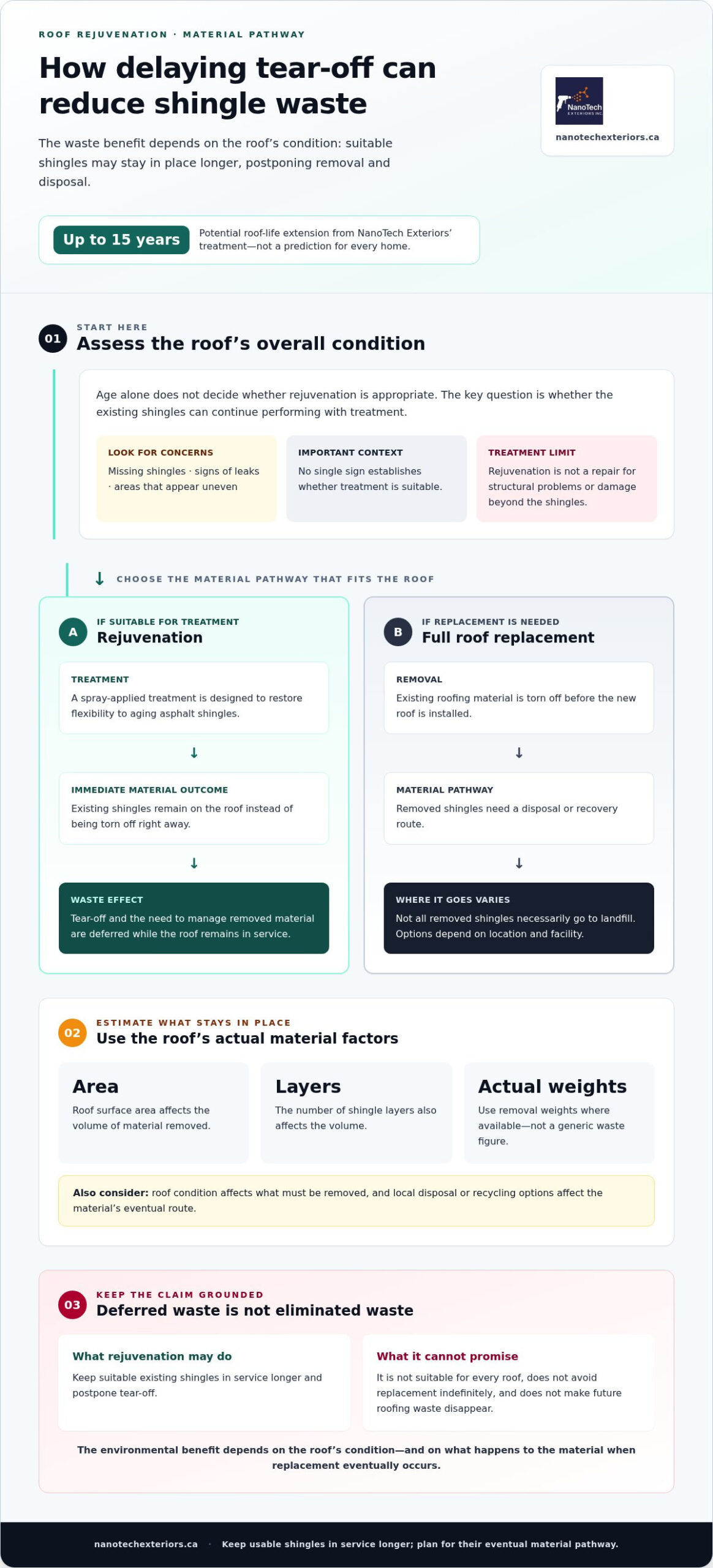
Estimate potential shingle waste avoided for a Southern Ontario home
A useful estimate starts with the roof itself, not a generic online figure. Roof area, the number of existing shingle layers, and the actual weight of removed material can all change the result. If rejuvenation is suitable, the estimate can describe material whose tear-off may be deferred. It shouldn’t be presented as a confirmed landfill-diversion total unless disposal records show where that material would otherwise have gone.
A practical way to frame a waste estimate
Use a simple, transparent method. Record the inputs and assumptions so the estimate helps compare options without being mistaken for a measured result.
- Start with roof area. Use project measurements or roofing records where available. Roof surface area, rather than the home’s floor area, is the relevant figure.
- Confirm the shingle layers. Existing roofs can have more than one layer, which changes the amount of material involved in a tear-off. Don’t assume a single layer without a basis.
- Use documented weight where possible. Actual removal weights or disposal records from a comparable, documented project are more useful than a broad online average. If neither is available, keep the calculation in area and layers, and label any weight estimate as uncertain.
- State what the number means. Explain that it represents material potentially kept on the roof for now if rejuvenation is appropriate. It doesn’t show that the material was permanently diverted from landfill.
For example, a homeowner can note the measured roof area and known layer count, then use those inputs to describe the potential tear-off deferred. Without a project-specific weight or a clearly supported conversion method, don’t turn that estimate into a tonnage claim. That restraint makes the explanation more credible.
Check local shingle disposal and recycling options
Disposal routes and accepted materials can differ between facilities. Before relying on a local diversion claim, use current Halton Region guidance and the rules of the municipality or receiving facility involved. Homeowners in Burlington, Hamilton, Oakville, Niagara, Kitchener, Guelph, and Cambridge should follow the guidance that applies to their property and the destination for the roofing material, rather than assuming neighbouring areas handle shingles the same way.
Look for current information about whether asphalt shingles are accepted, any sorting requirements, and whether the facility identifies a recovery route. If the destination isn’t documented, describe the amount of tear-off that might be delayed, not the amount “kept out of landfill.” A disposal estimate and a verified diversion figure are different claims.
This project-specific approach clarifies how roof rejuvenation saves on landfill waste without overstating the outcome: it may defer the removal of suitable shingles, while actual landfill diversion depends on what happens when roofing is eventually removed. For practical guidance on whether rejuvenation may suit your roof, explore NanoTech Exteriors’ roof rejuvenation service.
NanoTech Exteriors’ roof rejuvenation approach to reducing immediate tear-off
NanoTech Exteriors provides spray-applied roof rejuvenation for homeowners across Burlington, Hamilton, Oakville, Niagara, Kitchener, Guelph, and Cambridge. The treatment is designed to restore flexibility to aging asphalt shingles, offering a potential alternative to immediate replacement when the existing roof is suitable. The aim is practical: help appropriate shingles remain in service longer, rather than remove them before they need to be replaced.
NanoTech Exteriors’ roof rejuvenation can extend a roof’s life by up to 15 years. That’s a potential extension, not a guaranteed result or a timeline that applies to every roof. Condition matters. The treatment is intended for suitable roofs, and it doesn’t make a severely compromised roof appropriate for restoration or remove the eventual need for replacement.
What homeowners can expect from the rejuvenation concept
Roof rejuvenation focuses on the shingles already in place. A spray-applied treatment is designed to restore flexibility to aging shingles, with the goal of extending their useful service life where roof condition supports treatment. If the roof can remain in service, tear-off may be postponed, which means less immediate roofing material to manage. That is the relevant waste benefit, not a promise that shingles will never become waste.
Concerns such as granule loss can prompt questions about whether replacement is the only next step. The answer depends on the roof’s overall condition and what the issue indicates. NanoTech Exteriors’ explanation of an Ontario shingle granule loss solution offers additional context for homeowners considering options short of full replacement.
A sensible next step for homeowners
Start with the roof’s condition. An assessment can help establish whether the shingles and broader roofing system are suitable for rejuvenation, need repair, or call for replacement. This keeps the decision focused on what the roof needs, rather than assuming every aging roof can be treated or that avoiding tear-off should come first.
If rejuvenation is appropriate, its potential environmental benefit is that it may defer tear-off and the immediate handling of removed shingles. It doesn’t, on its own, establish how much material would otherwise reach landfill or what will happen at the roof’s eventual end of life. Those outcomes depend on the project and the disposal route. That’s why how roof rejuvenation saves on landfill waste is best understood as a conditional benefit of keeping suitable shingles in service longer.
Homeowners can use roof condition as the starting point for an informed decision about restoration or replacement. Explore roof rejuvenation with NanoTech Exteriors to learn about the approach and consider how it fits your roof.
Make your next roof decision with the full picture
Base your roofing decision on the roof in front of you, not on a blanket claim about which option is always better for the environment. Consider the roof’s condition, whether restoration is appropriate, and what would happen to removed materials if replacement is needed. This gives you a clearer way to weigh practical needs alongside waste concerns.
Understanding how roof rejuvenation saves on landfill waste means keeping the claim proportionate: the potential benefit depends on whether the roof can remain in service and what happens to its shingles later. A careful assessment can separate a realistic opportunity to defer work from a roof that needs a different solution. Either way, the goal is a sound decision for your home, made with a clear view of its material impacts.
Explore roof rejuvenation with NanoTech Exteriors to learn more and consider whether it may suit your roof. A well-informed next step can protect your home while keeping waste claims grounded in what the project can achieve.
Frequently Asked Questions
How can I estimate how much shingle waste roof rejuvenation may avoid?
Start with measured roof area and determine how many shingle layers a future replacement would remove. Then use project-specific weight records or disposal tickets, if available, to estimate the material involved. An area measurement without a documented weight can support an area-based estimate, but not a reliable tonnage claim. State your assumptions clearly, and remember that rejuvenation only defers tear-off if the roof is suitable for treatment.
Can asphalt shingles be recycled in Ontario?
Sometimes, but acceptance depends on the receiving facility, the shingles’ condition, and local programs in effect when they’re removed. Don’t assume a facility in one municipality accepts material from another. Use current guidance from the relevant municipality or intended facility, including applicable Halton Region information. If you describe a project as recycling or diverting shingles, keep records that identify the material’s destination and support that claim.
What happens to old shingles after a roof replacement?
Old shingles are removed, then managed through the route available for that project. Depending on local services and facility acceptance, roofing material may go to landfill or another recovery route. The destination shouldn’t be assumed just because the roof was replaced. Project paperwork, such as a disposal record or facility receipt, can help establish where the material went and support a more accurate account of its final destination.
Does roof rejuvenation work on every asphalt-shingle roof?
No. It’s intended for aging shingles that remain suitable for treatment, not roofs with every type or level of damage. Leaks, widespread deterioration, or concerns beyond the shingles may point to repair or replacement instead. A roof’s age alone can’t determine suitability. An assessment can help distinguish wear that may be appropriate for restoration from problems that need a different solution, so the decision reflects the roof’s actual condition.
Is roof rejuvenation always better for the environment than replacement?
No option is automatically greener in every case. To understand how roof rejuvenation saves on landfill waste, distinguish material that stays in place for now from material permanently diverted from disposal. A fair comparison would also consider treatment inputs, transport, replacement materials, and eventual disposal over a consistent timeframe. Without comparable, project-specific lifecycle evidence, describe the immediate material difference rather than making a universal environmental claim.
How much landfill space do old roof shingles take up?
There isn’t one reliable volume for every home. The space occupied depends on roof area, the number and type of shingle layers, and how the removed material is handled or compacted. Weight records don’t automatically show landfill volume, and a general online estimate may not match a particular roof. Use project measurements and disposal documentation where available; otherwise, explain the factors without assigning a specific volume.