What if the best place to start isn’t with the lowest quote, but with a closer look at how a roofer works? If you’re wondering how to find a trustworthy roofer in your area, focus on clear communication, relevant credentials, consistent customer feedback and whether the company services your local neighbourhood.
It’s reasonable to want confidence before inviting a roofing crew to work on your home. A polished website or one positive review is not enough on its own. Look at how the contractor assesses your roof, explains the proposed work and communicates when plans change.
This guide explains how to assess a roofer’s credentials, reviews, local reputation and written estimate. You’ll also learn how to match a contractor’s experience and service area to your home, so you can make an informed decision with fewer unanswered questions before work begins.
Key Takeaways
- Look for a roofer who explains the scope, timeline and payment schedule clearly, and communicates promptly when unexpected issues affect the plan.
- Manufacturer certifications can show familiarity with specific roofing products, but their requirements and benefits vary by program.
- Read reviews for recurring patterns in communication and workmanship, and weigh a contractor’s reputation and relevant experience alongside the estimate.
- Confirm that the roofer serves your part of Toronto or the GTA and has experience with the type of roof work your home needs.
1. Contractor communication and handling unexpected problems
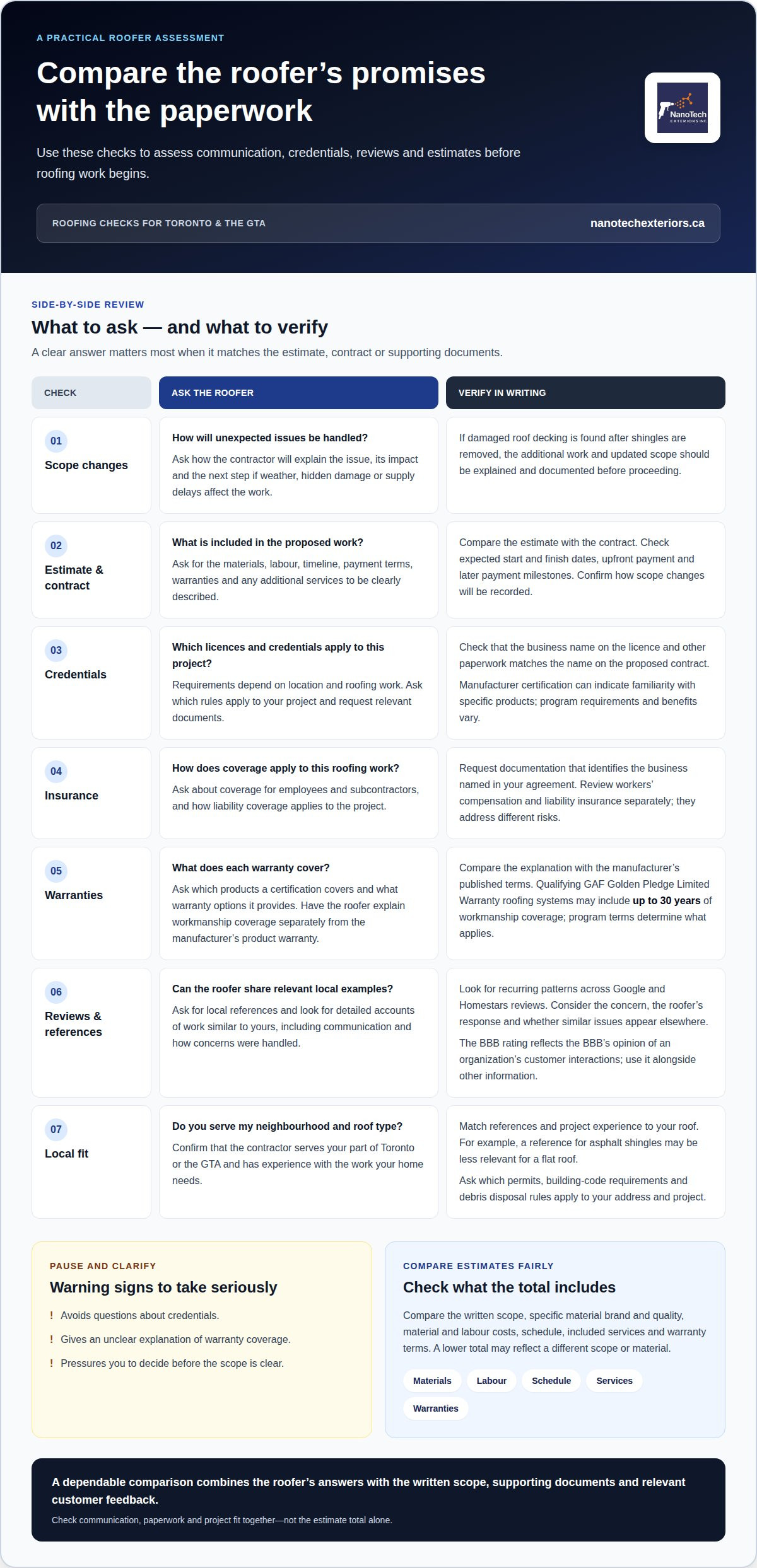
Start with a practical question: how will the contractor explain changes to the work? Weather, hidden damage and supply delays can affect a roofing project, so expect a clear explanation of the issue, its impact and the next step. If damaged roof decking is found after shingles are removed, for example, the contractor should describe the additional work and document the updated scope before proceeding.
Local recommendations can help you find contractors with experience in your neighbourhood. Ask friends, family or a trusted real estate agent about roof repairs or replacements they’ve arranged. Community groups and local forums can also provide useful accounts of communication and follow-through. Treat each recommendation as a starting point, then assess the roofer’s answers and paperwork yourself.
Ask to see the contractor’s business licence and relevant credentials. Licensing requirements depend on your location and the type of roofing work, so ask which rules apply to your project. Also request documentation showing insurance coverage for employees and subcontractors. Clear answers and paperwork are more useful than verbal assurances.
A written roofing contract should describe the materials, warranties, timeline and payment terms. Check the expected start and finish dates, the upfront payment and the schedule for later payments. Before signing, compare the contract with the estimate and clarify how changes to the work will be recorded.
Permit, building-code and disposal requirements vary by municipality and project. Ask the roofer which approvals apply to your address, how code-related work will be handled and how roofing debris will be removed. These details should match the project scope in your contract.
Before hiring, ask who will manage the project, how updates will be shared and what happens if hidden damage changes the scope. Confirm the expected schedule, payment milestones and warranty terms in writing. Specific answers make it easier to compare the roofer’s communication with the commitments in the estimate.
2. Checking manufacturer certification requirements
A manufacturer certification can indicate that a roofing contractor is familiar with specific products. Depending on the manufacturer’s program, certification may also make the contractor eligible to offer enhanced warranties. Ask which products the certification covers and what warranty options it provides. Since requirements vary by program, compare the explanation with the manufacturer’s published terms.
Credentials are one part of the assessment. Ask which licences apply to the work at your Toronto or GTA property, and request to see relevant documents. A business licence can help you assess whether a company is operating legitimately. Check that the business name on the paperwork matches the name on the proposed contract.
The Better Business Bureau directory lets homeowners search for businesses by name or category and enter a town. Its rating reflects the BBB’s opinion of an organization’s customer interactions, including local interactions. Treat the rating as one piece of information alongside project experience, customer reviews and the roofer’s answers about the work.
Watch for warning signs such as avoiding credential questions, offering unclear warranty explanations or pressuring you to decide before the scope is clear. Ask the contractor to explain workmanship coverage separately from the manufacturer’s product warranty. Qualifying GAF Golden Pledge Limited Warranty roofing systems may include up to 30 years of workmanship coverage; the program terms determine what applies.
Request documentation showing insurance coverage for employees and subcontractors, and ask how liability coverage applies to the roofing work. Workers’ compensation and liability insurance address different risks, so review them separately. Confirm that the documents identify the business named in your agreement. This helps clarify who is responsible if an injury or property damage occurs during construction.
For a residential project, make sure the credentials and warranty discussion match the proposed scope, whether it involves shingles or a flat roof. The residential roofing information can help you understand the work involved in a home roofing project.
3. Comparing online reviews and company reputations
Look for patterns across Google and Homestars reviews rather than relying on a high overall rating. Notice whether customers describe clear communication, completed work and how the contractor responded to concerns. A detailed account of a roofing project can offer more context than a brief rating, especially when it concerns work similar to yours.
Ask contractors for local references and testimonials, then compare them with your proposed project. A reference for asphalt shingles may be less relevant if your home has a flat roof. Read negative feedback carefully, too. One complaint provides limited context, so consider the issue, the contractor’s response and whether similar concerns appear in other reviews.
Check feedback connected to the communities the contractor serves, including Toronto and GTA neighbourhoods. Look for specific details about the project, such as the type of roof, the work completed and how the customer describes communication. If a review raises a concern, consider whether the contractor’s public response addresses it directly and professionally.
Compare the written scope of each estimate, not just the total. Check whether the roofing materials match, including the specific brand and quality of asphalt shingles. The estimate should clearly separate material and labour costs. Note any additional services and differences in warranty terms. A lower total may reflect a different scope or material, so identify those differences before comparing prices.
Set the estimates side by side and mark differences in materials, labour, schedule and included services. If the proposals describe different work, ask for clarification so you can compare like with like. This makes the trade-offs clear without letting price alone determine your choice.
Weigh each roofer’s relevant experience, service quality and reputation against your project needs. Exploring established specialists like algroofinglimited.com offers a helpful example of how reputable roofers present their replacement services and past project standards. Reviews, local references and detailed estimates each provide a different perspective. Together, they help you assess the proposed work and make a more informed choice for your home.
4. Finding roofers serving Toronto and the Greater Toronto Area
If you’re working out how to find a trustworthy roofer in my area, begin by narrowing the search to your municipality and roof type. For a Toronto or GTA project, check whether a contractor serves your exact address, then compare their experience with the work your home needs. A broad claim of serving the region doesn’t tell you whether your street is included.
Search using a specific place name, such as Toronto, Burlington, Hamilton, Oakville, Niagara, Kitchener, Guelph or Cambridge, alongside the roofing work required. Ask each contractor whether your property falls within their service area. That simple check helps you focus on roofers who can work at your home rather than businesses whose advertised coverage stops elsewhere.
Next, match relevant project experience to your roof. A home with asphalt shingles, an outdoor living space, or a flat-roof addition each require different materials and engineering approaches. For example, specialized contractors like North Florida Screen Enclosures illustrate how patio covers and elite roofing systems demand specific installation expertise. Ask about projects resembling yours, such as a flat-roof repair or shingle replacement in a similar neighbourhood. Specific examples are more useful than general construction experience alone.
When considering how to find a trustworthy roofer in my area, remember that proximity is only one part of the decision. Ask how the contractor assesses your roof and who will coordinate the work. Familiarity with local housing can provide useful context, but experience with your roof type matters too. For example, a flat-roof project is a closer comparison than shingle work.
Compare each proposal with your address and the work discussed. The property location, roof type and project scope should be specific to your home, not copied from a generic template. If two roofers serve your municipality, assess how clearly each explains the work and manages communication. Choose the fit that suits your project, not proximity alone.
NanoTech Exteriors
NanoTech Exteriors helps homeowners with Residential Roofing, Roof Repair and Roof Rejuvenation in Burlington, Hamilton, Oakville, Niagara, Kitchener, Guelph and Cambridge. The right option depends on your roof’s condition and needs. If shingles are aging, roof rejuvenation may be worth considering. If the roof needs repair or replacement, NanoTech Exteriors provides those services, too.
Share your roof type, location and main concern with NanoTech Exteriors to discuss your project. The team can help you understand which roofing service fits the work required, so you can consider your options clearly.
Contact NanoTech Exteriors to discuss your roofing needs.
Make your next roofing decision with confidence
Turn your research into a clear conversation about your home. Before reaching out, note what you’ve observed, such as a leak, worn shingles or concerns about an aging roof. Sharing those details helps focus the discussion on the roof’s condition and the work it may need. If you’re still considering how to find a trustworthy roofer in my area, notice whether the conversation helps you understand your options without pressure.
NanoTech Exteriors provides Roof Repair, Residential Roofing and Roof Rejuvenation for different roofing needs in Burlington, Hamilton, Oakville, Niagara, Kitchener, Guelph and Cambridge. Explain what you’re seeing and what you want to address. A clear discussion can help you understand the work involved and decide on your next step.
Contact NanoTech Exteriors to discuss your roofing project and move forward with confidence.
Frequently Asked Questions
Where do you even start?
Start with your property address and the roofing problem you need assessed. Note the roof type, any visible damage and when you first noticed the issue. Then look for contractors serving your community, whether that’s Toronto, Burlington, Hamilton, Oakville, Niagara, Kitchener, Guelph or Cambridge. This concise project brief helps you explain your needs consistently when arranging assessments.
What licences, certifications, and insurance should a Canadian roofer have?
Requirements vary by location, so ask which licences apply to your project and request relevant credentials. In Quebec, roofing contractors must hold an RBQ licence in category 7.0 or an applicable general building contractor category. Manufacturer certifications relate to specific programs and products. Ask for documentation showing insurance coverage includes employees and subcontractors, and ensure it identifies the business doing your work.
How many roofing quotes should I get, and how do I compare them?
In Quebec, homeowners are advised to request estimates from at least three roofing contractors; Ottawa homeowners are advised to get estimates from at least three roofers. Compare proposals based on the same work scope, roof area and material choices. If an estimate makes assumptions about damage or access, ask how those affect the proposed work before comparing totals.
What payment schedule is fair, and what consumer protections apply to roofing contracts in Canada?
A fair schedule is clear in writing: the contract should state the upfront amount and when later payments are due. Tie each payment milestone to an identified part of the project, and keep a copy of the signed agreement and payment records. Consumer protections vary by province. In Quebec, a customer may cancel a contract signed at home with an itinerant merchant for any reason and without charge within 10 days of signing.