The gentlest-sounding roof treatment isn’t automatically the safest or the right fit for your roof. When comparing non-toxic roof treatment options, look beyond the label: ingredients, application method and potential runoff all matter, especially around people, pets, plants and asphalt shingles.
It’s reasonable to want fewer chemical concerns and less risk of overspray or damage. But “non-toxic,” “eco-friendly” and “biodegradable” don’t mean the same thing, and each claim needs reliable product information to support it. The right approach also depends on the problem. Cleaning targets surface growth or stains; it doesn’t restore aging shingles. Roof rejuvenation is designed for aging shingles, with the goal of restoring flexibility and potentially extending roof life by up to 15 years.
This guide compares common treatments and practical safety considerations, explains what product claims can and can’t tell you, and helps you match a method to your roof’s condition and your goals. Identifying the issue first can help you avoid unnecessary exposure, preventable shingle damage and treatments that solve the wrong problem.
Key Takeaways
- Compare non-toxic roof treatment options by checking ingredient disclosure, intended surface, application directions and runoff considerations, not just marketing claims.
- Use the product label and Safety Data Sheet to understand handling information. An SDS isn’t a blanket guarantee of safety in every use.
- Match the approach to the visible issue and shingle condition. Cleaning, moss control, repair and rejuvenation address different needs.
- Before treatment, identify the roof material, define your goal, review product documentation and consider nearby plants, pets and drainage.
- For suitable aging shingles, roof rejuvenation may be an option for homeowners in Burlington, Hamilton, Oakville, Niagara, Kitchener, Guelph and Cambridge.
What ‘Non-Toxic Roof Treatment’ Means, and What It Does Not
“Non-toxic” is a product claim that needs context, not proof that a treatment carries zero risk in every situation. Practical risk depends on the product’s properties and how people or the surrounding environment could be exposed. A product may present different concerns when concentrated than when diluted as directed, or during application than after it dries. The label, current Safety Data Sheet (SDS), application method and disposal directions help clarify what the claim does and doesn’t establish.
Purpose matters too. Roof cleaners target surface staining or growth such as algae, moss or lichen. Other treatments address different goals, such as caring for aging shingles. Cleaning doesn’t restore worn shingles or fix a leak. For a general overview of chemical and non-chemical approaches, see Roof Cleaning Methods. Whatever the goal, the method needs to suit the roof material and the issue.
How to read ‘non-toxic,’ ‘eco-friendly,’ and ‘bleach-free’ claims
These terms aren’t interchangeable, and none means a product is suitable for every roof or safe in every use. “Eco-friendly” doesn’t specify effects on people or pets; “bleach-free” only describes what the product claims it excludes. Marketing language can be a starting point, but it isn’t a substitute for specific product information.
Read the label for the intended surface, directions, dilution and precautions. Then consult the current SDS for handling and hazard information. An SDS describes potential hazards and safe handling; it doesn’t guarantee that a product is harmless, environmentally safe or appropriate for a particular roof. If a product is marketed as a pesticide for moss control, check that its Canadian registration and label include the intended use.
Who and what may be exposed during roof treatment?
Exposure can happen in several ways. Application mist may drift beyond the roof; runoff may reach eaves, soil or drainage areas; and product may contact nearby plants, outdoor surfaces or people. Wind, roof pitch, application equipment and the amount used can affect where material travels. Don’t assume a product claim rules out these routes.
Keep children, pets and neighbours clear of the application area, and follow the product’s instructions for access, protective equipment, ventilation, cleanup and disposal. Precautions vary by product, so avoid broad assurances such as “safe for pets” unless current documentation supports them for the product and its actual use. When comparing non-toxic roof treatment options, rely on product information rather than a reassuring label alone.
How to Compare Roof Treatment Ingredients, Application, and Safety Information
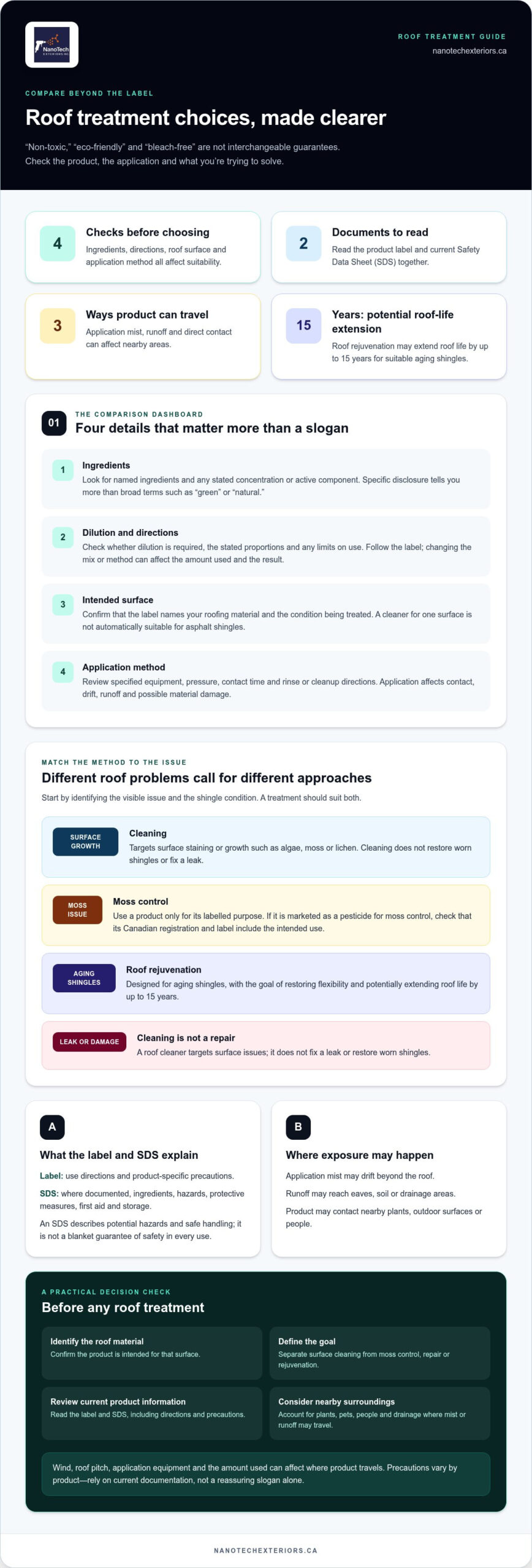
Compare the whole treatment process, not just an ingredient name. A product’s suitability depends on what it is intended to treat, whether it is appropriate for the roof material, how it must be diluted and applied, and where the liquid may go. For non-toxic roof treatment options, start with the product label and current Safety Data Sheet (SDS), then consider the conditions where it will be applied.
| What to compare | What to look for | Why it matters |
|---|---|---|
| Ingredients | Named ingredients and any stated concentration or active component. | Specific disclosure is more informative than broad terms such as “green” or “natural.” |
| Dilution and directions | Whether dilution is required, the stated proportions and any limits on use. | Changing the mix or application can affect the amount of product involved and the result. |
| Intended surface | Roofing materials and conditions named on the label. | A cleaner suitable for one surface isn’t automatically suitable for asphalt shingles or another roof material. |
| Application method | Specified equipment, pressure, contact time and rinse or cleanup directions. | Application affects contact, drift, runoff and the possibility of material damage. |
What the label and Safety Data Sheet can tell you
The label provides use directions and product-specific precautions. Where documented, the SDS adds information about ingredients, hazards, protective measures, first aid and storage. Read both together: a listed hazard describes a potential concern, while actual exposure depends on the task, amount, concentration and conditions. Treat claims about toxicity, biodegradability, plant or pet safety, and runoff as details to verify against current documentation, not assumptions based on a slogan.
Exposure risk depends on both product concentration and application conditions, including how it’s applied and where spray or runoff can travel. Dilution instructions matter, as do wind, equipment, roof slope and nearby surfaces. Follow the label rather than adjusting the mixture or substituting another method.
Compare treatment methods without assuming one is safest
Water-only rinsing avoids adding a cleaner, but may not remove every type of buildup. Excessive pressure can damage asphalt shingles. Detergent or cleaner products may help with particular surface soils or growth, but ingredients, contact time and runoff considerations vary. Targeted roof treatments are designed for specific purposes and may have distinct directions. None is automatically the safest or most effective choice without product-specific evidence and suitable instructions.
Match the method to the roof material and the problem. Don’t assume a product intended for a hard surface is appropriate for shingles, or that low-pressure application makes any solution suitable. If the goal is caring for aging shingles rather than cleaning the surface, explore roof rejuvenation for aging shingles as a separate approach.
Cleaning, Moss Control, or Shingle Rejuvenation: Which Option Fits?
Start with three questions: What do you see on the roof? What condition are the shingles in? What result do you want? Visible moss or dark staining points to a surface-care issue, while brittle, curling or worn shingles call for a closer look at the roof itself. Choosing among non-toxic roof treatment options won’t help if the treatment’s purpose doesn’t match the problem.
When the problem is moss, algae, or surface staining
Cleaning targets visible buildup and can improve appearance, but a cleaner roof isn’t necessarily a sound roof. Moss, algae and stains may look similar from the ground, yet they aren’t the same issue. Identify the growth before selecting a cleaning approach, and follow directions intended for the roofing material.
Aggressive scrubbing or high-pressure washing can damage asphalt shingles. A method that removes buildup quickly may also disturb the shingle surface. Don’t assume a cleaner will remove or prevent all growth in every condition; results depend on the product, application and roof environment.
Keep the goal clear. If the concern is a dark streak or patch of moss, surface cleaning may be relevant. If you see a leak, sagging, lifted or missing shingles, widespread cracking, or other signs of deterioration, a surface treatment won’t address the underlying problem. These conditions warrant an assessment for repair or replacement, not an attempt to make the roof look cleaner.
When aging shingles may need a different treatment
Rejuvenation has a different purpose from washing away visible buildup. NanoTech Exteriors provides a spray-applied roof rejuvenation service designed to restore flexibility to aging shingles. The treatment may extend roof life by up to 15 years, but this isn’t a guaranteed outcome. Suitability and results depend on the roof’s condition.
If your goal is shingle care rather than stain removal, learn more about Burlington roof rejuvenation and how it differs from cleaning.
Use this practical guide to match the work to the need:
- Visible surface growth or staining, sound shingles: Consider a material-compatible cleaning approach and follow its product directions.
- Aging shingles without signs of major failure: Explore whether rejuvenation suits the roof’s condition and your maintenance goal.
- Leaks, structural concerns or extensive shingle damage: Prioritize a roof assessment for repair or replacement.
Cleaning doesn’t repair leaks, correct structural issues or restore worn shingles. Rejuvenation isn’t a cleaning product either. Separating these purposes helps prevent using a surface treatment where the roof needs a more substantial solution.
A Safer-Choice Roof Treatment Checklist for Southern Ontario Homes
A careful plan starts before any product reaches the roof. Whether you’re in Burlington, Hamilton, Oakville, Niagara, Kitchener, Guelph or Cambridge, use the same sequence: identify the roofing material, define the goal, review current product directions, then assess the property. This helps you compare non-toxic roof treatment options using practical details rather than relying on a label alone.
Before treatment: assess the roof and property
Record what’s on the roof and what surrounds it. Note the material, visible moss or staining, shingle condition and any signs of leakage. Inspect from the ground where possible; don’t climb onto a roof to check it. Then note gardens, downspouts, patios, play areas and other surfaces that could receive spray or runoff. Let the product directions and site conditions guide precautions, not generic safety assurances.
- Identify the material: Confirm whether the roof is asphalt shingle or another material, and check that the product directions cover it.
- Define the goal: Decide whether you’re addressing surface buildup, caring for aging shingles or dealing with damage that may need repair.
- Review documentation: Read the current label and Safety Data Sheet for intended use, dilution, application instructions, protective measures and cleanup guidance.
- Assess the site: Note gardens, downspouts, pets, children’s play areas, neighbouring properties and surfaces below the work area.
Be specific about runoff pathways. A downspout may direct water towards a garden or paved area, while roof edges above planting beds can leave vegetation close to potential drips. Consider how spray could travel beyond the roofline and whether people or pets use nearby areas during application. These observations can inform a treatment plan, but don’t replace product-specific directions.
During and after application: reduce avoidable exposure
Follow documented instructions for application, protective equipment, access restrictions and cleanup. Keep people and pets out of the application area as directed. Wind can carry mist beyond the intended surface, while rain can affect drying and move residue through eaves and downspouts. If conditions could interfere with the label’s directions or site precautions, postpone treatment rather than improvising. Precautions vary by formulation.
After application, follow the product’s cleanup and re-entry guidance, if provided. Check the surrounding property for signs of unintended contact or runoff, and handle leftover product and containers according to label directions. If you notice granules collecting in gutters or at downspouts, that may provide useful context about roof condition. Learn about roof shingle granule loss before deciding that cleaning or treatment is the next step.
If your assessment points to aging shingles rather than surface buildup, explore roof rejuvenation options as a separate roof-care approach.
Choosing a Roof Treatment That Matches the Roof’s Real Condition
The right choice depends on what the roof needs, not which treatment sounds gentlest or most convenient. First, define the goal: clean visible buildup, care for suitable aging shingles, repair damage or replace a roof that has reached the end of its serviceable life. Then match the work to the roof’s condition and follow product-specific directions. A surface treatment can’t replace a repair assessment when the problem is structural.
A simple decision path for homeowners
Use visible signs to guide the next step, but don’t treat a view from the ground as a full roof inspection. A leak, sagging area or damaged shingles changes the priority. If you’re unsure whether the concern is cosmetic or a sign of deterioration, understand the roof’s condition before choosing among non-toxic roof treatment options.
- If you see moss, algae or staining: Compare cleaning methods intended for your roof material, and review the label and safety information for application and runoff precautions. Cleaning addresses surface buildup, not worn shingles.
- If shingles are aging: Consider whether rejuvenation suits their condition and your goal. Roof rejuvenation is designed for aging shingles, not for washing away moss or stains.
- If there are leaks or structural concerns: Prioritize an assessment for roof repair or replacement. Applying a cleaner or rejuvenation treatment won’t correct water entry, structural problems or extensive shingle failure.
These categories aren’t interchangeable. Removing a dark stain may improve appearance without changing the condition of brittle shingles. Likewise, rejuvenation won’t fix a leak. Choosing based on the roof’s needs helps you avoid spending time on a treatment that can’t address the underlying issue.
Explore roof rejuvenation in the local service area
NanoTech Exteriors is based in Burlington and serves surrounding Southern Ontario communities, including Hamilton, Oakville, Niagara, Kitchener, Guelph and Cambridge. Its spray-applied rejuvenation service is designed to restore flexibility to aging shingles. The treatment may extend roof life by up to 15 years, but that’s a possible extension, not a guaranteed result, and rejuvenation isn’t suitable for every roof.
NanoTech Exteriors is an authorized GoNano service provider. If your goal is shingle care and the roof’s condition may make rejuvenation appropriate, explore the service as one option. Keep product claims about toxicity or environmental impact separate from the question of whether the treatment suits the roof; those claims need support from current product documentation.
Explore roof rejuvenation with NanoTech Exteriors
Make Your Next Roof-Care Decision with Confidence
Before choosing a treatment, decide what you want the roof to do next: look cleaner, maintain aging shingles or address a problem that needs repair. A clear goal makes it easier to assess product claims and choose a practical next step. The best non-toxic roof treatment options aren’t simply the ones with the most reassuring label; they’re the ones whose documented use, application and purpose fit the roof and property.
If aging asphalt shingles are your concern, roof rejuvenation is a distinct approach to shingle care. NanoTech Exteriors is a Burlington-based roofing company serving Southern Ontario. Its rejuvenation treatment is designed to restore flexibility to aging shingles, and NanoTech Exteriors is an authorized service provider for GoNano nanotechnology roofing treatments.
Understand the roof’s condition before committing to a treatment. Explore roof rejuvenation with NanoTech Exteriors as you consider the next step for your home. A well-matched plan can help you move forward with greater confidence.
Frequently Asked Questions
Does ‘non-toxic’ mean a roof treatment is completely harmless?
No. The term doesn’t promise that a product is harmless in every situation. A label claim can’t replace product-specific directions, especially if a concentrated solution is spilled, gets into eyes or is used differently than instructed. Before use, locate the first-aid and accidental-spill information on the label or Safety Data Sheet. If those documents don’t support a broad safety claim, don’t treat it as proof of zero risk.
Are oxygen-based roof cleaners safer than bleach-based cleaners?
Not automatically. “Oxygen-based” and “bleach-based” describe broad categories, not the complete formula, concentration or conditions of use. A fair comparison needs the current label, intended roof material, dilution directions and application method for each product. One formulation may suit a particular cleaning task better, but that doesn’t establish that it’s safer for every person, roof or property. Don’t choose by ingredient category alone.
Can roof treatment runoff harm plants or pets?
Runoff can create a risk if product reaches places where plants or animals may contact it. For example, runoff from a downspout towards a vegetable garden could expose soil or foliage, while a pet might walk through a wet area and groom its paws. Follow the product’s directions for protecting nearby areas and restricting access. Don’t assume rinsing a surface or waiting a set time makes it safe unless the label says so.
Is roof cleaning the same as roof rejuvenation?
No. Cleaning addresses surface dirt, staining or growth; rejuvenation is intended to care for suitable aging shingles. They aren’t interchangeable, and a cleaner won’t restore flexibility to worn shingles. A roof with algae staining but sound shingles presents a different goal from one with visibly aging shingles and no surface buildup. Identify the roof’s condition and your desired outcome before selecting a treatment.
Can I apply a non-toxic roof treatment myself?
Possibly, if the product directions allow homeowner application and you can follow them safely. Roof work adds a serious fall risk, particularly on steep, wet or fragile surfaces, so a reassuring product label doesn’t make roof access safe. Don’t climb onto shingles to spray, scrub or rinse if you can’t do so securely. Never mix products or change the dilution to try to improve the result.
What should I check before choosing a roof treatment in Ontario?
Check that the current label names your roof material and intended use, then review dilution, application, protective measures and cleanup directions. If a product is used as a pesticide for moss control, confirm its Canadian registration and that the label permits that use. For homes in Burlington, Hamilton, Oakville, Niagara, Kitchener, Guelph or Cambridge, also consider how roof edges and downspouts direct runoff across the property.
Does roof rejuvenation remove moss and algae?
No. Roof rejuvenation isn’t a moss or algae cleaner; it’s designed to address aging shingles. If visible growth is the concern, evaluate an appropriate roof-cleaning approach separately and don’t assume rejuvenation will remove it. NanoTech Exteriors’ spray-applied rejuvenation treatment is designed to restore flexibility to aging shingles, but suitability depends on roof condition. The treatment’s intended purpose is a better guide than its name or marketing language.