A roof can look renewed in a photo without showing whether it’s sound or suitable for treatment. When reviewing roof rejuvenation before and after photos, separate what you can see from what you can’t: images may show a surface change, but they can’t reveal everything beneath the shingles.
It’s reasonable to want clear evidence before deciding what to do with an aging roof. A useful comparison shows the same roof before and after treatment, with enough context to understand when the images were taken and what changed. Lighting, weather and camera angle can all affect how colour and surface condition appear. Even a well-matched pair can’t confirm shingle flexibility, reveal hidden damage or establish how a roof will perform over time.
This article explains what visual changes photos may show, how to assess a comparison and why the roof’s actual condition matters when considering treatment. NanoTech Exteriors provides spray-applied roof rejuvenation for aging shingles, as well as roof repair, refurbishment and replacement. Photos are a starting point for understanding the treatment, not a substitute for deciding what your roof needs.
Key Takeaways
- Use roof rejuvenation before and after photos to compare visible details such as shingle colour, surface consistency and wear.
- Look for paired images of the same roof, with clear captions and timing, before treating a photo as useful evidence.
- A visible change can’t confirm hidden damage or prove how a roof will perform.
- Note signs of wear or other concerns, then consider the roof’s actual condition when deciding whether rejuvenation may suit your home.
- NanoTech Exteriors is an authorized service provider for GoNano treatments. Clear project context helps put photos in perspective.
Roof rejuvenation before and after photos: what changes should you notice?
Start by asking what the images actually show: appearance, condition or both? Roof rejuvenation before and after photos may show a change in shingle colour, surface consistency or the appearance of wear, such as bald-looking patches or uneven areas. These details help you compare the visible surface. They don’t establish what’s happening beneath it.
Compare like with like. A treated roof may look darker or more consistent in colour, but a change in sunlight, camera settings or weather can also affect its appearance. Asphalt shingles come in different forms, including three-tab and architectural styles. The Asphalt Shingle overview provides useful background when identifying the roofing material shown. Even a clear surface view can’t establish shingle flexibility, roof-deck condition, hidden deterioration or remaining lifespan.
A photo can show a visible change, but it can’t verify the roof’s full condition. Keep that distinction in mind when reviewing examples and considering whether rejuvenation may suit your home. NanoTech Exteriors’ roof rejuvenation guide for Burlington homeowners explains the service and the factors involved in considering it.
How to compare the same roof before and after treatment
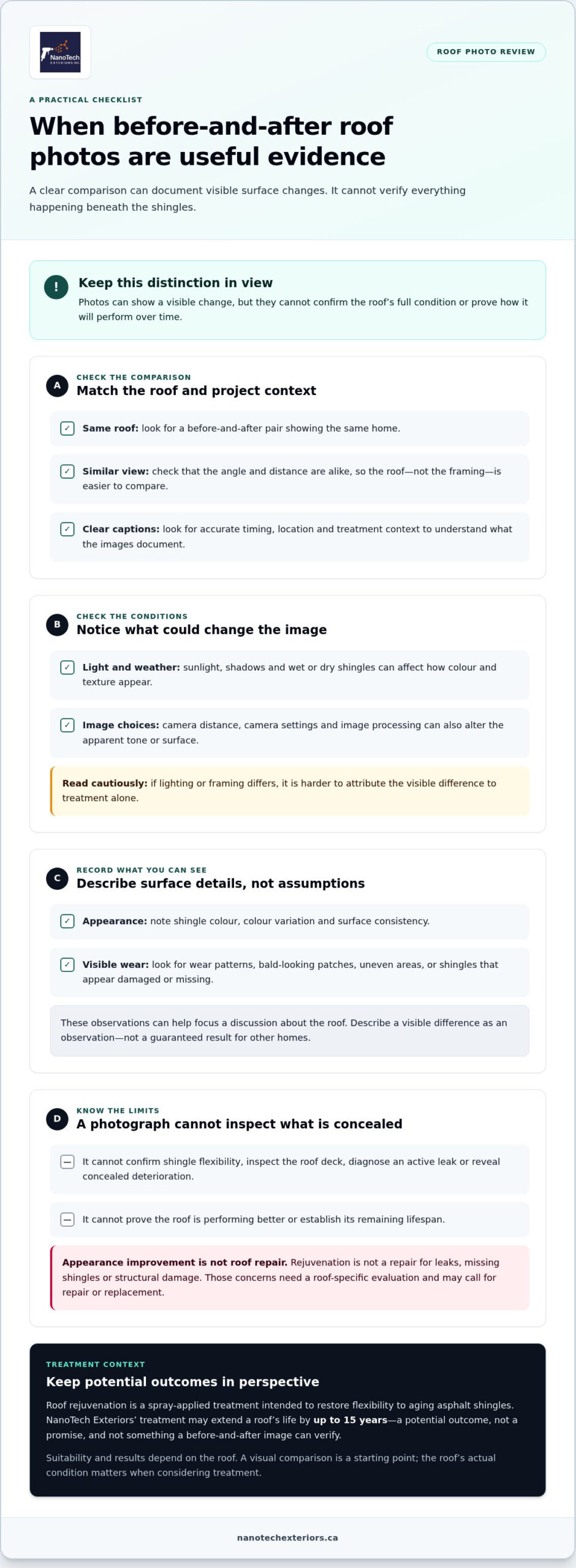
A useful comparison lets you focus on the roof rather than differences between the pictures. Look for a matched pair showing the same home from a similar angle and distance. Captions should provide accurate timing, location and treatment context, so you can understand what the images document.
Check the conditions, too. Sunlight, wet or dry shingles, shadows, camera distance and image processing can all change how colour and texture appear. If the framing or lighting differs, interpret the comparison cautiously. It may still show a surface change, but it’s harder to attribute that difference to the treatment alone.
What photographs can, and cannot, show
Photos can help you describe visible details: colour variation, surface consistency, wear patterns and shingles that appear damaged or missing. These observations can help you focus a discussion about your roof. They don’t prove that shingles have regained flexibility or that the roof is performing better.
A photograph can’t diagnose an active leak, inspect the roof deck or confirm concealed deterioration. A roof may look more uniform while still having issues outside the camera’s view. Likewise, a close-up of weathering doesn’t establish that rejuvenation is appropriate. Consider what you can see alongside the roof’s overall condition, especially if you’ve noticed water entry, damaged shingles or other concerns.
What roof rejuvenation treatment changes on aging asphalt shingles
Roof rejuvenation is a spray-applied treatment intended to restore flexibility to aging asphalt shingles. It addresses the shingle material, not every part of a roofing system. That distinction matters when interpreting roof rejuvenation before and after photos: a visible difference may document an appearance change, but it doesn’t establish the roof’s overall condition or prove how treatment affected its performance.
Shingles age through environmental exposure. The NIST Study on Asphalt Shingle Degradation examines how factors such as ultraviolet radiation, temperature and humidity relate to shingle degradation. Rejuvenation is intended to restore flexibility, but a photograph captures only what is visible in that image.
Why a treated roof may look different in photographs
Describe only changes visible in a matched pair of the same roof. Captions should identify the project and give accurate treatment timing and context. If the roof appears different in colour or surface consistency, present that as an observation, not a guaranteed outcome for other homes.
Light affects how a roof’s colour reads. Moisture, shadows, camera settings and image processing can also alter apparent tone and texture. Compare images taken from similar angles and distances, and consider whether the weather or lighting differs. Clear context helps distinguish an observed change from a photographic variation.
Appearance improvement is not the same as roof repair
Rejuvenation isn’t a repair for leaks, missing shingles or structural damage. Those concerns need a roof-specific evaluation and may call for repair or replacement instead. If granule loss is visible, describe it separately rather than implying that an appearance change resolves the underlying issue. Roof shingle granule loss guidance provides more context.
NanoTech Exteriors’ roof rejuvenation treatment may extend a roof’s life by up to 15 years. This is a potential outcome, not a promise or a result that can be verified from a before-and-after image. Suitability and results depend on the roof. A visual comparison alone can’t establish remaining lifespan or replace an evaluation of its condition.
A treatment has an intended purpose; a photo records only what’s visible. Keep project-specific evidence distinct from general explanations of the service, and don’t present one roof’s appearance as a universal result. If you’re considering treatment for aging shingles, explore NanoTech Exteriors’ roof rejuvenation service to learn more about the treatment and its potential fit for your roof.
How to judge whether before-and-after roof photos are useful evidence
Useful evidence gives you enough context to understand what the images show, not just a dramatic visual contrast. Treat roof rejuvenation before and after photos as a record of one project. Separate details you can verify, such as whether both images show the same roof and when they were taken, from general descriptions of how rejuvenation is intended to work. Promotional language may explain a company’s view of the treatment, but it doesn’t independently prove a photographed result or predict what will happen on your home.
Use this comparison to assess the evidence:
| Photo detail | More useful evidence | What to approach cautiously |
|---|---|---|
| Pairing | Both images show the same roof from a comparable viewpoint. | Different homes, roof sections or camera angles presented as a direct comparison. |
| Timing | Captions state when each image was taken in relation to treatment. | “Before” and “after” labels without dates or timing context. |
| Captions | Project context identifies the location and treatment accurately. | Broad claims about results without details about the pictured roof. |
| Visible features | The same roof area and relevant surface features are easy to compare. | Changes that could be explained by light, weather, edits or framing. |
A homeowner’s checklist for credible roof rejuvenation photos
Check the pair systematically. First, compare rooflines, vents, valleys and other landmarks to see whether both images show the same roof. Next, read the captions for treatment timing and project context. Then look for changes in viewpoint, lighting or image processing that could make the result appear more dramatic. If key details are missing, treat the images as an illustration, not strong evidence of a treatment outcome.
The strongest photo evidence pairs the same roof and viewpoint with clear timing, specific captions and visible features that can be compared fairly.
This emphasis on clear, honest visual evidence is equally relevant across other exterior maintenance tasks. For homeowners reviewing exterior and hardscape care, exterior cleaning specialists like Ehrman’s Power Wash demonstrate how dependable before-and-after documentation helps verify real surface improvements without misleading visual effects.
Questions photos cannot answer about your roof
Photographs of another homeowner’s roof can’t establish whether your shingles are suitable for rejuvenation. They also can’t confirm concealed damage or show how much service life remains. Even if a roof in Hamilton looks similar to yours, differences in its condition and history mean its photographed outcome can’t predict yours.
Use images to guide your questions, not make the final call. If your roof has warning signs that raise the possibility of replacement, compare those concerns with this Ontario roof replacement checklist. The decision should be based on your roof’s condition, not just what a photo suggests.
When roof rejuvenation may suit a Burlington-area home
Examples can help you understand what a rejuvenated roof may look like, but they can’t tell you whether your own shingles are suitable. Use them as a reference, then take three practical steps: review what you can see, note any concerns and have the roof’s condition evaluated. This keeps the decision focused on your home rather than how closely it resembles a photographed project.
This approach applies across Burlington and nearby communities, including Hamilton, Oakville, Niagara, Kitchener, Guelph and Cambridge. Homes in the same area can still have roofs with different materials, maintenance histories and visible conditions. A photo from a nearby street isn’t a substitute for evaluating the roof in front of you.
Signs that call for assessment beyond photo comparisons
Some concerns need attention before you consider rejuvenation. A leak, extensive visible damage or suspected structural issue calls for an evaluation, not a conclusion based on an online comparison. Photos may help you explain what you’ve noticed, but they can’t establish the cause or severity of a problem or determine whether rejuvenation is appropriate.
Repair and replacement are different from rejuvenation. If damage is present, the roof may need repair; if its overall condition warrants it, replacement may be more suitable—a situation where high-performance roofing and rainwater drainage components, such as those supplied by LitCore Limited, become essential. The right next step depends on the specific roof. Don’t let a good-looking comparison distract you from a concern, and don’t assume that a roof with visible wear is automatically suitable for treatment.
Use photos to prepare for a roof-specific decision
A few simple observations can make an evaluation more useful. From a safe position on the ground, note what you can see and take clear photos if possible. Don’t climb onto the roof to get a closer view. Record where you see wear, any shingles that appear damaged or missing, and signs inside the home, such as water entry. Keep observations separate from conclusions: describe what you see rather than trying to diagnose the cause.
- Review visible roof areas from the ground and note any changes or damage.
- Gather clear photos from a safe location, along with any concerns you’ve observed indoors.
- Share those observations during an evaluation so the discussion starts with your roof, not just a comparison image.
An evaluation considers the actual roof and its condition. It can help determine whether rejuvenation is a potential option or whether repair or replacement deserves attention instead. That’s how general examples become a practical decision about your home.
If you’re ready to move from photo comparisons to a roof-specific discussion, explore NanoTech Exteriors’ roofing services.
See what roof rejuvenation can look like with NanoTech Exteriors
Local project examples are most useful when they include enough context to explain what the photos show. For roof rejuvenation before and after photos, that means images of the same roof, with accurate captions identifying the location, treatment timing and relevant project details. The images can help you observe visible changes, but they shouldn’t be presented as proof of hidden roof condition or long-term performance.
NanoTech Exteriors is an authorized service provider for GoNano treatments and provides spray-applied roof rejuvenation intended to restore flexibility to aging shingles. Treatment may extend a roof’s life by up to 15 years, but that potential depends on the project and isn’t guaranteed. A photo pair shows one roof’s appearance at particular points in time; it can’t promise the same outcome for another home.
How to present a local roof rejuvenation example
A clear project caption says what the photos document without making claims beyond the evidence. Identify the location and treatment timing, confirm that both images show the same roof, and describe only visible differences. Avoid attributing changes to treatment if lighting, weather, image processing or camera position could explain them. Don’t claim that an image proves improved flexibility, leak prevention or added lifespan.
A useful caption format is: “Same roof, photographed before treatment and at [time after treatment], in [location]. The images show [specific visible observation]; they don’t establish hidden condition or future performance.” Use accurate project details and describe only what the images show.
Turn photo research into a next step
Use examples to understand what may be visible, then shift your focus to your own roof. A roof-specific evaluation considers the actual shingles and their condition, rather than relying on a resemblance to a photo. Rejuvenation may suit some aging shingles, while a roof with significant concerns may need repair or replacement.
- Note visible wear or damage you’ve observed from a safe vantage point.
- Keep project photos and captions in context, and separate observations from promises.
- Use an evaluation to discuss whether rejuvenation may suit your roof.
NanoTech Exteriors serves Burlington and communities across the region, including Hamilton, Oakville, Niagara, Kitchener, Guelph and Cambridge. Conditions can vary from one property to another, so local examples are a starting point, not a substitute for evaluating your home. If you’re in the area and want to explore whether roof rejuvenation could suit your shingles, explore roof rejuvenation with NanoTech Exteriors.
Make your next roofing decision with confidence
Use roof rejuvenation before and after photos to sharpen your questions, not rush your decision. Save examples that seem relevant, then note what you want to understand about your own roof, such as the condition of its shingles, visible wear or whether treatment is worth considering. This turns browsing into a focused discussion about your home rather than a search for a perfect match online.
A practical next step is to have the roof’s condition evaluated and discuss the options that fit. NanoTech Exteriors provides roof rejuvenation, repair, refurbishment and replacement for Burlington-area homeowners. There’s no need to decide based on appearance alone. Explore roof rejuvenation with NanoTech Exteriors and take the next step with a clearer picture of your choices.
Frequently Asked Questions
Can roof rejuvenation before-and-after photos prove a roof will last longer?
No. Roof rejuvenation before and after photos can document visible changes, but they can’t prove how long a roof will last. A longevity claim depends on the roof’s condition and evidence beyond what a still image captures. Treat photos as examples of appearance, not a forecast for your home. Consider whether the project details behind a lifespan statement apply to the roof being discussed.
Do before-and-after roof photos show whether shingles are structurally sound?
No. A surface view can’t reveal the condition of the roof deck or concealed deterioration beneath the shingles. A roof may look consistent from the street while water damage remains out of view. If you’ve noticed staining on a ceiling or dampness in an attic, share that information during an evaluation. Photos can help describe what you’ve seen, but they can’t replace an inspection of the roof itself.
Why can the same shingles look different in roof photos?
Camera and weather conditions can alter how shingles appear, even if the roof hasn’t changed. A wet surface after rain may look darker than a dry one, while low-angle sunlight can deepen shadows between shingles. Automatic exposure and white balance can also shift the apparent colour. For a fair comparison, look for similar lighting and dry conditions, and be cautious if one image has been heavily edited or taken from a different angle.
Can roof rejuvenation fix a leak?
No. Roof rejuvenation is not a leak repair. If you see water entering the home, treat that as a separate problem and arrange a roof evaluation to identify its source and the appropriate response. Note when the leak appears and which room or ceiling area is affected. That information can help guide the evaluation. Don’t assume a roof is leak-free because its surface looks improved in a photograph.
How do I know if my roof may be suitable for rejuvenation?
An evaluation of the roof’s condition is the practical way to determine suitability. Rejuvenation is intended for aging asphalt shingles that may benefit from restored flexibility, but visible age alone doesn’t establish that treatment is appropriate. Note the roof’s approximate age if you know it, any repairs or leaks, and areas with missing or damaged shingles. In Burlington, Hamilton or nearby communities, these details help focus the discussion on your roof.
Are stock photos useful for comparing roof rejuvenation results?
Stock photos can help illustrate general roofing terms or show common shingle styles, but they aren’t reliable evidence of a particular rejuvenation service or outcome. The pictured roof may not have been treated, and its location, timing and condition may be unknown. For a project comparison, look for images tied to a specific roof, with captions that explain what’s being shown. Use stock imagery for background, not proof.