A roof doesn’t always need replacing just because its shingles are ageing. The benefits of roof rejuvenation for older homes can include restored flexibility and up to 15 additional years of roof life, provided the roof is structurally sound and suitable for treatment.
It’s reasonable to ask whether roof rejuvenation can make a practical difference or merely delay a larger repair. The answer depends on the roof’s condition: rejuvenation can help aging shingles, but it won’t fix active leaks, damaged decking, or structural problems.
This guide explains how rejuvenation works, which signs may make an older roof a candidate, and how often treatment may need reapplication. You’ll also learn what affects long-term costs, how rejuvenation compares with replacement, and what to understand about insurance claims before deciding on the next step.
Key Takeaways
- Rejuvenation is intended for aging shingles on a structurally sound roof; active leaks or damaged decking call for repair before treatment is considered.
- Learn how plant-based oil treatments help restore shingle flexibility and why roof condition matters to the result.
- Plan for annual inspections after treatment, and understand why some roofs may need reapplication about every five years.
- Compare rejuvenation with replacement by weighing the roof’s current condition, expected added service life and long-term maintenance needs.
- Find out why a rejuvenated roof doesn’t automatically change insurance coverage, and what roof age and condition can mean for claims.
What Is Roof Rejuvenation (& Does It Really Work)?
NanoTech Exteriors describes its flagship spray-applied treatment as restoring flexibility to aging shingles and extending roof life by up to 15 years. It can help an older home avoid premature full replacement, but it cannot correct structural damage.
The treatment approach is broadly similar across Canada, but service practices and applicable building requirements can vary by municipality. For an older home, the key benefits are extending a suitable roof’s service life, avoiding the disruption of tear-off, and potentially reducing costs compared with replacement.
Comparing Rejuvenation and Replacement Costs
Roof rejuvenation costs less than full replacement because it treats existing shingles instead of removing them and installing a new roof. That difference matters when an older roof remains structurally sound and the decision is whether to extend its use or replace it now.
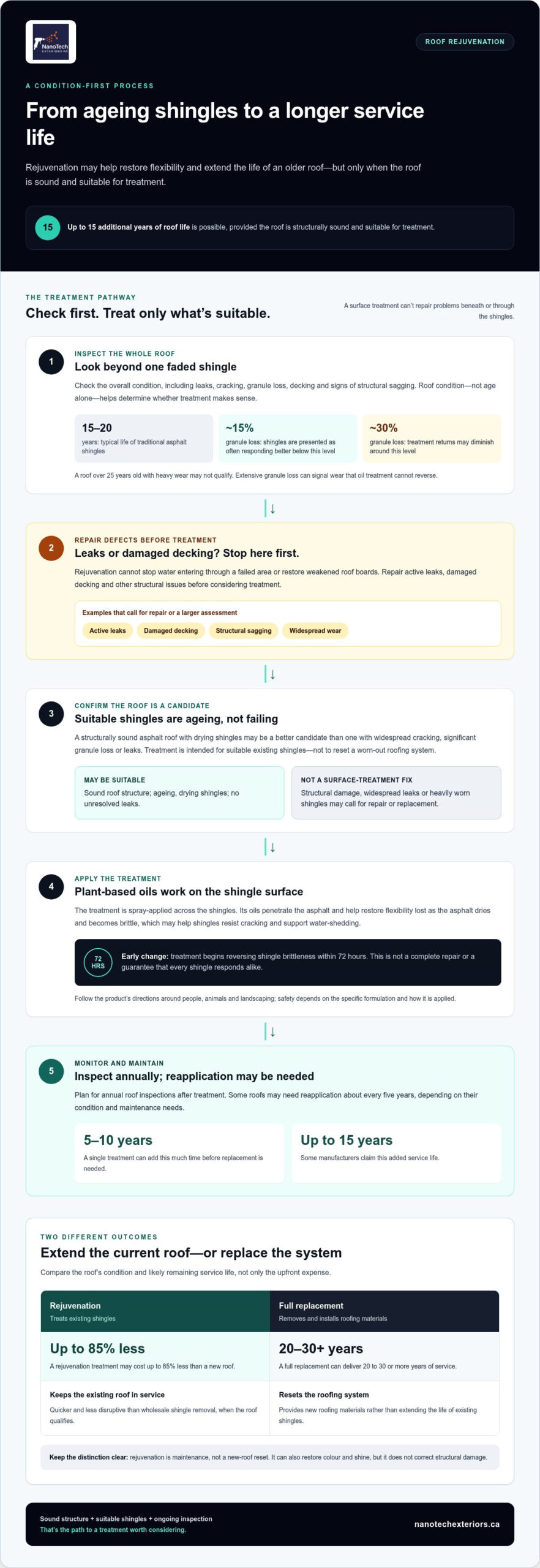
A rejuvenation treatment may cost up to 85% less than a new roof, while a full replacement provides new roofing materials and can deliver 20 to 30 or more years of service. Those are different outcomes: treatment extends the life of the current roof; replacement resets the roofing system. Compare the roof’s condition and likely remaining service life, not only the upfront expense.
When Repairs or Replacement Come First
Repair or replacement should come before rejuvenation when active leaks or damaged decking compromise the roof. A treatment can’t stop water entering through a failed area or restore weakened roof boards beneath the shingles.
For example, a leak around a roof penetration needs repair before the surrounding shingles are treated. Widespread leaks, structural sagging, or damaged decking point to a larger problem than surface-level drying. Addressing these defects first helps ensure rejuvenation doesn’t mask an issue that still needs work.
Signs Maintenance Is No Longer Enough
Maintenance may no longer be enough when an asphalt roof has widespread wear, severe granule loss, or structural sagging. Rejuvenation is designed for suitable existing shingles, not a roof that has lost its underlying integrity.
Cracking, fading, and granule loss can appear as shingles age; traditional asphalt shingles typically last 15 to 20 years. Around 15% granule loss is presented as a level below which shingles often respond better to rejuvenation, while returns may diminish around 30% loss. A roof over 25 years old with heavy wear may not qualify. Look at the overall pattern, not one faded shingle.
Benefits Compared With Full Replacement
For a roof that qualifies, rejuvenation can extend service life without removing the existing shingles. This can help homeowners defer replacement while keeping a sound roof in service.
A single treatment can add 5 to 10 years before replacement is needed, and some manufacturers claim up to 15 years. The process is also quicker and less disruptive than a full replacement, which involves removing and installing roofing materials. Rejuvenation can improve appearance by restoring colour and shine, but it is maintenance, not a new-roof reset. If the roof has active leaks or structural damage, repair or replacement remains the more appropriate path.
How plant-based oil treatments restore asphalt-shingle flexibility
Plant-based oil treatments work on aging asphalt shingles by helping restore flexibility lost as the asphalt dries and becomes brittle. That can help shingles resist cracking and support their water-shedding function. The benefits of roof rejuvenation for older homes depend on the shingles still being in suitable condition.
Treatment safety depends on the specific formulation and how it’s applied, not simply on whether it contains plant-based ingredients. Follow the product directions around people, animals, and landscaping.
The treatment is spray-applied across the shingle surface, where its oils can penetrate the asphalt. As flexibility improves, shingles may better tolerate movement from changing temperatures instead of becoming as brittle. Treatment may help address minor surface issues and support the roof’s water-shedding function, but it is not a substitute for assessing and addressing more serious roof problems.
Timing matters. Rejuvenation treatment begins reversing shingle brittleness within 72 hours of application. That describes an early change, not a complete roof repair or a guarantee that every shingle responds alike. The roof’s existing condition, including cracking and granule loss, affects whether the treatment is suitable. Granules protect the asphalt surface, so extensive loss can indicate wear that an oil treatment cannot reverse.
Drafts don’t automatically point to worn shingles. Air leaks in the attic and ventilation problems can create drafts even when the roof covering remains intact. Balanced attic ventilation draws intake air through soffits or eaves and releases exhaust through a ridge or roof vents. If a room feels cold, this distinction can help separate an attic air-leak issue from shingle wear.
Extending shingle life can also reduce roofing waste by delaying removal of an existing roof. The U.S. Environmental Protection Agency estimates that roughly 11 million tons of asphalt shingle waste reaches U.S. landfills each year. That figure describes U.S. disposal, but the material-saving principle applies in Canada too: a roof kept in service avoids discarding its existing shingles during replacement.
There’s less disruption than with full replacement because treatment works on the existing roof rather than requiring wholesale shingle removal. A structurally sound asphalt roof with drying shingles may be a better treatment candidate than one with widespread cracking, significant granule loss, or leaks. The key distinction is between restoring worn material and replacing a failed roofing system.
To find out whether this approach fits an aging asphalt roof, review the details of a roof rejuvenation treatment.
Treatment reapplication schedules and long-term cost
Rejuvenation treatments are designed to restore aging shingles and extend a roof’s service life, not provide a permanent coating. For homeowners, a practical plan pairs regular inspections with treatment timing based on the roof’s condition.
Treatment Duration and Reapplication
Many treatments are designed to last 3-5 years per application, while retreatment schedules can be around every 5 years. An annual inspection helps homeowners track cracking, granule loss, and changes around roof edges before deciding whether another application fits. Roof rejuvenation can be repeated up to three times, depending on the product and the roof’s condition. Those intervals are planning guides, not a reason to treat a roof that needs structural work.
Suitability comes first. Structurally sound asphalt shingles roughly 6 to 20 years old can be candidates, while widespread leaks, sagging, or severe granule loss point to repairs or replacement planning. The application process described for rejuvenation includes cleaning the roof, repairing minor damage, and applying the solution across the surface. Most residential applications take two to four hours, making the work less disruptive than removing and replacing the roof.
A treatment can extend a roof’s lifespan by up to 15 years, but that figure describes potential added life, not the interval between applications. Homeowners should distinguish the treatment’s intended lifespan benefit from the coating’s reapplication schedule. For example, an annual inspection can identify surface wear before the next planned treatment becomes due.
Long-Term Treatment Costs
Long-term cost means considering the initial application, roof preparation, inspections, and any future treatment together. The cost depends on location, roof complexity, and condition. NanoTech Exteriors provides a tailored quote after a free roof assessment. This helps homeowners compare ongoing maintenance with the cost and timing of future replacement without relying on a generic estimate.
Preparation affects the decision. A roof with algae or moss needs cleaning before treatment, while minor damage needs attention as part of the work. A sound asphalt roof with limited surface wear presents a different maintenance case from one with widespread granule loss or leaks. These differences affect the work required and the timing of future inspections.
Reapplication also changes the long-term calculation. Treatments can be repeated up to three times, but each later application still depends on the roof remaining suitable. If annual inspections show the shingles have deteriorated beyond surface wear, putting money into another coating no longer addresses the main issue. Compare the roof’s condition and maintenance needs at each inspection, rather than treating a five-year interval as automatic.
Extending the service life of aging roofs
Roof rejuvenation extends the service life of existing asphalt shingles, rather than resetting a roof’s lifespan like replacement. Traditional asphalt shingles typically last 15-20 years, but age alone doesn’t determine their remaining service life. Structural condition, flexibility, and granule loss all affect whether extending use makes sense.
In Ontario’s climate, one treatment adds 5-8 years of reliable life to a mid-aged asphalt roof in good structural condition. That additional time can help homeowners plan for replacement instead of facing it immediately. It isn’t a new-roof reset: shingles past roughly 15 years should be viewed as gaining a few years, not starting over.
Condition changes the expected result. Around 30% granule loss is a point where rejuvenation returns usually diminish, because treatment can’t replace protective granules that have worn away. Cracks, widespread granule loss, active leaks, or sagging indicate that the roof needs attention beyond extending shingle life. A sound roof with drying shingles presents a different case.
Reported lifespan gains vary by roof and treatment. A single application can extend a roof’s life by 5-7 years, while treatments are described as increasing roof longevity by 25-50%. Some manufacturers claim up to 15 years from one application. Treat these as distinct claims, not a guaranteed outcome or a promise that every aging roof gains the same time.
For a homeowner planning ahead, the practical value is time to prepare for a future roofing project. If a sound roof gains additional service life, replacement can be scheduled around household plans rather than prompted by ordinary shingle ageing. Inspections help track whether the roof remains intact or develops wear that changes the decision.
Extending an existing roof’s service life also avoids removing its shingles during an immediate replacement. Keeping serviceable roofing in place delays disposal of those materials. This benefit depends on the roof being suitable for continued use, since retaining a failed roof won’t resolve leaks or structural issues.
Roof rejuvenation has a specific role: it helps maintain an existing roof when asphalt shingles are aging but the structure remains sound. It doesn’t substitute for repair when a leak is active or replacement when severe wear has compromised the roof. A roof with aging but intact shingles is a stronger candidate than one with extensive surface failure.
For Canadian homeowners, the useful lifespan estimate is tied to roof condition and climate, not age alone. Ontario’s 5-8-year range applies to a mid-aged asphalt roof in good structural condition. Track cracking, granule loss, and leaks over time; those signs show whether continued service remains practical or replacement should move forward.
Potential reduction in roof-related insurance claims
An aging roof can affect insurance decisions before a storm ever arrives. Depending on the insurer, coverage may be reduced when a roof is roughly 10 to 15 years old. In Ontario, insurers may inspect roofs over 15 years old more aggressively. Some insurers set new-policy age cutoffs at 10 or 15 years, while others use a five-year cutoff.
Roof rejuvenation may restore flexibility to aging asphalt shingles, but it doesn’t change the roof’s age or automatically change an insurance policy. Insurers assess the roof’s condition and apply the policy’s terms. A treatment record documents work completed, but it doesn’t prove that a roof meets every insurer’s requirements. Keep inspection findings and treatment details with your home records.
Storm damage is a separate question from routine wear. A claim assessment considers the reported event, the resulting damage, and the policy’s coverage terms. Showing that shingles were treated doesn’t establish that later wind damage is covered. Rejuvenation also can’t prevent every weather-related failure or replace repairs for existing leaks. Document visible damage and the roof’s prior condition to help distinguish storm impact from wear.
Figures sometimes associated with rejuvenation include a potential 20-30% reduction in roof-related insurance claims and premium discounts of 5-15%. These are not automatic savings or a standard Canadian insurance benefit. Premiums and claim decisions follow each insurer’s policy terms, property details, and assessment of the roof. A discount estimate should not be treated as a rebate owed to every homeowner.
Roof age can matter even when shingles look sound. Some insurers may refuse new coverage when a roof exceeds their age cutoff, and a homeowner whose claim for an older, weathered roof is denied could receive a letter requiring replacement within 90 days or risk losing the policy. That example makes the practical point: treatment doesn’t guarantee continued coverage or override a replacement requirement.
For a clear insurance conversation, organize the facts: roof age, inspection observations, treatment date, and any storm-related damage. If shingles show cracking or granule loss, include those details rather than relying only on a treatment record. Significant roof work can depend on how the insurer classifies the damage and applies the policy, so keep the distinction between maintenance and covered storm damage clear.
Before choosing treatment, compare the roof’s condition with the insurer’s stated requirements. A rejuvenated roof may have more flexible shingles, while coverage still depends on policy terms and the insurer’s assessment. A documented roof inspection can support the decision; keep the findings with your insurance records.
NanoTech Exteriors: Roof Rejuvenation
NanoTech Exteriors offers a spray-applied Roof Rejuvenation treatment for aging shingles that remain suitable for treatment. It’s designed to restore shingle flexibility and extend a roof’s lifespan by up to 15 years. The treatment can be a cost-effective alternative to replacement, potentially costing up to 85% less than a new roof.
If your roof has active leaks or damaged areas, Roof Repair may be the right next step before rejuvenation. If it needs replacement, NanoTech Exteriors provides Residential Roofing. Matching the work to the roof’s condition helps you focus on the right solution rather than treating rejuvenation as the answer for every older roof.
Contact NanoTech Exteriors to discuss your roof and the next step that suits its condition.
Make a Confident Plan for Your Roof
Your next roofing decision can fit into a broader home maintenance plan. Consider upcoming renovations, how long you expect to stay in the home, and when roof work would cause the least disruption. This perspective helps turn an urgent-feeling choice into a practical plan with clear priorities.
The benefits of roof rejuvenation for older homes matter most when extending the roof’s use fits your priorities. If you’re weighing rejuvenation against repair or replacement, focus on what you need the roof to do next, not only its age or appearance. A clear plan makes it easier to choose work that supports your home and budget over time.
For guidance on the next step for your roof, contact NanoTech Exteriors today. A thoughtful decision now can help you move forward with greater confidence.
Frequently Asked Questions
How long does the treatment last?
A treatment’s service interval and the extra roof life it may support are different measures. Rejuvenation treatments are commonly designed to last 3-5 years per application, while added roof life can be longer. NanoTech Exteriors describes its treatment as extending roof life by up to 15 years. Its Shingle Saver warranty is up to 15 years, and its Revive warranty is up to 10 years. A warranty period isn’t the same as a reapplication schedule.
What affects the price?
The price depends on roof location, complexity, and condition. Pitch, gables, accessibility, and the amount of cleaning or refurbishing needed affect the work involved. NanoTech Exteriors requires a free roof assessment to provide an accurate quote. Its treatment can cost up to 85% less than full replacement, but that potential saving isn’t a fixed price or a guaranteed outcome for every roof. Compare quotes based on the work each roof needs.
What is roof rejuvenation and how does it work on older asphalt shingle roofs?
Roof rejuvenation is a spray-applied treatment intended to restore flexibility to aging asphalt shingles. It penetrates the shingle surface, helping address brittleness without removing the existing roof. NanoTech Exteriors includes professional cleaning and refurbishing before applying the treatment. It doesn’t replace missing shingles or repair structural damage. The treatment does not void shingle manufacturer warranties from IKO, Owens Corning, BP, or GAF.
How much does roof rejuvenation cost in Canada compared with roof replacement?
There isn’t one Canada-wide price that applies to every roof. NanoTech Exteriors states that its treatment can cost up to 85% less than full replacement, with the actual quote based on location, roof complexity, and condition. A free roof assessment is required for an accurate quote. For a fair comparison, consider whether the replacement estimate includes tear-off and new materials, and whether treatment requires roof preparation or minor repairs.
Which roof ages, shingle types, and conditions are suitable for rejuvenation?
Suitability depends on the treatment and roof condition. NanoTech Exteriors identifies Shingle Saver for asphalt shingle roofs up to 12 years old, and Revive for roofs 8 to 25 years old. Its assessment considers the roof’s condition, not age alone. Shingles must be suitable for treatment, and significant damage can change the appropriate next step. These product-specific age ranges shouldn’t be treated as universal rules for every rejuvenation treatment.
When is roof rejuvenation ineffective or unsafe, such as with leaks, rot, or damaged shingles?
Rejuvenation isn’t a fix for active leaks, damaged decking, structural sagging, or widespread shingle failure. Those problems need repair or replacement planning before a surface treatment can be considered. Water staining inside a home, for example, may point to a leak that needs investigation rather than treatment. Rot or soft roof decking also indicates an underlying issue; treating the shingles won’t restore damaged structural material.
How does roof rejuvenation compare with roof repair, restoration, and full replacement?
Rejuvenation treats suitable existing shingles, repair addresses specific damage, and full replacement installs a new roofing system. Restoration can describe work that improves an existing roof, but the exact work varies by project. NanoTech Exteriors offers Roof Repair for leaks and damage, as well as Roof Rejuvenation and Residential Roofing. Its rejuvenation treatment does not void IKO, Owens Corning, BP, or GAF shingle manufacturer warranties.
What are the steps involved in a professional roof rejuvenation treatment?
A professional treatment involves assessing the roof, preparing its surface, addressing minor damage, and applying the rejuvenating solution. NanoTech Exteriors includes professional cleaning and refurbishing before application. The assessment helps identify issues that need repair instead of treatment. NanoTech Exteriors serves homeowners in Burlington, Hamilton, Oakville, Niagara, Kitchener, Guelph, and Cambridge. The roof’s condition determines whether rejuvenation is the right scope of work.