Could roof rejuvenation help with insurance renewal, or might your insurer still require a replacement? It’s a reasonable question when an older roof looks worn and a major project may not be necessary. Roof rejuvenation for insurance renewal can be part of the conversation, but treatment alone doesn’t guarantee that an insurer will accept the roof or change your coverage. Renewal decisions depend on the roof’s condition and your insurer’s requirements.
Before choosing a roofing option, identify what the roof needs: treatment for suitable aging shingles, repairs for specific damage, or replacement if the roof can’t be suitably restored. Then compare that work with the requirements in your renewal communications. This guide explains how age and visible condition may factor into a renewal, what roof rejuvenation can and cannot address, and how to organize useful records. NanoTech Exteriors provides roof rejuvenation, repair, refurbishment and replacement for homeowners in Burlington, Hamilton, Oakville, Niagara, Kitchener, Guelph and Cambridge.
Key Takeaways
- Roof age can prompt questions at renewal, but it doesn’t determine the outcome on its own. Your insurer’s criteria and the roof’s condition matter.
- Roof rejuvenation for insurance renewal may be an option for suitable aging shingles, but it doesn’t guarantee insurer approval or replace needed repairs.
- Compare rejuvenation, repair and replacement by their purpose and the condition each can address before choosing a path.
- Review renewal communications, document visible roof concerns from a safe vantage point, and gather maintenance records before discussing requirements with your insurer.
- NanoTech Exteriors serves homeowners in Burlington, Hamilton, Oakville, Niagara, Kitchener, Guelph and Cambridge with roof rejuvenation and other roofing services.
Roof rejuvenation for insurance renewal: what homeowners should know
An aging roof can raise questions as your home insurance renewal approaches, but age alone doesn’t determine the outcome. Your insurer may consider the roof’s visible condition, reported damage and maintenance history, alongside its own policy requirements. Requirements and review processes vary, so there isn’t one roof-age threshold that applies to every homeowner in Burlington, Hamilton, Oakville, Niagara, Kitchener, Guelph or Cambridge.
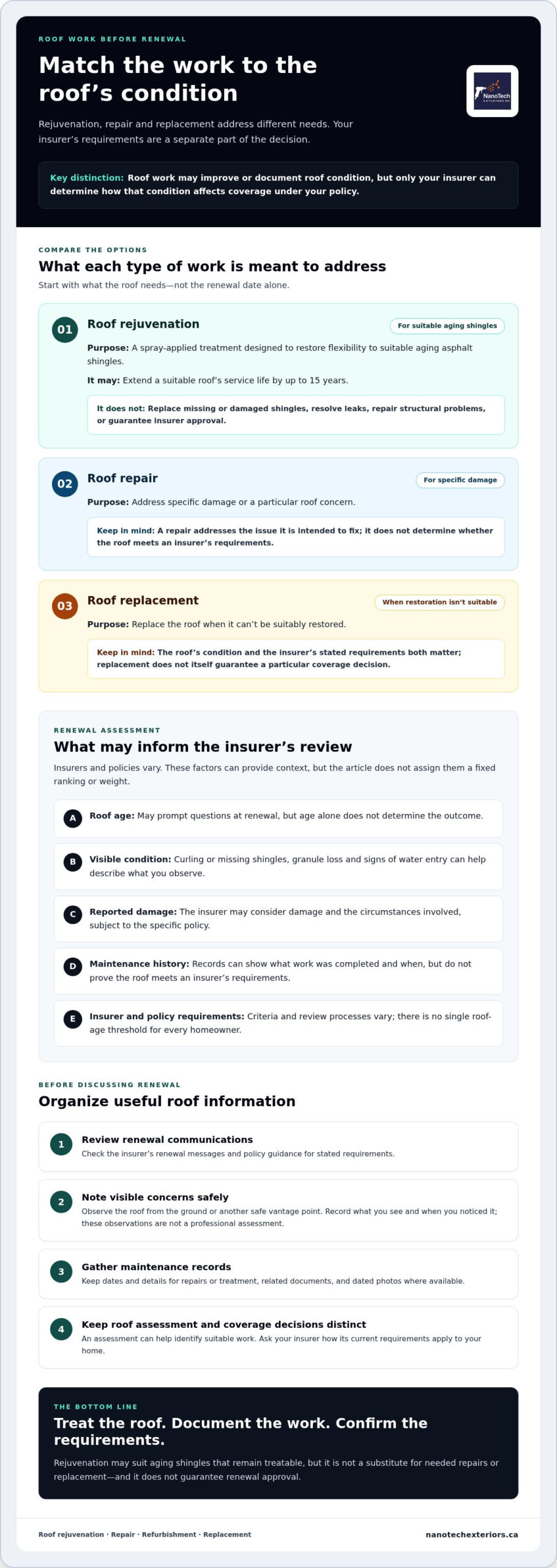
Roof rejuvenation is a spray-applied treatment designed to restore flexibility to suitable aging asphalt shingles. The treatment addresses the shingles, not the insurance policy. It may extend a suitable roof’s service life by up to 15 years, but that doesn’t mean an insurer will consider the roof acceptable for renewal. A roof assessment and an insurer’s coverage decision serve different purposes.
Why roof condition can come up at renewal
During a renewal review, an insurer may ask about roof age or condition, or consider visible wear and reported damage. This routine underwriting review is different from assessing a claim after a sudden event. If wind or another event causes damage, the insurer considers the circumstances and the policy terms. Gradual wear and damage after a sudden event aren’t the same, and coverage depends on the specific policy.
What roof rejuvenation can and cannot do
Rejuvenation is intended for aging shingles that remain suitable for treatment. It aims to restore flexibility, not replace missing or damaged shingles, resolve leaks or repair structural problems. Asphalt shingles are a common roofing material; the Asphalt shingle reference offers background on their construction. An assessment of the roof can help determine whether the shingles are suitable for treatment or whether repairs or replacement are needed instead.
Think of roof rejuvenation as one possible maintenance option, not a remedy for every roof concern. If shingles are severely damaged or the roof has underlying issues, treatment won’t make those problems disappear. The right next step depends on what the roof needs, not just its age or the timing of renewal.
Roof rejuvenation addresses the condition of suitable shingles; only your insurer can determine how the roof affects coverage under your policy. For roof rejuvenation for insurance renewal, keep those decisions separate: assess the roof on its merits, then review your insurer’s specific requirements before relying on any treatment to address a renewal concern.
How roof rejuvenation relates to an insurer’s renewal assessment
Roof rejuvenation can be part of your roof-maintenance history, but it doesn’t set the terms of your home insurance. An insurer may consider roof age, visible condition and documented damage when reviewing a renewal. The weight given to each factor, and the way a roof is assessed, can vary by insurer and policy.
This distinction matters if you’re considering roof rejuvenation for insurance renewal. Treatment may help restore flexibility to suitable aging shingles, but it isn’t a way to bypass a roof requirement. It doesn’t oblige an insurer to renew coverage, change policy terms or accept a roof that doesn’t meet its criteria.
Roof age, visible wear, and maintenance records
Visible signs such as curling or missing shingles, granule loss and signs of water entry can help describe a roof’s condition. Note what you can see from the ground or another safe vantage point, along with when you observed it. These observations provide context, not a professional assessment. Their significance depends on the roof as a whole and the insurer’s criteria.
Maintenance records add another piece of context. Keep dates and details for roof work, including repairs or treatment, and retain related documentation. Records show what work was done and when; they don’t prove that the roof meets a particular insurer’s requirements.
What rejuvenation documentation can tell you
If shingles receive treatment, keep the service documentation with your home records. Note the treatment date and scope, and retain documents that describe the work performed. Clear records can help you explain the roof’s maintenance history during a renewal discussion, especially alongside dated photos and records of earlier repairs.
Documentation can show that work was completed; it can’t establish that an insurer considers the roof eligible for coverage. Only the insurer can explain how its current requirements apply to your home. Review your renewal communications and policy guidance, then direct questions about eligibility to your insurer.
Keep the steps distinct: document the roof’s condition, understand what treatment or repairs address, and clarify the insurer’s requirements. For an overview of roof rejuvenation options, NanoTech Exteriors can help homeowners understand whether treatment may suit their shingles.
Roof rejuvenation vs. repair or replacement before renewal
Choosing the right roof work starts with the roof’s actual condition, not the renewal date alone. Rejuvenation may suit aging asphalt shingles that remain in treatable condition. A repair addresses specific damage, while replacement may be needed when the roof can’t be suitably restored. The insurer’s stated requirements matter too: work that improves the roof’s condition may not meet a particular renewal requirement.
| Option | Purpose | When it may suit | Key limitation |
|---|---|---|---|
| Rejuvenation | A spray-applied treatment intended to restore flexibility to suitable aging shingles. | Shingles show age but remain in condition for treatment, without major damage that calls for another solution. | It doesn’t fix leaks, structural issues or significant damage, and doesn’t guarantee an insurer will accept the roof. |
| Repair | Address a specific problem, such as damaged or missing shingles. | Damage is localized and the rest of the roof remains serviceable. | A repair may not resolve widespread deterioration or satisfy an insurer’s broader requirements. |
| Replacement | Remove the existing roofing and install a new roof. | The roof is extensively deteriorated, has significant damage, or can’t be suitably restored. | It’s a larger project, and replacement alone doesn’t determine insurance terms. |
When rejuvenation may be worth considering
If shingles are aging but major damage is absent, rejuvenation may be worth assessing as a maintenance option. Suitability depends on the shingles’ condition, not simply on how close renewal is. NanoTech Exteriors’ spray-applied treatment is designed to extend roof life by up to 15 years. That’s a potential lifespan extension, not a guaranteed outcome, and it doesn’t mean the treatment will meet an insurer’s criteria.
When repair or replacement may be the better fit
Active leaks, structural concerns or significant damage call for attention beyond rejuvenation. A repair may address a localized issue; widespread deterioration may make replacement the more suitable path. Treatment shouldn’t be used in place of necessary work. For more signs to consider, read How to Tell if Your Roof Needs Replacing.
For roof rejuvenation for insurance renewal, make two checks before deciding: whether the roof’s condition suits the work, and whether that work aligns with the insurer’s stated requirements. Keeping those questions separate can help you avoid assuming that one roofing option will resolve every renewal concern.
How to prepare your roof information before insurance renewal
A little organization can make a renewal conversation clearer. Keep roof observations and maintenance records together, then use your insurer’s communications to guide your questions. This won’t predetermine the decision, but it can help you describe the roof accurately and understand what information is still needed.
Create a clear roof-condition record
Start with what you can safely observe from the ground or another secure vantage point. Take clear, dated photos of visible areas, and note concerns such as missing or curled shingles. If you notice a ceiling stain or another possible sign of water entry indoors, record where and when you saw it. Don’t climb onto a roof or use an unsafe position to get a better image.
Use this sequence to assemble your information:
- Review renewal communications. Note any questions, requested information or stated roof-related requirements.
- Record observations. Write down visible concerns, when you noticed them, and any related interior signs. Keep observations factual rather than diagnosing the cause.
- Gather documents. Bring together available repair invoices, maintenance notes, dated photos and roof-treatment documentation. For treatment, retain the date and scope of work.
- Discuss requirements. Refer to the renewal notice and policy wording when asking your insurer what applies to your home.
Keep the file easy to update, whether as a digital folder or a paper record. For more background on treatment, see Roof Rejuvenation in Burlington, Ontario: The Homeowner’s Definitive Guide.
Discuss renewal requirements without making assumptions
Ask your insurer directly whether it requires specific documentation, repairs or a roof assessment. If you’re considering roof rejuvenation for insurance renewal, ask how the insurer treats that work under your current policy rather than assuming treatment satisfies a requirement. Keep the response with your roof records, including the date and any written guidance. The answer applies to your situation, not necessarily to every insurer or policy.
Once your roof information is organized, NanoTech Exteriors can help you understand whether roof rejuvenation may suit your shingles. A clear record supports a more informed conversation, while the insurer remains the source for its coverage requirements.
Explore roof rejuvenation with NanoTech Exteriors
An insurance renewal concern can make a roof decision feel urgent. A clearer approach is to separate the questions: What condition is the roof in? What does the insurer require? Which roofing option suits the roof itself? Rejuvenation may be worth exploring if aging shingles remain suitable for treatment, but the renewal deadline alone doesn’t determine the right work, and no treatment can guarantee an insurer’s decision.
A treatment option grounded in roof condition
NanoTech Exteriors is a Burlington-based roofing company serving homeowners in Burlington, Hamilton, Oakville, Niagara, Kitchener, Guelph and Cambridge. Its roof rejuvenation is a spray-applied treatment designed to restore flexibility to aging shingles and extend roof life by up to 15 years. That’s a potential lifespan extension, not a promised result or a change to insurance coverage.
NanoTech Exteriors is an authorized service provider for GoNano nanotechnology roofing treatments. The company also provides roof repair, refurbishment and replacement. The suitable path depends on what the roof needs: shingles in appropriate condition may be candidates for rejuvenation; specific damage may call for repair; and a roof that can’t be suitably restored may need replacement. Treatment isn’t a substitute for required repairs or replacement.
For roof rejuvenation for insurance renewal, keep the roof decision and the insurance decision distinct. Consider whether the shingles are suitable and what the treatment is intended to address. Then refer to your policy or renewal communications for the insurer’s specific requirements. Maintenance work can form part of the roof’s history, but it doesn’t determine whether coverage will be renewed.
Take the next step with confidence
Before choosing an option, consider three points: the roof’s condition, the scope of work that condition calls for, and any requirements your insurer has stated. If you’re unsure whether rejuvenation fits, comparing the available roofing options with the roof’s condition can help you move forward without assuming treatment will satisfy renewal criteria.
Explore roof rejuvenation with NanoTech Exteriors to learn more about the treatment and whether it may be suitable for your shingles.
Make your next roofing decision with clarity
Roof rejuvenation for insurance renewal is one option to consider, not a shortcut to coverage approval. The right choice starts with the roof’s actual condition: suitable aging shingles may be candidates for treatment, specific damage may call for repair, and a roof that can’t be restored appropriately may need replacement. Your insurer’s requirements are a separate part of the decision, so use its guidance rather than assuming any roofing work will determine the renewal outcome.
NanoTech Exteriors is a Burlington-based provider serving homeowners in Burlington, Hamilton, Oakville, Niagara, Kitchener, Guelph and Cambridge, and an authorized service provider for GoNano roofing treatments. Its spray-applied rejuvenation treatment is designed to restore flexibility to suitable shingles and may extend roof life by up to 15 years, depending on roof suitability and condition. The company also provides repair, refurbishment and replacement services, helping homeowners consider options suited to the roof.
Start with the facts: understand the roof’s condition, clarify insurer-specific requirements, and then explore an appropriate next step. Explore roof rejuvenation with NanoTech Exteriors and move forward with a clearer view of your roofing options.
Frequently Asked Questions
Can roof rejuvenation help with insurance renewal?
Roof rejuvenation may help address the condition of suitable aging shingles, but it can’t guarantee renewal or a change in coverage. For roof rejuvenation for insurance renewal, treat the work and the insurer’s decision as separate matters. Keep treatment records as part of your roof’s maintenance history, then compare your insurer’s specific requirements with the roof’s condition. Insurer criteria vary, so don’t assume treatment automatically satisfies them.
Will my insurer accept roof rejuvenation instead of replacement?
Only your insurer can say whether rejuvenation meets its requirements for your home. A treatment record shows work performed; it doesn’t confirm that the roof qualifies for renewal or replaces a requirement for roof replacement. Review your policy and renewal communications, then ask the insurer how it assesses your roof and what documentation or work it requires. The answer depends on the insurer’s criteria and the roof’s actual condition.
Does roof rejuvenation extend the life of asphalt shingles?
It may extend roof life when the asphalt shingles are suitable for treatment. NanoTech Exteriors’ spray-applied rejuvenation treatment is designed to restore flexibility to aging shingles and extend roof life by up to 15 years. That figure is a potential maximum, not a guaranteed result for every roof. Suitability and condition matter, and rejuvenation doesn’t reverse every kind of wear or damage.
What should I do if my insurer asks about my roof before renewal?
Start by reviewing the renewal notice and relevant policy wording so you understand what information the insurer is requesting. Record visible concerns, such as missing shingles or signs of water entry, and take dated photos from a safe vantage point. Gather available repair invoices, maintenance notes and treatment records. Ask the insurer whether it requires particular documents, repairs or an assessment, and keep its response with your roof records.
Can roof rejuvenation fix leaks or structural roof damage?
No. Roof rejuvenation is intended to restore flexibility to suitable aging shingles, not repair leaks or structural damage. If you notice water entry, damaged roofing or structural concerns, the roof may need repair or another appropriate solution before treatment is considered. NanoTech Exteriors provides roof repair, refurbishment and replacement, with the suitable option depending on the roof’s condition. Don’t treat rejuvenation as a substitute for work the roof needs.
Should I rejuvenate my roof before contacting my insurer?
Not solely because renewal is approaching. First, review the insurer’s communications and clarify any roof-related requirements; then consider whether your shingles are suitable for treatment. This helps you avoid assuming rejuvenation will satisfy a policy condition or change a coverage decision. NanoTech Exteriors serves homeowners in Burlington, Hamilton, Oakville, Niagara, Kitchener, Guelph and Cambridge. Its roofing options can be considered in light of the roof’s condition and your insurer’s stated requirements.