Is your driveway a ticking time bomb for structural failure? Your concrete is essentially a hard sponge, and in Southern Ontario, that porosity is a major liability. Every winter, moisture and road salt settle deep within the surface, expanding as they freeze and creating the visible spalling or pitting you see every spring. Choosing the right concrete sealing Burlington Ontario technology is the only way to stop this cycle of decay before it leads to expensive structural cracks. We understand the frustration of watching ugly oil stains and salt damage ruin your property’s curb appeal.
We agree that you shouldn’t have to worry about your exterior surfaces every time the temperature drops. This guide will teach you how to identify early warning signs of damage and choose the right sealing technology to survive our local climate. We’ll provide a clear checklist to help you protect your investment and maintain the original colour of your surfaces. You’ll learn how modern, penetrating solutions can fortify your concrete from the inside out, providing the peace of mind that comes with a job done right.
Key Takeaways
- Understand why the freeze-thaw cycle is the primary enemy of local masonry and how concrete’s sponge-like nature accelerates winter damage.
- Master the “Water Bead Test” to quickly identify if your current concrete sealing Burlington Ontario has failed or if your surfaces are vulnerable to salt.
- Compare the high-gloss aesthetics of acrylic coatings against the long-term structural benefits of chemically bonded penetrating sealers.
- Learn why professional-grade deep cleaning is the only way to ensure proper adhesion and effective stain removal before sealing.
- Adopt a preservation-focused strategy to protect your property’s curb appeal while avoiding the massive expense of total concrete replacement.
Why Concrete Fails in Burlington: The Science of the Freeze-Thaw Cycle
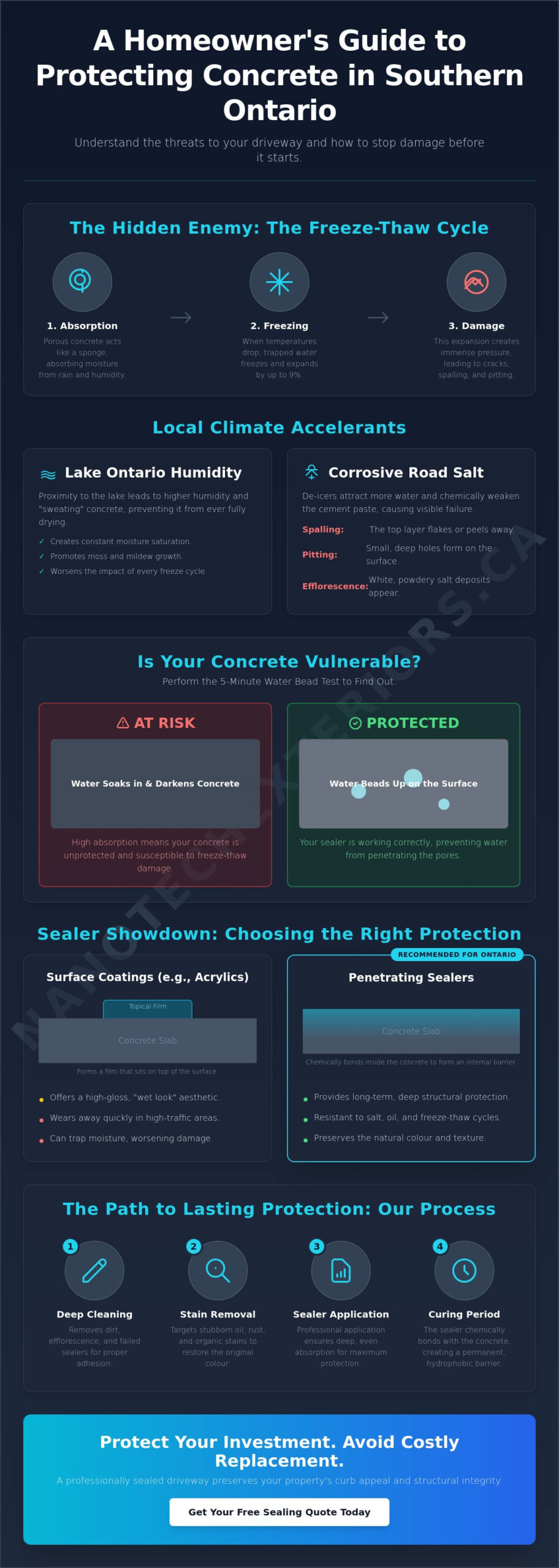
Concrete looks impenetrable, but under a microscope, it’s actually a hard, porous sponge. For homeowners considering concrete sealing Burlington Ontario, understanding this porosity is critical. During our humid autumns and wet winters, moisture enters these tiny pores through capillary action. When the temperature drops, that trapped water undergoes a physical transformation, expanding by roughly 9% in volume. This expansion creates immense internal pressure that the rigid structure of concrete cannot withstand. Over time, this pressure causes the surface to crack, flake, and eventually crumble. It’s a cumulative process where every winter cycle builds on the damage of the last, slowly compromising the structural integrity of your property.
The Impact of Lake Ontario Humidity
Living near the shoreline changes the math for your driveway’s lifespan. Proximity to Lake Ontario results in higher ambient humidity, which often leads to “sweating” concrete. This happens when warm, moist air hits a cool concrete slab, causing condensation to settle deep into the pores. Because the lake keeps our local climate damp, residential surfaces in Burlington rarely have the chance to dry out completely. This constant moisture retention doesn’t just invite freeze-thaw damage. It also creates a breeding ground for moss and mildew in shaded patio areas, which can further degrade the surface and ruin its original colour over time.
Salt Damage: Beyond Just Aesthetics
Road salt and de-icers like calcium chloride are necessary for safety, but they are devastating for masonry. Salt is hygroscopic, meaning it attracts and holds even more water inside the concrete than fresh water alone. It also lowers the freezing point of water. While this sounds helpful for clearing ice, it actually increases the frequency of freeze-thaw cycles. Instead of freezing once and staying frozen, the water inside your driveway might freeze and melt dozens of times in a single week. This process is both physical and chemical. De-icers react with the cement paste, which is the alkaline glue that holds the aggregate together. This reaction weakens the bond, leading to several types of visible failure:
- Spalling: The top layer of concrete flakes or peels off in thin pieces.
- Pitting: Small, deep holes form as the cement paste dissolves.
- Efflorescence: White, powdery salt deposits rise to the surface, signaling deep moisture issues.
Even if your contractor used “salt-resistant” concrete during the initial pour, it still requires a protective barrier to remain intact. Exploring different concrete sealer types is the most effective way to block these chemicals from reaching the core of your slab. Professional concrete sealing Burlington Ontario ensures that road salt stays on the surface where it belongs, rather than eating your driveway from the inside out. It’s a simple, logical step to avoid the massive expense of a total tear-out and replacement.
The Homeowner’s Diagnostic Checklist: Does Your Concrete Need Sealing?
Most homeowners don’t realize their driveway is failing until a structural crack appears. By then, the cost of repair has already doubled. Identifying the need for concrete sealing Burlington Ontario before the first frost is the most efficient way to preserve your investment. You can perform a professional-grade diagnostic in under five minutes with nothing more than a garden hose and a keen eye. Don’t wait for visible crumbling to take action.
Performing the Water Bead Test
This is the gold standard for checking surface integrity. Pour a small amount of water onto various sections of your driveway. If the water beads up and sits on the surface, your current sealer is still performing its job. However, if the concrete darkens immediately, it means the water is being sucked into the pores. You should prioritize testing high-traffic areas where tire friction wears down coatings faster, as well as the centre of the slab where water often pools. Leading research on penetrating sealers confirms that high absorption rates are the strongest indicator of future freeze-thaw failure. If your concrete “drinks” the water, it’s vulnerable to the next deep freeze.
Visual cues provide the rest of the story. Look for spalling, which appears as thin, flaky layers peeling off the top surface. This isn’t just a cosmetic issue; it’s the loss of the “cream” layer that protects the aggregate below. You might also notice efflorescence, a white, powdery substance that looks like salt. This is actually a sign that moisture is moving through the concrete and bringing internal minerals to the surface. If you see this, your concrete is actively “breathing” liquid water, which is a red flag for imminent structural damage. UV rays also play a role by evaporating the resins in older sealers, leading to a dull, faded appearance that leaves the masonry brittle.
Visual Red Flags to Organize by Priority
Not all damage requires the same level of urgency. Use this priority list to evaluate your property and determine your next steps:
- Primary Concern: Exposed aggregate. If you can see the small stones or pebbles inside the concrete, the protective top layer is gone. Moisture can now travel deep into the slab, leading to rapid deterioration.
- Secondary Concern: Persistent staining. Oil, rust, and leaf tannins that won’t wash away indicate the pores are open and vulnerable. These contaminants can cause permanent discolouration if not addressed.
- Tertiary Concern: UV fading and hairline fissures. If your stamped or coloured concrete looks dull or grey, the protective resin has likely evaporated. Small fissures, while not yet structural, are the entry points for winter ice.
Catching these signs early allows for restoration rather than replacement. If your inspection reveals any of these red flags, it’s time to consider a professional concrete sealing solution to fortify your exterior surfaces. Waiting another season only gives the Ontario winter more time to turn a small fix into a major renovation project. Taking a proactive approach now ensures your property maintains its curb appeal and structural strength for years to come.
Surface Coatings vs. Penetrating Sealers: A Comparison for Ontario Homes
Choosing between a surface coating and a penetrating sealer is the most important decision you’ll make for your property’s exterior. Most hardware store options are acrylic-based coatings. These sit on the surface like a layer of plastic, providing a high-gloss “wet look” that many homeowners find appealing for stamped concrete. However, these topical layers are prone to peeling and require reapplication every 24 months. Because they form a film, they can also become dangerously slippery on sloped Burlington driveways when wet or icy.
In contrast, penetrating sealers like silanes or siloxanes offer a more robust solution for concrete sealing Burlington Ontario. Instead of sitting on top, they penetrate the surface and chemically bond with the concrete’s internal structure. This creates a hydrophobic barrier that keeps water out while allowing the slab to breathe. This breathability is vital because it prevents internal moisture from becoming trapped and causing pressure during the science of the freeze-thaw cycle. While acrylics might last two years, a high-quality penetrating sealer can protect your surface for 7 to 10 years without changing the traction of the concrete.
The Nanotechnology Advantage
Modern nanotechnology takes the penetrating approach even further. Traditional sealers have larger molecules that can only travel so far into the pores. Nano-sealers utilize microscopic particles that reach deeper into the capillary structure, providing a more comprehensive shield against salt and moisture. This mirrors our approach to Roof Rejuvenation in Burlington, where we focus on fortifying existing materials rather than simply covering them up. By preserving the structural integrity of the concrete from within, we save homeowners from the cycle of frequent, expensive repairs. It’s a smarter, more efficient way to manage property maintenance.
Aesthetics: High-Gloss vs. Natural Look
Your choice often comes down to the desired visual outcome. If you have stamped or coloured concrete and want to enhance the vibrancy, a high-gloss acrylic might be the right aesthetic choice. Just be prepared for the maintenance; these finishes require regular cleaning and touch-ups to prevent a patchy appearance. For standard broom-finish driveways, a “natural look” penetrating sealer is usually the superior option. It provides invisible protection that doesn’t yellow under UV rays or flake off under tire friction. This ensures your driveway looks clean and well-maintained without the high-maintenance burden of a topical film.
The Professional Sealing Process: What to Expect
The most advanced concrete sealing Burlington Ontario technology will fail if the preparation is flawed. It’s a common mistake to assume a quick rinse with a garden hose is sufficient to prepare a driveway for treatment. In reality, professional sealing requires a methodical, multi-step process to ensure the chemical bond actually takes hold. We approach every project with a specialist’s discipline, starting with a forensic level of cleaning that goes far beyond surface-level aesthetics.
Industrial-grade surface cleaners are necessary to pull embedded contaminants like automotive oils, rust from fertilizers, and rubber tire marks out of the concrete pores. Without this remediation, the sealer simply sits on top of the debris, leading to premature flaking and a patchy appearance. We realize that “bone dry” concrete is the only way to ensure a permanent bond. If moisture remains trapped in the pores during application, the sealer will turn cloudy or fail to penetrate deep enough to provide lasting protection.
Surface Preparation and Pressure Washing
Standard pressure washers can often do more harm than good if used by an untrained hand. We utilize industrial-grade surface cleaners that provide consistent, high-pressure water flow without etching the masonry. It’s vital to use pH-neutral cleaning agents during this phase. Harsh acidic or alkaline cleaners can damage the cement paste that holds your driveway together, leading to the very spalling we’re trying to prevent. Once the cleaning is complete, we follow a strict “24-hour rule” for drying. Given the humidity levels near Lake Ontario, this waiting period is non-negotiable to ensure the moisture content of the slab is low enough for the sealer to absorb deeply.
Precision Application for Longevity
The application method is just as important as the product itself. We typically use high-volume, low-pressure sprayers to achieve a uniform finish. This avoids the “tiger stripping” or blotchy patches often seen with DIY roller applications. Timing is also a factor. We avoid the heat of the midday sun, as excessive heat can cause the sealer to flash-dry on the surface before it has a chance to penetrate the capillary structure. A second coat is often the difference between a one-year result and five years of protection, as it ensures every microscopic void is fully saturated.
Curing times are straightforward but critical for success. You can generally walk on the surface after 4 to 6 hours, but we recommend keeping vehicles off the driveway for a full 24 to 48 hours depending on the ambient temperature. This allows the chemical bond to reach full structural strength before it faces the friction of heavy tires. If you’re ready to secure your property’s exterior and avoid the stress of winter damage, book your professional concrete sealing service today to ensure a professional, long-lasting result.
Fortifying Your Home: Why Burlington Trusts NanoTech Exteriors
Property maintenance is often viewed as a series of reactive repairs, but we advocate for a more disciplined approach. At NanoTech Exteriors, we position ourselves as your expert guide in total home fortification. We don’t believe in temporary fixes or aesthetic band-aids. Instead, we utilize advanced material science to protect your property’s most vulnerable surfaces. Choosing NanoTech Exteriors for your concrete sealing Burlington Ontario project means you’re investing in a system designed to outlast traditional coatings while maintaining the structural integrity of your masonry.
Our “Preservation First” mindset is rooted in simple logic: it’s far more efficient to protect an existing surface than it is to replace one. Tearing out and pouring a new concrete driveway in Southern Ontario is a massive, disruptive expense that can often be avoided with timely intervention. We help homeowners realize significant long-term savings by identifying vulnerabilities early and applying professional-grade penetrants that bond at a molecular level. This proactive strategy ensures your exterior remains resilient against the aggressive salt and ice cycles common to our region.
This commitment to protection extends beyond just your driveway. We see the home as a complete envelope that requires consistent care across all materials. There is a natural synergy between our concrete treatments and our wood sealing services. Just as concrete absorbs moisture, your deck and fence are susceptible to the same rot and UV degradation. By applying a unified standard of protection across your entire property, you create a comprehensive barrier that enhances both curb appeal and resale value.
A Holistic Approach to Exterior Maintenance
Working with a local Burlington contractor provides a distinct advantage. We understand the specific challenges of Halton Region soil and the unique lake-effect weather patterns that inland cities don’t face. This local expertise allows us to calibrate our application techniques for maximum efficacy. We are committed to using sustainable, long-lasting nanotechnology that fortifies your home’s exterior surfaces against the harshest environmental stressors without the need for frequent, wasteful reapplications. This scientific precision ensures that every square foot of your property is prepared to survive the next decade of Ontario winters.
Your Next Steps for a Protected Property
The path to a maintenance-free exterior starts with an accurate diagnosis. We recommend booking a professional assessment to determine the current state of your concrete’s porosity and structural health. Many homeowners find that bundling their sealing services provides a more efficient, complete exterior refresh that addresses the driveway, patio, and wooden structures in a single, organized project. This methodical approach eliminates the guesswork and provides the peace of mind that comes with knowing your home is fully fortified.
Ready to protect your investment? Request a quote from NanoTech Exteriors today and take the first step toward a more resilient, beautiful property.
Secure Your Property Against the Next Deep Freeze
Protecting your driveway is a matter of science, not just aesthetics. We’ve explored how the local freeze-thaw cycle acts as a silent destroyer of masonry and why simple surface coatings often fail to provide lasting security. By choosing a high-performance penetrating sealer, you block moisture at the molecular level while allowing your concrete to breathe. This disciplined approach to concrete sealing Burlington Ontario ensures your exterior surfaces remain structurally sound for years to come. It’s the most sensible way to avoid the stress of crumbling pavement and unsightly salt damage.
As an Authorized GoNano Dealer specialized in Southern Ontario climate protection, we focus on restoration rather than replacement. Our methods can offer up to 85% savings compared to the massive expense of pouring new concrete. We realize that your home is your most significant investment, and it deserves a protection strategy that is both logical and efficient. Our professional-grade products are applied with scientific precision to guarantee a long-lasting barrier.
Protect your concrete today with a NanoTech professional sealing assessment. Taking this simple step now will save you from the stress of expensive spring repairs and keep your property’s curb appeal intact for the long term. We look forward to helping you fortify your home.
Frequently Asked Questions
How often should I seal my concrete driveway in Burlington?
You should re-seal plain concrete driveways every 4 to 5 years to maintain structural integrity. Exposed aggregate requires attention every 3 years, while stamped or coloured surfaces usually need a fresh application every 2 to 3 years. These timelines are specific to the local climate, where lake-effect moisture and winter road salt accelerate the breakdown of protective barriers. Regular maintenance prevents the porous slab from absorbing water and failing during freeze-thaw cycles.
Will concrete sealing make my driveway or patio slippery when it rains?
Penetrating sealers won’t change the traction of your concrete because they bond inside the pores rather than forming a surface film. If you choose a high-gloss topical coating, the surface can become slippery when wet. We recommend using anti-skid additives with acrylic coatings to ensure safety on sloped surfaces. Our focus on penetrating technology provides invisible protection that keeps your property safe for walking and driving in all weather conditions.
Can I seal concrete that is already cracked or spalling?
You can seal damaged concrete, but you must repair structural cracks and clean away loose flakes first. While sealing won’t “fix” existing spalling, it stops the cycle of decay by preventing more water from entering the compromised area. It’s a logical step to stabilize the surface and avoid a full replacement. We prioritize a “Preservation First” approach to extend the lifespan of surfaces that are already showing signs of wear.
What is the best time of year to seal concrete in Ontario?
The ideal window for concrete sealing Burlington Ontario is between late May and early October. Temperatures should consistently stay above 10°C for the product to cure properly. We avoid application during the heat of midday or when rain is forecast within 24 hours. Scheduling your service in the autumn is a smart way to fortify your driveway before the first frost and road salt application of the season.
How long do I need to stay off my driveway after it has been sealed?
You can typically walk on the surface 4 to 6 hours after application, but vehicles require more patience. We recommend waiting 24 to 48 hours before driving or parking on the newly sealed concrete. This curing period ensures the chemical bond is strong enough to withstand the weight and friction of car tires. Factors like humidity and air temperature can influence these times, so we provide specific guidance based on current local conditions.
Is it worth sealing a new concrete driveway, or should I wait?
You should wait at least 28 days for new concrete to fully cure before applying any sealer. Sealing too early traps moisture inside the slab, which can lead to cloudiness or surface failure. Once the curing process is complete, sealing is a critical investment to prevent the very first winter from causing spalling or salt damage. It’s much more efficient to protect a pristine surface than to restore a damaged one later.
Does concrete sealing prevent oil stains and tire marks?
Quality sealers provide excellent resistance to oil, grease, and tire marks by keeping them on the surface. Instead of soaking into the concrete’s pores, these contaminants sit on the protective barrier where they can be easily washed away. While no sealer is completely “stain-proof” if chemicals are left to sit for weeks, the protection gives you a much larger window for cleaning. This is essential for maintaining a clean, professional look for your property.
Can I seal my concrete myself, or should I hire a professional in Burlington?
DIY projects are possible, but professional concrete sealing Burlington Ontario offers superior durability and preparation. Professionals use industrial-grade surface cleaners and high-solids sealers that aren’t available at standard hardware stores. We also have the equipment to ensure an even application without “tiger stripping” or blotchy patches. Hiring an expert guide ensures the job is done right the first time, providing peace of mind and a longer-lasting shield for your home’s exterior.