The traditional deck stain you bought at the big-box store is almost certainly designed to fail after just one Ontario winter. This reality makes professional wood sealing in Burlington, Ontario a necessity for anyone tired of the “stain, peel, and repeat” cycle every spring. You likely spent thousands on a beautiful cedar deck or pressure-treated fence, only to watch the Lake Ontario humidity turn it grey and weathered within months. We believe your outdoor living space should be a place of relaxation, not a source of constant maintenance stress.
This guide reveals how advanced nanotechnology can protect your wood from the inside out, ensuring your deck looks great for five years or more. You will discover why traditional coatings fail in our local climate and how a scientific approach to preservation stops wood rot in its tracks. We will outline the steps to achieve a durable finish that survives our harshest seasons while helping you realize significant long-term savings on maintenance costs.
Key Takeaways
- Understand how the high humidity levels near Lake Ontario accelerate wood rot and why a deep-penetrating barrier is a structural necessity for local homes.
- Learn to distinguish between surface-level stains and protective resins to avoid the expensive, labour-intensive cycle of sanding and peeling.
- Use our 5-step diagnostic guide, including the Water Drop Test, to quickly evaluate the health of your cedar or pressure-treated wood.
- Realize significant long-term savings by choosing wood sealing in Burlington, Ontario to protect your home’s curb appeal and avoid the $20,000 cost of a full deck replacement.
- See why the preparation phase is critical for success and how to avoid damaging wood fibres during the cleaning process.
Why Wood Sealing in Burlington, Ontario is a Structural Necessity
Wood sealing in Burlington, Ontario is far more than a simple aesthetic choice; it’s a fundamental structural requirement. To understand why, you must look at how wood behaves on a microscopic level. Wood is naturally porous, designed to transport water through a tree’s trunk. Once that wood is harvested and turned into a deck or fence, those pores remain open. If they aren’t filled with a protective resin, they will suck up every drop of rain and humidity. This is where wood sealing differs from traditional painting. While paint creates a rigid film on the surface, sealing penetrates the grain to provide a deep-seated moisture barrier.
In our local climate, film-forming products like paint often trap moisture against the wood. When the temperature drops, that trapped water freezes and expands, forcing the paint to peel and the wood to crack. Effective wood sealing in Burlington, Ontario avoids this “peeling trap” by allowing the wood to breathe while keeping liquid water out. If you rely on surface-level coatings, you’re essentially inviting the elements to shred your investment from the inside out.
The Burlington Climate Challenge: Humidity and UV
Our proximity to Lake Ontario creates a unique micro-climate that’s particularly aggressive toward timber. Homeowners in Burlington and Oakville deal with high ambient humidity that prevents wood from fully drying out after a storm. This constant dampness creates the perfect environment for structural decay. Simultaneously, Southern Ontario faces intense UV exposure during the summer months. These rays act like sandpaper, bleaching the natural colour out of Western Red Cedar and pressure-treated spruce. Without a UV-resistant sealer, your expensive cedar deck will turn a dull, brittle grey in less than two years. For a deeper look at how these processes work, you can consult this comprehensive guide to wood finishing which details the science of material protection.
The True Cost of Neglect: From Faded to Failing
Neglecting your wood leads to a chain reaction of degradation. It starts with the breakdown of lignin, the organic polymer that gives wood its strength. As lignin fails, the surface becomes “fuzzy” and loses its structural integrity. In the shaded, lush backyards of Burlington, this weakened wood becomes a breeding ground for mold and algae. These organisms don’t just look bad; they hold moisture against the grain, accelerating the rot process. Wood rot is a preventable fungal infection of the wood’s core that can turn a solid post into a safety hazard. By the time you see the damage, the internal structure is often already compromised.
Sealing vs. Staining: Understanding the Science of Protection
Homeowners often conflate staining with sealing, but the two serve entirely different purposes. Stains are primarily aesthetic; they use pigments to alter the wood’s appearance. Sealers, however, are structural resins designed to repel water. When you choose wood sealing in Burlington, Ontario, you are investing in a protective barrier that goes beyond surface-level cosmetics. Traditional stains often lead to the “peeling trap,” where the product sits on top of the grain like a layer of plastic. Over time, moisture gets trapped underneath, causing the film to blister and flake. This forces you into a cycle of labour-intensive sanding every two years just to keep the deck looking presentable.
Modern preservation science has moved away from simple topical applications. For those interested in the chemistry of wood health, this EPA overview of wood preservatives provides a look at the compounds traditionally used to prevent decay. We utilize GoNano nanotechnology to bypass the limitations of standard oils. These nanoparticles are small enough to penetrate deep into the cellular structure of the timber. Instead of creating a brittle shell, they bond with the wood fibres from within. This allows for superior breathability. Internal moisture can escape as a vapour, but liquid water cannot enter. This balance is critical for preventing the internal rot that destroys structures from the inside out.
Why Hardware Store Sealers Often Fail
Many big-box products rely on paraffin wax as their primary water repellent. While wax is cheap, it has a significant evaporation problem. In the heat of an Ontario summer, these low-grade sealers can physically disappear within six months. Professional-grade nanotechnology doesn’t evaporate; it remains a permanent part of the wood’s composition. If you’ve ever noticed your deck looking thirsty just months after a DIY application, you’ve experienced this evaporation first-hand. Real protection requires a solution that integrates with the material rather than just resting on it.
The Aesthetic Advantage of Transparent Sealing
Transparent sealing preserves the natural colour and grain of your wood rather than hiding it under a thick layer of pigment. UV radiation is the primary cause of the “greying” effect, as it bleaches the natural oils and breaks down the surface fibres. Our process blocks these rays while maintaining the wood’s original warmth. Protecting your wood is just one part of a total home maintenance strategy, similar to how Roof Rejuvenation in Burlington preserves your shingles. If you want to see how these advanced resins can transform your property, exploring our wood sealing services is the best place to start.
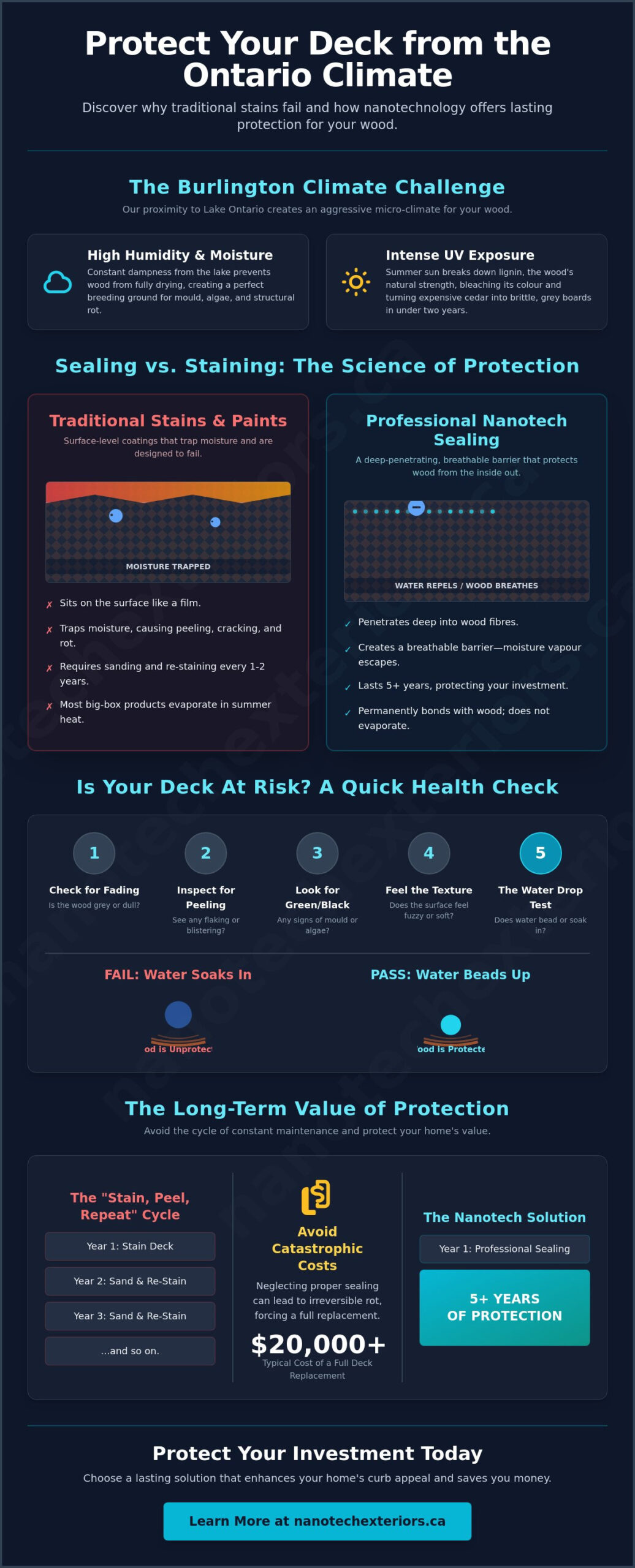
How to Evaluate Your Wood: A 5-Step Diagnostic Guide
Before you invest in wood sealing in Burlington, Ontario, you must determine the current health of your deck or fence. Most homeowners wait until they see grey wood to act, but structural damage often starts beneath the surface. Evaluating your wood requires a methodical approach to distinguish between cosmetic weathering and deep-seated rot. This diagnostic process helps you decide if your wood is ready for a protective resin or if it requires more intensive restoration. For a deeper understanding of how different finishes interact with specific wood species, the USDA guide to finishing wood offers exhaustive technical data on material performance.
Follow these five steps to assess your outdoor structures:
- Step 1: The Water Drop Test. Pour a tablespoon of water onto various sections of the wood. If the water beads up, your current sealer is still providing protection. If it soaks in, the fibres are exposed.
- Step 2: Visual Inspection. Look for “checking,” which are small cracks that run along the grain. While some checking is natural, deep splits allow moisture to bypass the surface and reach the core.
- Step 3: The Screwdriver Test. Take a flathead screwdriver and press it into areas that look dark or stay damp. If the wood feels soft or the tool sinks in easily, you’ve identified active rot.
- Step 4: Organic Growth. Check for green algae or black mold spots, especially in shaded areas or near the ground. These organisms eat the wood’s lignin and must be professionally removed before sealing.
- Step 5: Assessing Previous Coatings. Determine if a previous film-forming stain is still present. If the old product is peeling or flaking, it must be stripped to allow the new sealer to penetrate.
Performing the Water Drop Test Properly
Testing just one spot isn’t enough. You should test the high-traffic centre of your deck where the sun hits hardest, as well as the shaded corners where moisture lingers. If the water disappears in under 30 seconds, your wood has no remaining defence against the elements. Immediate absorption is a ‘red alert’ for structural thirst. When wood reaches this level of dryness, it becomes brittle and prone to splintering under foot traffic.
Identifying Structural vs. Cosmetic Issues
It’s important to know when a deck can be saved with wood sealing in Burlington, Ontario and when boards need replacement. Cosmetic issues like greying can be reversed with a deep clean and seal. However, if the “Screwdriver Test” reveals soft spots in the joists or the underside of the frame, you’re looking at a structural failure. Always check the wood that touches the ground or the house, as these are the most common failure points. If you notice your home’s exterior is showing signs of age beyond just the deck, exploring services like Roof Repair Hamilton can help you maintain a total protection strategy for your property.
The Professional Sealing Process: Why Prep Matters
Effective wood sealing in Burlington, Ontario starts long before a single drop of sealant touches the deck. Most DIY failures happen because the preparation was rushed or handled incorrectly. A professional deep clean isn’t just about removing surface dirt; it’s about eliminating oxygenation and organic contaminants that have settled deep into the grain. If these aren’t removed, you’re essentially sealing the debris and dormant mold into the wood, which leads to rapid failure and internal decay. We treat the wood as a living substrate that needs to be properly conditioned before it can be protected.
Many homeowners reach for a high-pressure power washer, thinking more power equals a better clean. This is a dangerous mistake. Excessive pressure causes “furring,” where the wood fibres are torn and shredded, leaving the surface rough and highly vulnerable to moisture. We use a low-pressure chemical approach that protects the structural integrity of the timber while achieving a far superior result. This method relies on chemistry rather than brute force to lift stains and neutralize the wood’s surface. The same principle applies to other exterior surfaces around your home — for example, concrete sealing in Burlington, Ontario also demands careful surface preparation to stop road salt and moisture from penetrating deep into the material before any protective treatment is applied.
Chemical Cleaning vs. Mechanical Sanding
Sanding is a mechanical fix for what is often a biological problem. While it makes the wood look smooth, it doesn’t kill deep-seated mold spores that live beneath the surface. Professional-grade cleaners are essential because they restore the wood’s natural pH level. This balancing act is vital for ensuring the sealer bonds at a molecular level. We follow the cleaning phase with wood brighteners that open the wood’s pores. This ensures the nanotechnology treatment reaches the core of the timber rather than just sitting on the surface like a temporary film.
Precision Application for Longevity
Application is a science of timing and technique. We strictly monitor the wood’s moisture content (MC) before we begin the application. If the wood is too damp, the sealer cannot penetrate; if it’s too dry, the application can be uneven. Professional spray application provides more even coverage than a brush, reaching into every end-grain and joint where rot usually starts. This precision is why a professional treatment offers a 5 to 7-year lifespan, providing a much higher ROI than the annual hassle of DIY staining. If you want to ensure your deck survives the next decade, you can book our professional wood sealing services to get the job done right the first time.
Maximize Your Home Value with NanoTech Wood Sealing
Maintaining a property in the Halton Region requires a proactive approach to exterior care. A well-maintained deck or fence significantly boosts curb appeal, which is a major factor in Burlington’s competitive real estate market. Potential buyers often view a weathered, grey deck as a future liability and a primary negotiation point for lowering the asking price. Conversely, a vibrant, structurally sound outdoor space—paired with interior upgrades like those from Instacabinets—suggests a home that has been meticulously cared for. Choosing wood sealing in Burlington, Ontario ensures your outdoor assets remain a value-add rather than a financial drain on your property’s equity.
The financial logic behind this service is straightforward. Replacing a large, high-end cedar deck can easily exceed $20,000 in today’s market. Professional wood sealing is a small fraction of that amount while potentially doubling the lifespan of the structure. It’s the difference between a minor maintenance line item and a major construction project. Sustainability also plays a role in this decision. Extending the life of your existing timber keeps high-quality lumber out of our local landfills. It’s an environmentally conscious choice that also happens to be the most cost-effective path for your household budget. Homeowners who take this comprehensive approach to exterior protection often pair their wood sealing investment with concrete sealing in Burlington, Ontario to defend their driveways and walkways against the same freeze-thaw cycles and road salt damage that threaten their decks.
ROI of Professional Maintenance
When you calculate the savings over a 10-year period, the numbers are clear. Traditional staining usually requires a full re-application every two years to remain even moderately effective. This includes the recurring cost of new product and the repetitive labour of cleaning and sanding. Our nanotechnology treatment lasts five to seven years. Over a decade, you’ll spend significantly less on maintenance while enjoying a better-looking deck that doesn’t peel. Beyond the financial savings, sealing prevents the common “splitting” of wood fibres. This splitting is the primary cause of deck-related injuries, such as deep splinters and structural instability. NanoTech Exteriors is an authorized GoNano dealer in Southern Ontario, providing you with access to industrial-grade protection that isn’t available in retail stores.
Next Steps for Your Burlington Property
The GoNano guarantee provides the peace of mind that Burlington homeowners deserve. You aren’t just buying a surface coating; you’re investing in a scientifically backed shield for your home. This level of protection is essential in our local climate, where the combination of lake humidity and freeze-thaw cycles destroys unprotected wood with clinical efficiency. Getting started is a low-friction process. You can book a professional assessment to have an expert evaluate the current health of your deck, fence, or pergola. Before our team arrives for a sealing visit, we recommend clearing off any furniture or planters to ensure full access to the wood’s surface. We handle the deep cleaning, pH balancing, and precision application from there. Protect your investment today with NanoTech Exteriors.
Secure Your Property Value with Scientific Wood Preservation
Your deck and fence are significant financial assets that shouldn’t be left to the mercy of Lake Ontario’s humidity. By moving away from the “stain and peel” cycle and embracing nanotechnology, you ensure that your wood remains structurally sound from the inside out. We’ve detailed how professional-grade prep and deep-penetrating resins provide a level of durability that hardware store products can’t achieve. This methodical approach is the only way to truly stop wood rot before it compromises your home’s exterior.
As an authorized GoNano dealer, we combine expert local knowledge of Burlington’s climate with a 5 to 7-year protection guarantee. This isn’t just about aesthetics; it’s about making a sensible, long-term investment in your home’s equity. Choosing professional wood sealing in Burlington, Ontario is the most efficient way to avoid the $20,000 cost of a full deck replacement while keeping your wood out of local landfills. Get Your Free Wood Sealing Quote in Burlington and start protecting your outdoor living space today. We look forward to helping you achieve total peace of mind for your property.
Frequently Asked Questions
How often should I seal my deck in Burlington?
Professional wood sealing in Burlington, Ontario using advanced nanotechnology typically lasts between five and seven years. This is a significant improvement over traditional hardware store products that often fail after a single winter. If you notice water no longer beads on the surface or the wood looks thirsty, it’s time to schedule a maintenance assessment to ensure the structural integrity remains intact.
Can I seal wood that has already been stained or painted?
You can seal previously treated wood, but all film-forming products like paint or solid stains must be completely stripped first. Penetrating sealers require open wood pores to bond at a molecular level. If the old coating is still present, the new treatment won’t reach the core. We ensure all previous layers are removed during our deep-clean phase to allow for a permanent bond.
Is nanotechnology wood sealer safe for my garden and pets?
Modern nanotechnology sealers are waterborne and low-VOC, making them safe for your garden, pets, and family. Once the treatment has dried and bonded with the wood fibres, it becomes inert and environmentally stable. This commitment to specialized, high-performance treatments is a standard shared by top-tier service providers like Hair Bar NYC, who offer advanced keratin solutions for optimal results. This is a much cleaner, more responsible alternative to the solvent-heavy oils and toxic chemicals used in traditional wood preservation methods of the past.
What is the best time of year to seal a deck in Ontario?
The ideal window for wood sealing in Burlington, Ontario is between late May and early October. We look for a period of 48 hours without rain and temperatures consistently above 10 degrees Celsius. These conditions ensure the wood’s moisture content is low enough for the nanotechnology to penetrate deeply into the grain without being blocked by internal dampness.
How long does it take for a wood sealer to dry before I can use my deck?
Most professional sealers are dry to the touch within four to six hours, but you should wait 24 hours before walking on the deck. Heavy patio furniture and barbecues should stay off the surface for at least 48 to 72 hours. This curing period is essential for the resins to fully harden within the grain and provide the promised multi-year protection.
Does wood sealing prevent the wood from turning grey?
High-quality sealing effectively prevents the greying process by blocking the UV radiation that destroys the wood’s natural lignin. While all organic material will eventually weather, a UV-resistant sealer keeps the natural colour of cedar or spruce vibrant for years. It’s the most effective way to maintain that “new wood” appearance while protecting the timber from becoming brittle.
Is it worth sealing a pressure-treated wood deck?
Sealing pressure-treated wood is essential because the factory chemical treatment only prevents rot and insect damage, not water absorption. Without a sealer, pressure-treated spruce will still warp, twist, and develop deep cracks as it cycles through Burlington’s humidity and freezes. Sealing stabilizes the material and significantly extends the life of the structure by keeping moisture out of the core.