A minor drip in your attic isn’t just a nuisance; it’s a compounding financial liability that grows every time a Southern Ontario freeze-thaw cycle hits. If you’ve noticed a small water stain or a damp patch, you might be tempted to wait until next season to address it. However, the real cost of ignoring roof leaks often transforms a simple repair into a five-figure structural disaster within months. It’s natural to feel hesitant when you’re worried about being upsold an entire roof you didn’t budget for.
We understand that most homeowners want to protect their equity without draining their savings. You deserve a solution that bridges the gap between a temporary patch and an expensive, unnecessary replacement. In this guide, we’ll reveal how water damage accelerates in our local climate and how modern restoration technology can save your shingles. You’ll discover a pragmatic way to fortify your home, stop the damage, and extend your roof’s lifespan for up to 15 years without the typical stress of a full construction project.
Key Takeaways
- Understand how a minor drip can quickly escalate into a major expense, as the cost of ignoring roof leaks often leads to structural damage that far exceeds the price of a timely repair.
- Identify how Southern Ontario’s unique freeze-thaw cycles and ice damming turn small shingle cracks into significant water intrusion points.
- Learn about the “Damage Cascade,” where unaddressed moisture ruins attic insulation R-values and triggers mould growth within just 48 hours.
- Discover how Roof Rejuvenation provides a scientifically backed middle ground, restoring shingle flexibility and protection for a fraction of the cost of a full replacement.
The Financial Compound Interest of Ignoring Roof Leaks
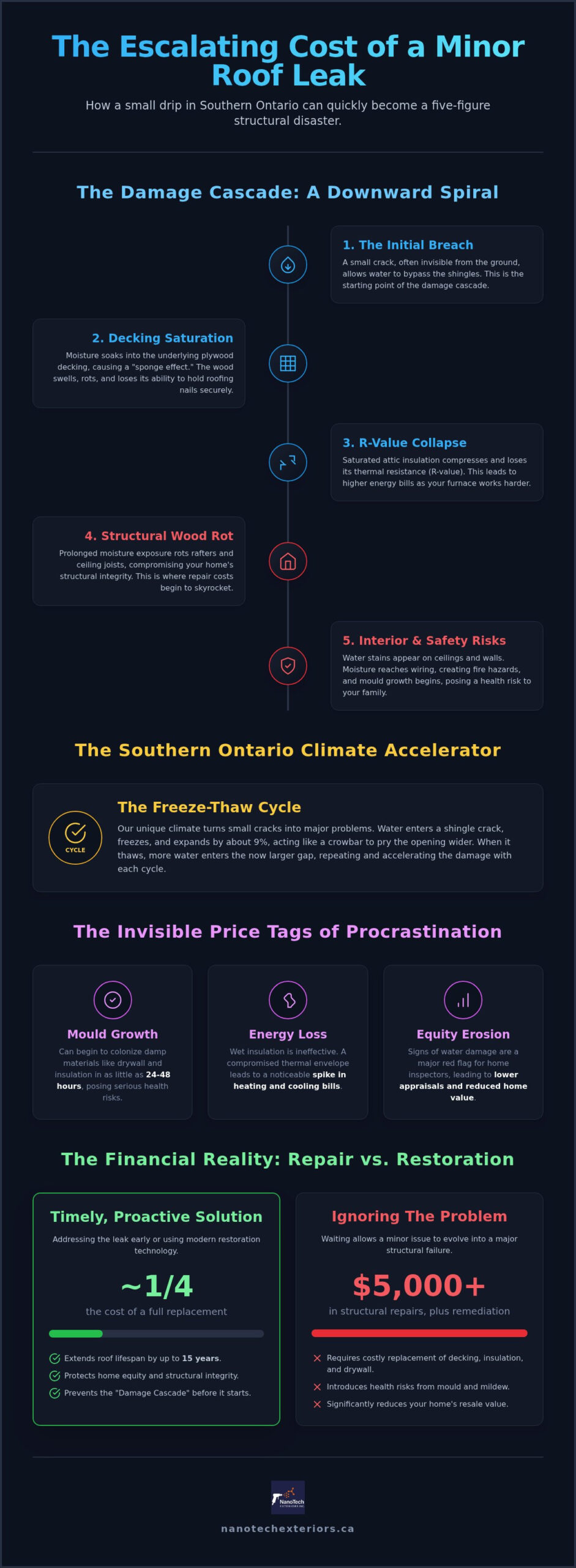
A leaking roof is never a static problem. It’s a progressive failure that gains momentum with every rainstorm or snowfall. While a minor shingle repair might cost a few hundred dollars today, that same intrusion point can easily evolve into a $5,000 structural restoration project within six months. This isn’t an exaggeration; it’s the reality of how moisture compromises building materials at an exponential rate. When water enters your home, it doesn’t just sit on the surface. It begins a “damage cascade,” following the path of least resistance along rafters and electrical conduits before pooling in areas far from the original entry point. This means that by the time you see a yellow stain on your living room ceiling, the structural wood in your attic has likely been saturated for weeks. The cost of ignoring roof leaks is the sum of structural repair, mould remediation, and lost energy efficiency.
The Psychology of Repair Procrastination
Many homeowners in Southern Ontario fall into the trap of “stain denial.” You might notice a small discolouration in the corner of a room and convince yourself it’s an old mark or a one-time event. Often, this procrastination is rooted in the fear of being told you need a full roof replacement you haven’t budgeted for. You might decide to “wait for spring” to avoid the perceived difficulty of winter repairs. In cities like Hamilton or Burlington, this is the most expensive decision you can make. Our local freeze-thaw cycles put immense pressure on existing roof vulnerabilities. If water enters a crack and freezes, it expands, prying shingles apart and widening the gap for the next melt. There’s a definitive tipping point where a simple restoration is no longer viable because the underlying plywood decking has lost its structural integrity.
Equity Erosion: The Impact on Home Appraisal
Beyond the immediate repair bills, unaddressed leaks quietly erode your home’s resale value. Home inspectors are trained to hunt for moisture signatures using thermal imaging and moisture meters. Even if a leak appears “dried up,” the evidence of past neglect remains in the form of rotted wood or degraded insulation. This creates a significant “trust gap” during real estate transactions. If a potential buyer sees evidence of water damage, they will naturally assume other critical maintenance tasks have been ignored. This often results in aggressive price negotiations or buyers walking away entirely. To protect your investment, you must understand how to tell if your roof needs replacing before the damage becomes a permanent mark on your property’s history. Addressing a leak immediately ensures your home remains a high-value asset rather than a liability.
The Damage Cascade: From Shingles to Structural Integrity
Once water bypasses your shingles, the clock starts on a series of failures that move downward through your home. The cost of ignoring roof leaks isn’t just about the shingles; it’s about the collateral damage to everything beneath them. Water follows gravity, often soaking into drywall, pooling around junction boxes, or even damaging expensive floor coverings. If your interior textiles have been affected by a leak, you can discover Carpet Repair Magic to see how professional restoration can save your flooring. By the time you notice a drip, the water has likely already travelled through several layers of your home’s protective envelope.
Insulation and the R-Value Collapse
Attic insulation is designed to trap air to keep heat inside your home during the winter. When fibreglass or cellulose becomes saturated, those air pockets collapse, and the material loses its thermal resistance permanently. This R-value collapse means your furnace must work harder to maintain temperatures, leading to a noticeable spike in monthly utility bills. Even worse, wet insulation creates cold spots on your ceiling, which encourages the formation of ice dams during the harsh Ontario winter. Often, the labour and material costs of removing and replacing sodden insulation are higher than the price of the roof repair itself. If you’ve noticed a leak, seeking a professional roof repair assessment immediately is the only way to protect your home’s thermal envelope.
Wood Rot and the ‘Sponge Effect’
Your roof decking serves as the structural foundation for your shingles. When plywood is exposed to consistent moisture, it undergoes a “sponge effect,” absorbing water and swelling until the wood fibres separate. This process destroys the wood’s ability to hold roofing nails securely, which can lead to shingles blowing off in high winds. In the humid, unventilated environment of a compromised attic, wood-decay fungi can begin to structurally weaken rafters and decking in as little as six months. Once the decking begins to sag or “bounce” underfoot, a simple shingle restoration is no longer an option, and a mandatory, high-cost replacement becomes your only path forward. Protecting these wooden components is essential for maintaining the long-term equity of your property.
Health Hazards and Energy Costs: The Invisible Price Tags
While wood rot and structural decay are significant concerns, the biological and atmospheric impact of moisture is often more immediate and harder to resolve. Mould spores require only three things to thrive: moisture, a food source like plywood or drywall, and stagnant air. These conditions are perfected in an attic following a leak. In as little as 48 hours, a colony can establish itself and begin releasing spores into your home’s ventilation system. This turns a leaky roof into a public health issue, triggering allergies, asthma, and persistent respiratory irritation for your family. The cost of ignoring roof leaks quickly shifts from a simple shingle repair to a complex medical and environmental challenge.
The Reality of Mould Remediation in Ontario
Professional mould remediation is a specialized process involving negative air pressure, HEPA filtration, and antimicrobial treatments. It’s significantly more expensive than a simple shingle fix because it requires hazardous material handling and specialized equipment. Many homeowners mistakenly believe that a quick wipe with bleach will solve the problem. However, surface cleaning only addresses the visible growth while the root system remains embedded in the porous wood of your rafters. Insurance companies in Ontario frequently deny mould claims if they determine the leak was a “long-standing” issue that the homeowner failed to address. This means you could be left with a massive out-of-pocket bill for remediation that could have been avoided with a proactive inspection.
Energy Inefficiency and Cooling Costs
Moisture doesn’t just damage materials; it fundamentally alters the climate of your home. A damp attic traps heat, creating a “sauna effect” that radiates through your upper-floor ceilings. During the summer, this force-feeds heat into your living spaces, making your air conditioner work significantly harder to maintain comfort. You’ll see this reflected in skyrocketing utility bills as your HVAC system struggles against the thermal mass of wet insulation and humid attic air. The cost of ignoring roof leaks is often paid monthly through these inflated energy charges. Restoring your home’s thermal efficiency starts with professional residential roofing in Burlington, ensuring your attic remains a dry, ventilated barrier rather than a heat-trapping liability. By addressing the leak today, you’re not just protecting your health; you’re stabilizing your household budget against unnecessary energy waste.
Why Southern Ontario’s Climate Accelerates Leak Damage
Our local weather patterns are uniquely aggressive toward residential roofing. In the Golden Horseshoe, we experience a high frequency of temperature fluctuations that force building materials to expand and contract daily. This environmental stress means the cost of ignoring roof leaks is significantly higher here than in more stable climates. A small gap in your flashing might survive a dry autumn, but it won’t withstand the relentless mechanical pressure of an Ontario winter. When you ignore a leak, you aren’t just dealing with water; you’re dealing with the physical forces of ice and humidity that work around the clock to dismantle your home’s structure.
The Expansion Power of Ice
The primary driver of winter roof failure is the physics of freezing water. Water expands by approximately 9% when it transitions from a liquid to a solid state. When snow melts on your roof and trickles into a hairline fracture in an asphalt shingle, it eventually refreezes as the sun sets. This expansion exerts enough outward pressure to physically tear shingle granules apart and widen existing gaps. In cities like Kitchener and Guelph, this cycle can happen dozens of times in a single season. Waiting until the spring thaw to address a minor issue often reveals that the cost of ignoring roof leaks has tripled because the ice has “pried” your roofing system away from the decking.
Wind and Driving Rain in the Niagara Region
Homeowners on the Niagara Peninsula face an additional challenge: high-wind events and “wind-driven rain.” Standard roofing is designed to shed water that falls vertically due to gravity. However, during a storm, wind can push rain horizontally or even upward, forcing moisture under brittle shingles and through gaps in aged caulking. If your shingles are already old and inflexible, they lack the “seal” required to resist these forces. Once the wind lifts a single shingle tab, the underlying wood is exposed to direct saturation. This is why professional inspections are critical after major storm events; the damage is often invisible from the ground but catastrophic for your attic’s dry-state integrity.
Our summers are equally punishing. The high humidity levels common in Southern Ontario accelerate the wood rot process mentioned earlier. A damp attic in July becomes a greenhouse for wood-decay fungi, which can compromise rafters much faster than in drier provinces. To prevent these seasonal stressors from turning a minor drip into a structural emergency, you must prioritize roof repair in Hamilton before the first heavy snowfall. Taking action now ensures your home remains a fortified barrier against whatever the next season brings. If you suspect your roof is vulnerable, don’t wait for the next storm to confirm it; contact NanoTech Exteriors today for a professional evaluation of your roof’s health.
Proactive Protection: Restoration as a Cost-Effective Alternative
Traditional roofing contractors often present a binary choice: either keep patching a failing system or commit to a full, five-figure replacement. This limited perspective ignores a scientifically proven middle path that addresses the root cause of shingle failure. When you consider the total cost of ignoring roof leaks, the most logical financial decision isn’t just stopping the water; it’s restoring the material’s ability to protect itself. By intervening early, you can avoid the massive structural bills discussed in previous sections while bypassing the waste and disruption of a full construction project. This approach is fundamentally about longevity and asset protection rather than temporary fixes.
How Nano-Restoration Works
Asphalt shingles are essentially a mixture of sand and petrochemical oils. Over time, the sun’s UV rays and Ontario’s temperature swings bake these oils out, leaving shingles brittle, grey, and prone to cracking. Nano-restoration technology uses a specialized, spray-applied treatment that penetrates deep into the asphalt matrix to replace these lost oils. This process restores the shingle’s original flexibility and granule adhesion, effectively stopping leaks before they begin. A single application can provide a 15-year life extension, allowing homeowners to maximize their existing investment. This technology is disrupting the traditional “rip and replace” industry by proving that a 10-year-old roof isn’t necessarily at the end of its life; it’s simply in need of replenishment.
The 85% Savings Argument
The financial case for rejuvenation is undeniable. In most cases, this treatment costs up to 85% less than a full roof replacement. This allows you to reallocate your home maintenance budget toward other high-value improvements while knowing your structure is fortified; for example, you can explore Recurring Pest Maintenance and Tree Service Fees to see how professional upkeep prevents broader property issues. For homeowners with an aging roof, choosing roof rejuvenation in Burlington is a strategic move that protects home equity without the noise, debris, and logistical headaches of a full tear-off. You receive a transferable warranty and the peace of mind that comes with a scientifically backed solution. There is also a significant environmental benefit; by extending the life of your shingles, you’re helping to keep tons of asphalt waste out of Ontario landfills.
The true cost of ignoring roof leaks is the lost opportunity to save your current roof while it’s still a candidate for restoration. Don’t let a small vulnerability turn into a structural liability that requires a total overhaul. Take the pragmatic step toward long-term protection and environmental responsibility today. Contact NanoTech Exteriors for a free roof health assessment and discover if your home is a candidate for high-tech rejuvenation. Our experts will provide a transparent evaluation, helping you find the smartest path to a dry, secure home.
Protect Your Investment with Scientific Restoration
Waiting for a leak to reveal itself in your living room is a strategy that only leads to compounding expenses. The cumulative cost of ignoring roof leaks reaches far beyond a few shingles, impacting your home’s structural wood, insulation R-value, and your family’s health. In Southern Ontario, our climate doesn’t offer second chances; it punishes delay through relentless freeze-thaw cycles that turn minor gaps into major liabilities. You have the power to bypass the disruption of a full replacement while securing your home’s equity for years to come.
NanoTech Exteriors provides a pragmatic, tech-driven alternative to the traditional “rip and replace” model. Our specialized GoNano treatment restores shingle flexibility for a 15-year life extension at a price that is up to 85% less than a full replacement. As local specialists serving Burlington, Hamilton, and Oakville, we understand how to fortify your roof against local weather patterns. Book your free roof inspection with NanoTech Exteriors today to ensure your home remains a dry, high-value asset. Taking a proactive step now is the most logical way to gain lasting peace of mind and protect your household budget.
Frequently Asked Questions
Is it worth fixing a small leak on an old roof?
Yes, addressing a minor leak is always a sound financial decision regardless of the roof’s age. A small entry point allows water to saturate attic insulation and structural wood, leading to rot that persists even after the shingles are eventually replaced. Fixing the leak immediately prevents these secondary damages and buys you time to plan for a long-term restoration or replacement strategy without compromising your home’s integrity.
How much does the average roof leak repair cost in Ontario?
Repair costs vary based on the leak’s location and the extent of the damage to the underlying structure. A simple shingle or flashing fix is typically the most affordable entry point, but the total cost of ignoring roof leaks escalates if moisture has already compromised the attic’s R-value or decking. It is best to obtain a professional assessment to determine the specific scope of work required for your home’s unique situation.
Can a roof leak cause a fire?
Yes, water intrusion poses a significant fire hazard if it comes into contact with your home’s electrical system. Moisture often travels along rafters or through ceiling joists to reach junction boxes, recessed lighting, or attic wiring. This creates a high risk of short circuits and electrical fires. If you suspect water is near any electrical components, you should treat the leak as an urgent safety priority.
Will my homeowners’ insurance cover a leak if I ignored it for months?
Most insurance policies in Ontario cover “sudden and accidental” damage but specifically exclude issues resulting from a lack of maintenance. If a claims adjuster determines that the damage was caused by a long-standing leak you failed to address, they may deny coverage for both the roof and the interior repairs. Maintaining a paper trail of proactive inspections and repairs is essential for protecting your coverage eligibility.
How quickly does mould start to grow after a roof leak?
Mould spores can begin to colonize damp building materials in as little as 24 to 48 hours. In the stagnant, warm environment of an Ontario attic, a small leak provides the perfect conditions for rapid growth on plywood decking and drywall. Once a colony is established, the cost of ignoring roof leaks often includes professional mould remediation, which is significantly more expensive than a standard shingle repair.
Can I just use roof sealant or caulk to fix a leak myself?
Temporary sealants are rarely a permanent solution and can often trap moisture inside the roofing system, accelerating wood rot. While a tube of caulk might stop a visible drip during a storm, it doesn’t address the underlying material failure or the saturated underlayment beneath the shingles. Professional repairs ensure the source of the intrusion is correctly identified and fortified using materials designed for long-term weather resistance.
Does a roof leak always mean I need a full replacement?
No, a leak does not automatically necessitate a full roof replacement. Many issues are localized and can be resolved through targeted repairs or comprehensive rejuvenation if the structural decking remains sound. However, if a leak is neglected until the plywood sags or the rafters rot, the project scope will inevitably shift from a minor restoration to a mandatory, high-cost replacement.
What is the difference between a roof repair and roof rejuvenation?
A roof repair is a reactive fix designed to stop a specific failure point, such as a damaged vent or a missing shingle. Roof rejuvenation is a proactive, scientifically backed treatment that restores the essential oils to your entire shingle system. While a repair stops an active drip, rejuvenation fortifies the whole roof against future leaks, restores shingle flexibility, and can extend the life of your roof by up to 15 years.