Most homeowners view a flat roof as a ticking time bomb for leaks, but the truth is that water isn’t the enemy; poor engineering is. You likely worry about pooling water and ice damming during a harsh Southern Ontario winter, especially when facing high quotes for a full replacement. It’s frustrating to choose between materials like EPDM, SBS, or TPO without knowing which one will actually keep your interior dry. We understand that you want peace of mind without the unnecessary stress of a failing system.
This guide simplifies your flat roof installation residential project by focusing on a drainage-first philosophy that ensures a leak-free home for 20 years or more. You’ll gain a clear understanding of how the 2026 Ontario Building Code updates affect your insulation and drainage requirements. We will preview the best materials for our local climate, the specific installation steps required for a durable seal, and how to find a specialist who values long-term protection over a quick fix.
Key Takeaways
- Identify why the “freeze-thaw” cycle in Southern Ontario makes a “slope-to-drain” design essential for preventing ice dams and pooling water.
- Compare the performance and value of SBS, EPDM, and TPO membranes to select the best material for your flat roof installation residential project.
- Learn why the integrity of the underlying wood substrate is the most vital component of a leak-free, professional installation.
- Discover how roof rejuvenation and consistent maintenance can add up to 15 years of life to your system while avoiding the high cost of a full replacement.
Residential Flat Roof Installation in Southern Ontario: Environmental Challenges
A residential flat roof isn’t actually flat. In the professional roofing industry, we define these as low-slope systems, typically featuring a pitch of less than 10 degrees. This slight angle is essential for moving water toward drainage points rather than allowing it to sit. To understand the history and design of flat roofs, one must look at how they evolved from simple architectural shelters into the complex, multi-layered systems used today. For homeowners in Southern Ontario, a flat roof installation residential project requires more than just a waterproof membrane; it demands a system engineered to withstand the specific stressors of the Golden Horseshoe.
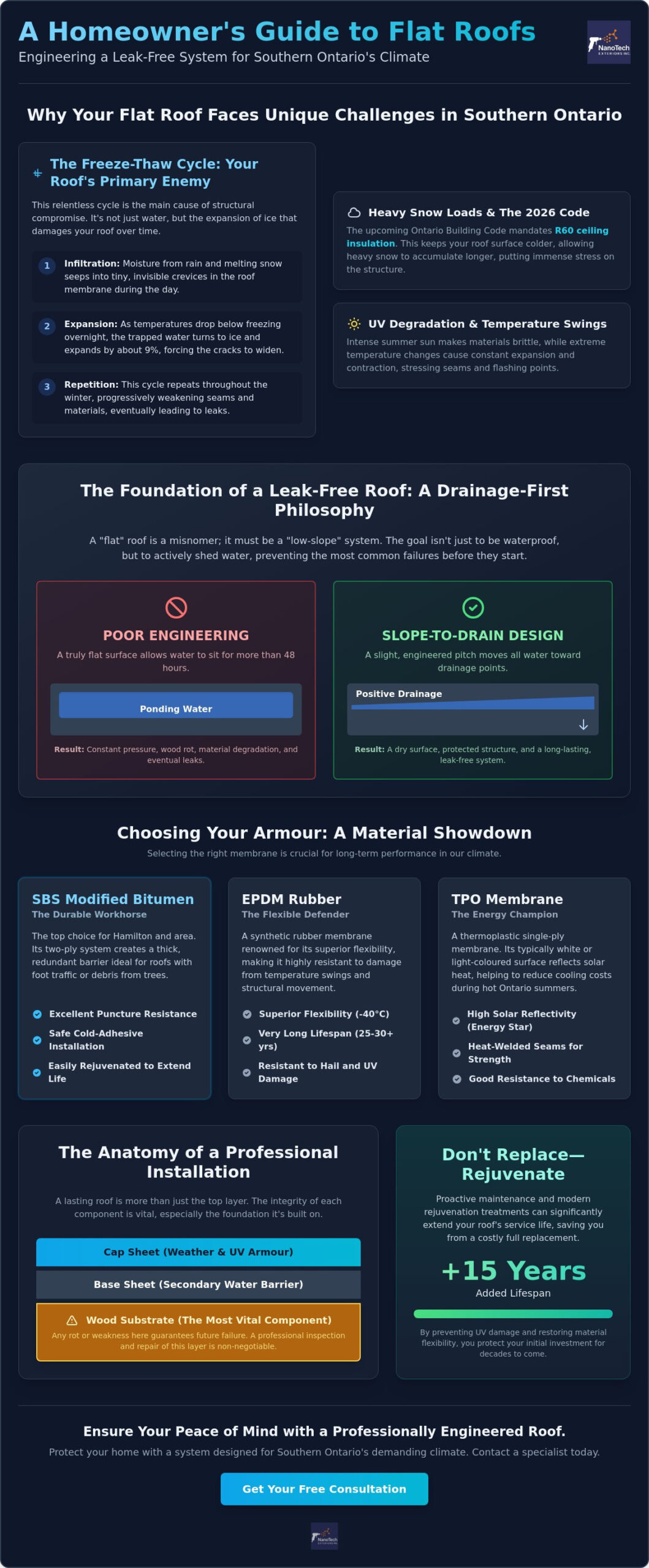
The freeze-thaw cycle is the primary enemy for residents in Burlington and Hamilton. During a typical Ontario winter, moisture enters small crevices in the roof surface during the day. As temperatures drop at night, that water expands as it turns to ice, widening cracks and weakening seams. This repetitive stress eventually leads to structural compromise. Unlike commercial buildings with massive, uniform surface areas, residential structures often deal with intricate transitions and aesthetic requirements that can complicate drainage if not handled by a specialist.
Heavy snow loads also put unique pressure on local homes. The 2026 Ontario Building Code update mandates enhanced energy efficiency, including R60 insulation for ceilings, which changes how heat is retained within the home. This increased insulation means the roof surface stays colder, allowing snow to sit longer rather than melting off. A professional installation must account for this weight to prevent structural sagging or interior ceiling damage.
The Impact of the Golden Horseshoe Climate
Local weather patterns present technical challenges that a standard “one-size-fits-all” approach cannot solve. In Oakville and Burlington, high humidity levels can interfere with the chemical adhesion of certain membranes if they aren’t installed under precise conditions. Extreme temperature swings also cause constant expansion and contraction of the roofing material. If the system lacks the necessary elasticity, it will eventually tear at the flashing points. Niagara region homeowners also face higher wind loads that can peel back poorly secured edges on exposed residential properties.
Common Flat Roof Failures Homeowners Face
The most visible failure is ponding water. If water remains on the surface for more than 48 hours after a storm, the weight puts immense pressure on the wooden substrate underneath. Over time, this leads to wood rot and eventual leaks. When planning a flat roof installation residential project, UV degradation is another factor to consider. Intense summer sun makes older bitumen or rubber systems brittle, causing them to crack. If you notice these signs, you should consult a how to tell if roof needs replacing guide to determine if your system is still salvageable through rejuvenation or requires a full intervention.
Comparing Residential Flat Roofing Materials: SBS, EPDM, and TPO
Selecting the right membrane determines whether your home stays dry for a decade or a quarter-century. In 2026, the market has stabilized around three primary technologies, each offering distinct advantages for the Southern Ontario climate. While cost is often the initial driver, we encourage homeowners to prioritize long-term durability and the ability to refurbish the system later. A smart flat roof installation residential choice balances upfront expense with the reality of future maintenance requirements.
SBS Modified Bitumen (2-Ply Systems)
SBS (Styrene-Butadiene-Styrene) is the undisputed workhorse of residential roofing in Hamilton. This system utilizes a two-ply approach where a base sheet and a cap sheet are layered to create a thick, redundant barrier. This multi-layer protection provides excellent puncture resistance. It’s an ideal choice for roofs that might see occasional foot traffic or falling debris from nearby trees.
Safety is a major concern during any home improvement project. While older torch-on methods are still in use, many modern installations in the Golden Horseshoe now utilize cold-applied adhesives or self-adhered membranes. These methods provide an industrial-strength bond without the fire risk associated with open flames on a residential property. SBS is also highly compatible with various liquid-applied rejuvenation treatments, allowing you to extend its life significantly down the road.
EPDM Rubber and TPO Membranes
EPDM (Ethylene Propylene Diene Monomer) is a synthetic rubber membrane that has been a staple in the industry for decades. It’s prized for its extreme UV resistance and its ability to remain flexible even in the middle of a Canadian winter. EPDM is typically black, which helps melt snow faster in the winter but can lead to higher heat absorption during the summer months.
TPO (Thermoplastic Polyolefin) is the contemporary choice for energy-conscious homeowners. When planning a flat roof installation residential project, TPO is often favoured for its heat-reflective “cool roof” properties. These surfaces bounce solar radiation away from the building, which directly supports the energy efficiency goals of the 2026 Ontario Building Code. The primary technical difference lies in the seams. While EPDM relies on adhesive tapes, TPO seams are heat-welded with hot air to fuse the sheets at a molecular level. As noted in various CRCA technical bulletins, heat-welded seams provide superior resistance to wind-driven rain.
Selecting a material that allows for future maintenance is a hallmark of a sensible homeowner. If you’re struggling to choose between these systems, our specialists can guide you through the residential roofing options that best suit your home’s unique structural needs. Choosing a system that can be easily refurbished ensures you won’t be facing another full replacement cost in fifteen years.
Key Considerations for a Leak-Free Flat Roof Installation
A common misconception among homeowners is that the specific brand of membrane is the most important factor in a dry home. While material quality certainly matters, a successful flat roof installation residential project relies more on the geometry and engineering of the system than the sheet itself. Even the most expensive membrane will fail if water is allowed to sit. The “flat roofs always leak” myth is usually the result of poor edge metal installation or a lack of proper slope. By focusing on the structural details, you can ensure a system that remains watertight for decades.
High-quality insulation also plays a silent but vital role in leak prevention. The 2026 Ontario Building Code requirements for increased R-values aren’t just about heat retention; they’re about moisture control. Without adequate thermal resistance, warm interior air hits the cold underside of the roof deck, causing condensation that mimics a leak. A professional installation ensures the dew point remains outside the structural wood, protecting your home from the inside out.
The Critical Role of Proper Drainage
Water must move. To achieve this, we utilize a “slope-to-drain” philosophy. Even on a low-slope roof, there should be a minimum incline to prevent ponding. We often realize this slope by using tapered insulation boards, which are custom-cut to create a gentle ramp toward the exit points. You have three primary options for managing this runoff:
- Internal Drains: These move water through the centre of the building into the plumbing system, keeping the pipes protected from freezing.
- Scuppers: Large openings in the perimeter wall that allow water to shoot off the side of the house.
- Eavestroughs: Standard gutters used when the roof slants toward an open edge.
During Southern Ontario autumns, these systems face heavy debris from falling leaves. A clogged drain is a structural risk, so we design these exit points to be easily accessible for routine maintenance.
Flashing and Penetration Details
Industry data shows that 90% of leaks occur at the edges or where the roof is punctured by chimneys, skylights, and vents. These transition points are where the membrane is most vulnerable to the expansion and contraction cycles common in the Golden Horseshoe. This is why we emphasize reinforced flashing in modern residential roofing in Burlington. Every HVAC unit or vent pipe must be double-sealed with target patches and professional-grade sealants. When these details are executed with technical precision, the risk of water ingress is virtually eliminated.
The Installation Process: What to Expect from Start to Finish
A professional flat roof installation residential project is a structured operation that prioritizes technical precision over speed. While some contractors promise a two-day turnaround, we focus on the integrity of the layers you can’t see. A roof is only as durable as the surface it sits on. Understanding each phase of the process allows you to monitor the quality of the work and ensures your investment is protected for the long term.
Phase 1: Tear-Off and Substrate Preparation
The most critical work happens before the new membrane ever touches the roof. We begin by removing all existing layers to realize the true condition of the structural roof deck. Skipping this step is a common industry shortcut that leads to trapped moisture and premature failure. Once the deck is exposed, we inspect for wood rot, structural sagging, or “soft spots” caused by previous leaks. Any compromised plywood must be replaced immediately to provide a stable, flat surface. After repairs, the deck is cleaned of all debris and primed to ensure maximum adhesion for the base layers.
Phase 2: Membrane Application and Sealing
Once the substrate is prepared, the layout of the membrane rolls begins. This stage requires a logical approach to ensure water flows toward the drainage points we established in the design phase. Whether we are using SBS, EPDM, or TPO, the focus remains on the seams. For thermoplastic systems like TPO, we use robotic heat-welders to fuse the sheets together at a molecular level. For rubber or bitumen systems, we utilize specialized bonding agents or cold-applied adhesives. We pay particular attention to vertical transitions, such as where the roof meets a wall or chimney, ensuring the membrane is reinforced and tucked securely behind metal flashing.
Property protection is a non-negotiable part of our protocol. We use heavy-duty tarps to shield your landscaping and siding from debris during the “messy” tear-off phase. Before the project is considered complete, we perform a final inspection that includes a “water-test.” By temporarily blocking the drains and allowing a small amount of water to sit on the surface, we can verify the watertight integrity of every seam and penetration. This methodical approach is why homeowners trust us for their flat roofing needs. If you’re ready to secure your home with a system built to last, contact us to discuss your project requirements.
Why Choose NanoTech Exteriors for Your Residential Flat Roof
Choosing a contractor for a flat roof installation residential project shouldn’t feel like a gamble. While many GTA-based firms claim to cover the entire province, NanoTech Exteriors focuses specifically on the Burlington, Hamilton, and Oakville corridor. We understand the local micro-climates. From the damp lakefront air to the high winds of the Niagara Escarpment, we know what causes local roofs to fail. This regional specialization ensures your roof is engineered for the exact stressors it will face daily. We position ourselves as a sensible advocate for you, the homeowner, by offering solutions that prioritize longevity over a quick sale.
Most roofing companies operate on a replace-only business model. We find that wasteful and often unnecessary. Our approach is fundamentally different. We look at your roof as a long-term asset that requires protection rather than just a surface that needs periodic replacement. By focusing on technical precision and material science, we provide peace of mind. Your home remains dry without the recurring stress of high-cost interventions. We don’t use high-pressure tactics; we use logic and proven technology to solve your roofing challenges.
A Holistic Approach to Roof Care
We don’t just install new systems; we help you maximize the value of what you already own. Many modern homes feature complex designs that blend sloped and flat sections. Our team possesses the expertise to manage these transitions seamlessly. If your home has aging sections that aren’t yet ready for a full tear-off, we offer restoration for aging shingles to keep your entire exterior in peak condition. With active service teams in Kitchener, Guelph, and Niagara, we offer local accountability that larger, distant franchises simply can’t match.
Authorized GoNano Expertise
As an authorized GoNano dealer, we utilize advanced nanotechnology to fortify your roofing membranes against the elements. These specialized treatments penetrate the material to restore flexibility. They add a layer of protection that can extend the life of your investment by 10 to 15 years. It’s a pragmatic, scientifically backed solution that keeps more money in your pocket while providing superior defence against UV rays and moisture. This technology is a game-changer for any flat roof installation residential project, as it allows for maintenance that prevents the need for future replacements.
We invite you to move past the confusion of material types and high quotes. Schedule your professional flat roof assessment with NanoTech Exteriors today. We’ll provide a clear, honest look at your whole system and offer a path forward that makes sense for your home and your budget.
Securing Your Home with a Future-Proof Roofing Strategy
A successful residential project in Southern Ontario requires more than just a new layer of rubber or bitumen. It demands a drainage-first philosophy that respects our local freeze-thaw cycles and heavy snow loads. By prioritizing the structural substrate and technical flashing details, you move away from the myth of the “leaky flat roof” and toward a system that provides genuine peace of mind. Whether you select the puncture resistance of SBS or the heat-reflective efficiency of TPO, the real value lies in professional execution and proactive maintenance.
When planning your flat roof installation residential project, remember that a holistic assessment often reveals smarter, more cost-effective ways to protect your asset. As specialists in the Burlington, Hamilton, and Oakville climate since our inception, NanoTech Exteriors provides the technical expertise and authorized GoNano treatments needed to fortify your system for the long term. You don’t have to settle for temporary fixes or high-pressure replacement quotes. Protect your home with a professional flat roof installation from NanoTech Exteriors and enjoy a waterproof home that stands up to whatever the Ontario winter delivers.
Frequently Asked Questions
How long does a residential flat roof installation take in Ontario?
A typical residential project in Ontario takes between two and four days to complete. This timeline assumes favourable weather conditions and includes the essential tear-off and substrate preparation phases. Larger homes or those requiring complex tapered insulation systems may extend the schedule slightly. We focus on getting the deck dried-in quickly to protect your interior from unexpected rain showers during the process.
What is the best flat roof material for a residential home in Hamilton?
SBS modified bitumen is widely considered the best workhorse material for Hamilton homes due to its multi-ply durability and puncture resistance. TPO is an excellent alternative if you want to prioritize energy efficiency and heat reflection. The right choice depends on your specific structural needs and whether your roof sees regular foot traffic. We help you evaluate these options based on the long-term protection of your residence.
Can I install a new flat roof over an existing one?
While building codes may allow for a second layer, we strongly recommend a full tear-off for any flat roof installation residential project. Installing a new membrane over an old one traps existing moisture and prevents us from inspecting the wooden deck for rot. A clean substrate is the only way to guarantee the 20-year lifespan you expect from a professional installation.
How much does a flat roof installation cost in Burlington?
The total investment for a project in Burlington depends on the material selected, the complexity of the drainage system, and the condition of the underlying wood. Factors like the height of the building and the number of penetrations like chimneys or skylights also influence the final requirements. We recommend a professional assessment to determine the specific needs of your home rather than relying on generic square-foot estimates.
Do flat roofs always leak in the winter?
Flat roofs only leak in the winter if they suffer from poor drainage or inadequate insulation. When heat escapes from the house, it melts snow on the roof surface, which then refreezes at the cold edges to create ice dams. Ensuring your roof has a proper “slope-to-drain” design and meets 2026 Ontario Building Code insulation standards will keep your home dry and leak-free throughout the season.
How often should I have my residential flat roof inspected?
You should schedule a professional inspection twice a year, ideally in the spring and autumn. These seasonal checks allow you to clear debris from drains and scuppers before heavy rains or snow arrive. Regular maintenance is the most effective way to identify small issues with seams or flashing before they turn into expensive interior repairs. It’s a pragmatic step that protects your long-term investment.
What is the difference between a commercial and residential flat roof?
Residential flat roofs are generally smaller and feature more complex transition points than large-scale commercial systems. While commercial roofs focus on massive, uniform coverage, residential systems must integrate with siding, eavestroughs, and specific aesthetic details of the home. Insulation requirements also differ, as residential codes often demand higher R-values to maintain interior comfort in smaller living spaces.
Can a flat roof be rejuvenated instead of replaced?
Many roofs can be rejuvenated using advanced nanotechnology treatments like GoNano instead of being fully replaced. If the underlying substrate is still structurally sound, these treatments can restore flexibility to the membrane and add up to 15 years of life. This is a disruptive, cost-effective alternative that avoids the mess and expense of a full flat roof installation residential while providing superior waterproof protection.