If your shingles came with a 30-year warranty, why are they already curling and losing granules after only 15 years? It’s a frustrating reality for many homeowners in Southern Ontario who find themselves facing a C$10,000 to C$20,000 replacement bill much sooner than expected. You likely feel that a warranty should mean something, yet the gap between those paper promises and the actual performance of your roof feels like a moving target. Understanding how long do asphalt shingles last in our unique climate is essential for protecting your home and your bank account.
The truth is that Ontario’s extreme temperature swings and brutal freeze-thaw cycles cause shingles to dry out and lose their essential oils, leading to premature failure. You deserve a solution that’s based on science rather than sales cycles. In this article, you’ll discover the real factors that dictate your roof’s lifespan and learn how advanced nanotechnology can extend that life by up to 15 years. We will examine the 30-year myth versus local reality, providing you with a clear path to maintain structural integrity while avoiding the stress of an unnecessary, full-scale replacement.
Key Takeaways
- Learn why manufacturer warranties often fail to reflect the actual service life of a roof in the volatile Southern Ontario climate.
- Understand how Ontario’s intense freeze-thaw cycles and UV exposure physically strip shingles of their protective oils and flexibility.
- Identify the critical visual warning signs, such as granule loss and curling, that indicate your roof is reaching its breaking point.
- Discover how nanotechnology changes the calculation of how long do asphalt shingles last by restoring structural integrity for up to 15 additional years.
- Apply the “80/20 Rule” to determine if your home is a candidate for cost-effective roof rejuvenation or if a full replacement is required.
The Reality of Asphalt Shingle Lifespan in Southern Ontario
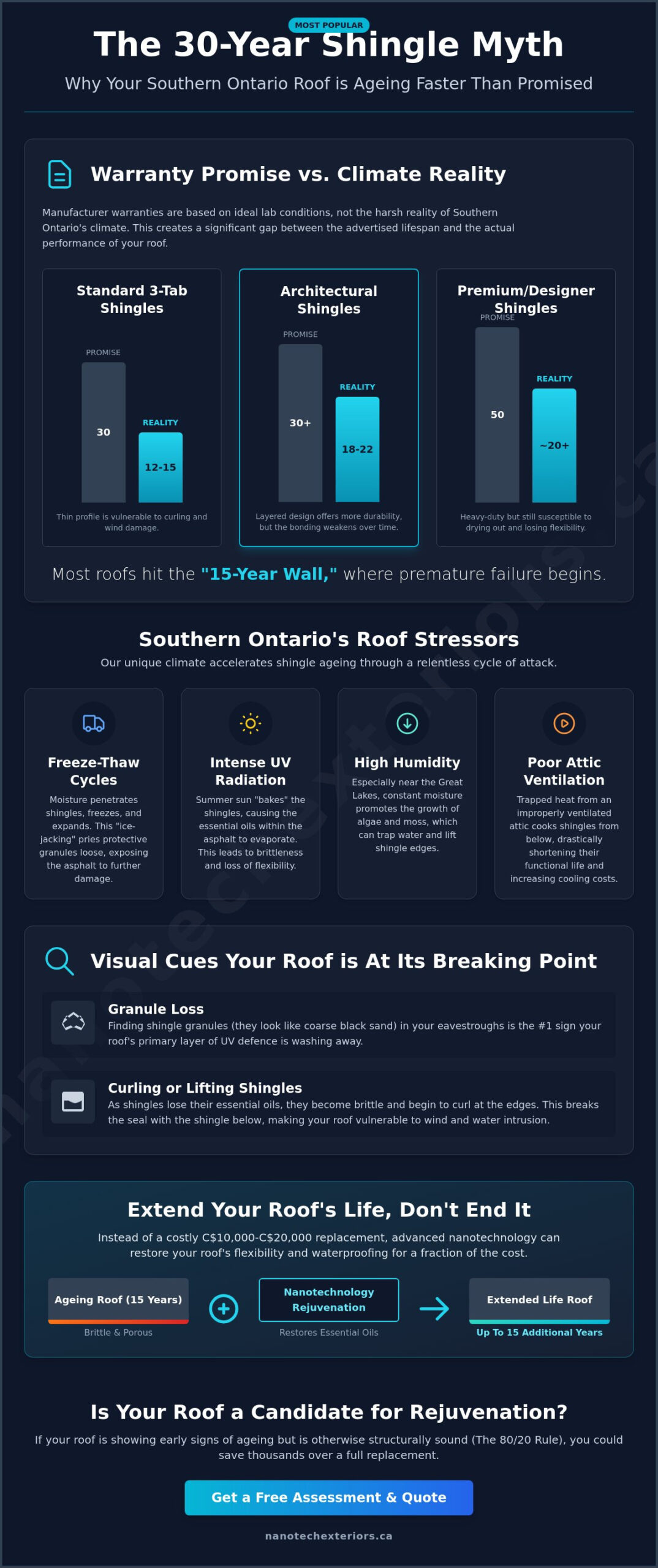
Many homeowners in the Golden Horseshoe believe their roof is a “set it and forget it” investment for three decades. This belief is fueled by the bold “30-Year” labels prominently displayed on shingle bundles. However, the gap between a manufacturer’s rating and the actual service life in Canada is often vast. While the materials are technically capable of lasting 30 years in a controlled laboratory environment, the reality on a home in Burlington or Hamilton is quite different. In our region, many roofs hit what we call the “15-Year Wall.” This is the point where the initial flexibility of the asphalt begins to fail, leading to visible distress. You might notice small granules in your gutters or slight lifting at the edges. These aren’t just cosmetic issues; they are signs that the chemical integrity of your roof is shifting.
The 30-Year Shingle Myth Explained
Manufacturer warranties are frequently misunderstood. They primarily protect against factory defects, not the inevitable wear and tear of a Southern Ontario winter. If you read the fine print, you will find that “normal weathering” or environmental degradation is rarely covered. This creates a significant discrepancy when determining how long do asphalt shingles last in practice. Laboratory tests don’t account for the rapid pressure changes or the high humidity levels we experience near Lake Ontario. Shingle service life is the period before the asphalt loses its waterproofing flexibility. Once those essential oils evaporate, the shingle becomes brittle and porous. For a foundational look at these materials, this Asphalt shingle overview details the composition and history of these products.
Average Lifespan by Shingle Category
The specific type of material installed on your home dictates your timeline, but every category faces the same environmental stressors. Understanding these tiers helps you manage your expectations and your budget.
- Standard 3-Tab Shingles: These are the traditional, flat shingles often found on older homes or budget-conscious builds. In the Ontario climate, the 12 to 15-year reality is the standard. After this point, the thin profile often leads to curling and blow-offs during autumn windstorms.
- Architectural (Laminate) Shingles: These are the most popular choice today because of their layered, dimensional look. While they are marketed for 30 years or more, 18 to 22 years is the typical ceiling in our region before the bond between layers begins to weaken.
- Premium/Designer Shingles: These heavy-duty shingles are designed to mimic slate or cedar shakes. They offer superior wind resistance, but they are not immune to the “drying out” effect. Despite their higher price point, they often require maintenance or rejuvenation around the two-decade mark to ensure they remain waterproof.
If your roof is approaching these age milestones, it doesn’t always mean you need to spend C$15,000 on a full replacement. It simply means the “marketing life” has ended and the “real-world service life” requires your attention. Recognizing this gap is the first step toward making a smarter, more cost-effective decision for your home. Homeowners who want to explore every available option to save money on roof replacement in Ontario will find that restoration alternatives and provincial rebates can dramatically reduce the financial burden.
Environmental Factors Accelerating Roof Aging in Our Region
Southern Ontario’s climate is notoriously hard on building materials. While we often focus on the visible damage from a single storm, the real threat to your roof is the cumulative effect of our unique environmental stressors. When asking how long do asphalt shingles last, you have to account for the relentless cycle of expansion and contraction. During an Ontario winter, moisture seeps into the porous surface of the shingle. When this water freezes, it expands; it physically pries the protective stone granules away from the asphalt mat. This process repeats hundreds of times each season, slowly stripping away the roof’s primary line of defence.
The summer months bring a different kind of stress. High humidity levels combined with intense UV radiation create a “slow cook” effect that degrades the shingle’s chemical composition. If your attic lacks proper ventilation, this heat is trapped against the underside of the roof deck. Your shingles are effectively being baked from both sides. This thermal pressure is particularly intense for homes near Lake Ontario. These microclimates often produce higher humidity and more frequent lake-effect precipitation than inland areas, which accelerates the decay of the organic components within the shingle.
The Molecular Culprit: Oil Evaporation
At the heart of every shingle is a blend of bitumen and petrochemical oils. These oils provide the flexibility needed to withstand thermal shock. As the roof surface heats up, these oils begin to migrate and eventually evaporate. This chemical shift makes the material brittle. Once the oil is gone, the shingle can no longer hold onto its protective granules. This is why you see “shingle sand” in your gutters. It’s a clear indicator that the molecular bond is failing. If you are concerned about this degradation, a professional roof rejuvenation assessment can determine if those lost oils can be replaced before the damage becomes structural.
Local Weather Stressors: From Oakville to Niagara
The geography of the Golden Horseshoe creates specific challenges for roof longevity.
- Wind Lift: In areas like Oakville and Burlington, high winds can easily catch the edges of brittle shingles. Because the material has lost its flexibility, it doesn’t bend; it snaps.
- Heavy Snow Loads: The weight of accumulated snow in the Niagara region puts constant pressure on the shingles. Aged, brittle materials are less capable of distributing this weight, leading to micro-cracks.
- Temperature Swings: The rapid shifts between a frozen night and a sunny, above-zero afternoon in the spring cause constant movement. These swings create tiny fractures that eventually allow water to reach the wood decking below.
Understanding these factors helps explain why a roof might fail years before its warranty expires. It isn’t just about the age of the shingle; it’s about the intensity of the environment it has endured. Monitoring these local stressors is the only way to accurately predict how long do asphalt shingles last on your specific property.
Visual Cues: How to Tell if Your Shingles are Reaching Their Limit
Identifying the physical state of your roof doesn’t always require a ladder. Many indicators of wear are visible from the ground if you know where to look. When evaluating how long do asphalt shingles last on your specific home, the most obvious sign is granule loss. If you find a layer of “shingle sand” in your eavestroughs after a heavy rain, it means the protective layer is shedding. These granules act as the roof’s sunscreen; without them, the underlying asphalt is exposed directly to UV rays, which rapidly accelerates the drying process. Once the mat is exposed, the countdown to a leak begins.
Curling and cupping are the next major milestones of decay. Curling occurs when the corners of the shingle turn upward, while cupping happens when the centre of the shingle sinks. Both are definitive visual signals of advanced dehydration. As the shingles lose their essential oils, they shrink and pull away from the roof deck. This creates gaps where wind-driven rain can penetrate, often leading to moisture damage during the turbulent spring and fall seasons. You may also notice thermal splitting, which appears as vertical cracks running through the body of the shingle. These are caused by the extreme expansion and contraction cycles common in the Golden Horseshoe. Many homeowners are surprised to learn that brittle shingles restoration can reverse this chemical dehydration without the need for a full tear-off, saving thousands of dollars in the process.
Biological growth is another factor often overlooked by homeowners. In Ontario, moss and algae are more than just an aesthetic nuisance. These organisms trap moisture against the shingle surface and can eventually lead to rot in the underlying wood deck. If you see green patches or dark streaks, your roof is holding onto water longer than it should, which significantly reduces how long do asphalt shingles last by softening the material’s core.
In many cases, the proximity of large trees can worsen this biological growth by blocking sunlight and dropping moisture-trapping debris. Homeowners who find that shade is accelerating their roof’s decline may want to explore Tree Removal to improve the longevity of their shingles.
The “Touch Test” for Shingle Health
If you can safely access a small section of your roof, a simple flexibility test provides immediate clarity. Healthy shingles should bend easily without cracking. If they snap like a dry cracker when you gently lift a corner, they have reached their brittle point. Once shingles become brittle, they lose the ability to seal against wind-driven rain. You should also check for “bald spots” where the granules have completely disappeared, leaving the black asphalt mat exposed and vulnerable to the next heatwave.
Interior Warning Signs
Sometimes the best evidence of a failing roof is found inside your home. During a bright day, head into your attic and look for pinpoints of daylight peeking through the roof deck. This indicates structural gaps that the shingles are no longer covering. Water staining on your ceilings is a lagging indicator; by the time you see a brown ring on the drywall, the shingle failure has likely been occurring for months. Poor attic insulation often exacerbates this by allowing heat to escape, which causes uneven snow melt and contributes to the premature curling of the shingles above.
Beyond Replacement: Extending Shingle Life with Nanotechnology
Traditional roofing companies often present homeowners with a binary choice: ignore the aging roof or spend thousands on a full replacement. This approach ignores the fundamental science of material decay. If you understand that shingles fail primarily because they lose their internal chemistry, you realize that replacing the entire structure isn’t always the most logical step. Roof rejuvenation represents a shift in how we maintain our homes. It’s a scientifically backed method of restoring the chemical balance of the asphalt mat, effectively pausing the aging process. By addressing the root cause of brittleness, we change the calculation of how long do asphalt shingles last on your property.
We utilize GoNano nanotechnology to penetrate deep into the shingle structure. Unlike surface coatings that simply sit on top of the granules, this treatment works at a molecular level to re-infuse the asphalt with the oils it has lost to the Ontario sun. A single application can reset the aging clock, adding up to 15 years of reliable service life. This isn’t just about delaying the inevitable; it’s about maximizing the value of the materials you already have. There’s also a significant environmental benefit to this approach. Over 550,000 roofs are replaced annually across Canada, contributing massive amounts of waste to our landfills. Choosing restoration over replacement is a pragmatic way to reduce your environmental footprint while protecting your home.
How Rejuvenation Works at a Cellular Level
The core of an asphalt shingle is designed to be pliable. This “self-healing” property allows the material to expand and contract without cracking. As the oils evaporate, the shingle becomes a rigid, brittle shell. GoNano technology restores this flexibility, allowing the shingle to once again absorb the impact of hail and the stress of high winds. This restoration also improves granule adhesion. By softening the asphalt, the protective stones are pulled back into the mat, which provides a renewed shield against UV damage. This process increases wind resistance by restoring the shingle’s original weight and structural integrity.
The Cost-Benefit of Restoration
Financial logic is often the strongest driver for roof rejuvenation. A full roof replacement in Southern Ontario can easily exceed C$15,000, creating a significant burden for many families. Rejuvenation offers a more efficient path, providing a decade or more of protection for a fraction of that cost. Treating a roof at the 15-year mark is a strategic move. It catches the shingles before the damage becomes structural, ensuring you get the full value out of your initial investment. You can discover if your roof is a candidate for GoNano rejuvenation by scheduling a professional assessment today.
If you’re looking for a smarter way to manage your home’s exterior, it’s time to look beyond the traditional replacement model. You can secure your home’s future without the stress of a massive construction project. Learn more about our roof rejuvenation services to see how we can protect your investment for the long term.
Navigating the Choice: Repair, Rejuvenate, or Replace?
Deciding the future of your roof requires a logical framework rather than a reactive emotional response to a high quote. We use the “80/20 Rule” to help homeowners evaluate their options. If more than 20% of your roof surface is physically missing shingles or the underlying wood deck shows signs of soft spots and rot, the structure has moved beyond the point of simple maintenance. However, if the issues are primarily surface-level, such as widespread granule loss or minor curling, you are likely in the “Rejuvenation Zone.” This distinction is critical because it prevents you from overspending on a full replacement when the structural integrity of your home remains perfectly intact.
Your long-term goals for the property also dictate the best path forward. If you plan to sell your home in the next few years, rejuvenation offers a significant advantage. It provides a transferable warranty and restores the dark, rich colour of the shingles, which boosts curb appeal without the C$15,000 price tag of a new installation. For those staying long-term, rejuvenation acts as a preventative shield that resets the clock on how long do asphalt shingles last, allowing you to allocate those home improvement funds elsewhere. Insurance also plays a role; while policies often cover sudden wind or hail damage, they rarely pay for “age-related” wear. Understanding where your roof sits on the decay curve ensures you aren’t left footing a massive bill that could have been avoided with proactive care.
The Decision Matrix
Choosing between these three paths depends on the age and physical condition of your materials:
- When to Repair: Choose this for isolated leaks or minor wind damage on a roof less than 10 years old. If the surrounding shingles are still flexible and holding granules, a targeted fix is the most sensible move.
- When to Rejuvenate: This is the ideal solution for roofs between 10 and 20 years old that show signs of dehydration but have no active leaks. It restores the oils needed to keep the roof waterproof and wind-resistant.
- When to Replace: Replacement is necessary if you have multiple layers of shingles (which violates the Ontario Building Code), significant structural sagging, or if the shingles are so brittle they crumble when touched. Before committing to a full tear-off, review our complete guide on how to save money on roof replacement in Ontario, which covers strategic material choices and 2026 provincial rebates that can significantly reduce your total costs.
When a full replacement becomes the only viable path, selecting a contractor with extensive experience is paramount. For those seeking expert residential or commercial services in the Southern US, Supreme Roofing and Reconstruction represents the level of professionalism and quality needed to ensure a new roof stands the test of time.
Expert Consultation in Southern Ontario
Every roof in the Golden Horseshoe has a unique story based on its orientation to the sun and its proximity to the lake. Before you sign a contract for a total replacement, you deserve an honest assessment of your roof’s true age and condition. Our team provides a transparent health check that focuses on material science rather than high-pressure sales tactics. We help you identify if your shingles are truly at the end of their life or if they simply need a chemical “refill” to continue protecting your family. Book your professional roof inspection today to save thousands on your home maintenance and gain the peace of mind that comes with a scientifically backed decision.
Secure Your Home’s Future and Your Savings
Understanding the gap between marketing promises and the harsh reality of the Ontario climate is the first step toward smarter home ownership. We have explored how the relentless freeze-thaw cycle dictates how long do asphalt shingles last; it is rarely the full thirty years advertised on the package. By identifying the early signs of dehydration and choosing rejuvenation over a premature replacement, you can maintain your home’s structural integrity without the heavy financial strain of a full construction project.
As an Authorized GoNano Dealer serving Burlington, Hamilton, and the GTA, NanoTech Exteriors specializes in restoring the molecular health of your roof. Our innovative process can save you up to 85% compared to the cost of a full roof replacement while adding fifteen years of reliable protection. You don’t have to wait for a leak to dictate your maintenance timeline. Get a Free Roof Health Assessment and Quote today to gain peace of mind and extend the life of your home. Your roof still has plenty of life left; it just needs the right science to unlock it.
Frequently Asked Questions
How long do asphalt shingles really last in Ontario weather?
Most asphalt shingles in the Golden Horseshoe last between 15 and 25 years. While manufacturers often advertise longer timelines, our local freeze-thaw cycles and high humidity near Lake Ontario accelerate the aging process. Standard 3-tab shingles typically reach their limit at 12 to 15 years, while architectural shingles may last up to 22 years before the asphalt becomes too brittle to protect the home.
Can I extend the life of my 20-year-old shingles?
Yes, you can extend their life provided the underlying roof deck is structurally sound. If your shingles are showing signs of dehydration like granule loss but haven’t started leaking, nanotechnology treatments can re-infuse them with essential oils. This restoration process adds up to 15 years of service life to an aging roof, allowing you to delay a costly replacement while maintaining full protection against the elements.
Is roof rejuvenation better than replacing my roof?
Rejuvenation is a more efficient and cost-effective choice for roofs that are structurally healthy but chemically aging. It allows you to avoid the mess and high expense of a full tear-off. While a replacement is necessary if your roof has structural rot or multiple layers of shingles, rejuvenation is the superior option for homeowners looking to maximize value and reduce environmental waste in Ontario landfills.
What are the first signs that asphalt shingles are failing?
The earliest signs of failure are “shingle sand” accumulating in your eavestroughs and visible curling at the shingle edges. These signals indicate that the protective oils are evaporating, leaving the mat vulnerable to UV damage. When homeowners ask how long do asphalt shingles last, we point to these physical cues. Once shingles lose their flexibility, they can no longer seal against wind-driven rain or heavy snow loads.
Does a 30-year warranty mean my roof will last 30 years?
No, a 30-year warranty is primarily a protection against manufacturing defects rather than a guarantee of performance in the Ontario climate. Most warranties include fine print that excludes “normal weathering,” which covers the bulk of shingle decay in our region. In practice, you should expect to perform maintenance or consider rejuvenation long before that 30-year mark to ensure your roof remains waterproof and reliable.
How much does it cost to restore shingles vs. replacing them in Burlington?
Restoring your shingles is significantly more affordable than a full replacement, often saving you up to 85% compared to a new roof installation. In Burlington and Hamilton, a full replacement can easily cost between C$10,000 and C$20,000 depending on the roof’s size and complexity. Rejuvenation provides a professional, scientifically backed alternative that secures your home for a small fraction of that total investment.
Does roof rejuvenation work on all types of asphalt shingles?
Roof rejuvenation is effective on all standard asphalt-based materials, including 3-tab, architectural, and premium designer shingles. The nanotechnology is designed to penetrate the asphalt mat regardless of the shingle’s thickness or style. As long as the shingles are still physically intact and the wood decking below is dry, the treatment will successfully restore the flexibility and granule adhesion required for long-term durability.
Can I apply a roof restorer myself or do I need a pro?
Professional application is essential for safety and effectiveness. Commercial-grade nanotechnology requires specialized equipment to ensure the treatment penetrates deep into the shingle mat rather than just sitting on the surface. A professional assessment also confirms whether your roof is a viable candidate for restoration. This ensures you don’t spend money on a treatment if your roof has underlying structural issues that require a different approach.