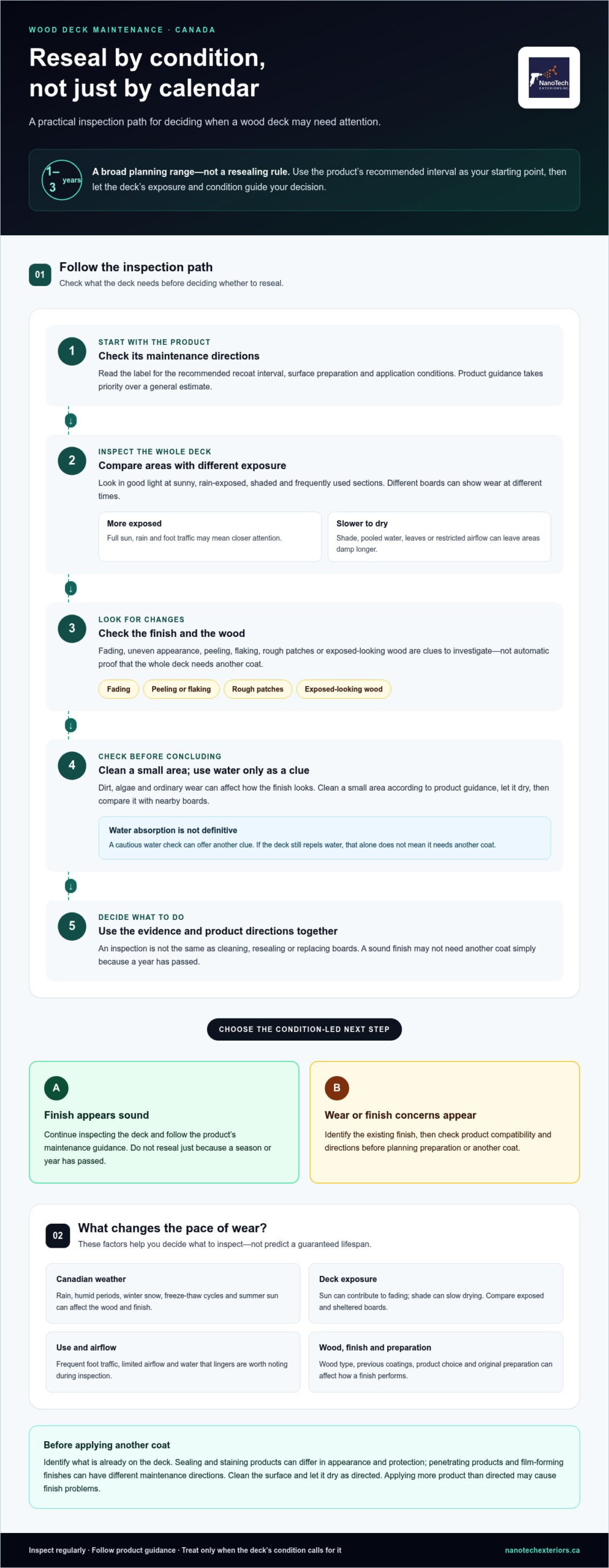
A fixed annual schedule isn’t right for every deck. If you’re wondering how often to seal a wood deck in Canada, use one to three years as a general planning range, not a rule. Snow, rain, strong sun and freeze-thaw cycles can wear down protection at different rates. The wood, finish and product instructions also affect timing.
Conflicting advice can make it hard to know whether to reseal or wait. Sealing isn’t always the same as staining: products can differ in appearance and protection, so read the label. If a deck still repels water, that alone doesn’t mean it needs another coat just because a season has passed.
This guide explains how to choose a sensible interval without over-treating the wood. You’ll learn how Canadian weather, deck exposure and wood type affect maintenance, how to spot fading protection, and what a simple water test can tell you. You’ll also see why product instructions matter, especially for new pressure-treated wood. The goal is a plan based on your deck’s condition, not a one-size-fits-all calendar.
Key Takeaways
- For how often to seal a wood deck in Canada, start with the product’s recommended interval, then adjust your inspection and maintenance plan to the deck’s exposure and condition.
- Inspect sunny, rain-exposed areas as well as shaded sections. Different parts of the deck can show wear at different times.
- Look for fading, peeling, flaking, roughness or exposed wood. A cautious water-absorption check can offer another clue, but it isn’t definitive on its own.
- Before resealing, identify the existing finish, clean the surface and let it dry as directed. Product compatibility and preparation matter.
- Professional wood sealing can help when preparation is extensive, but inspections and product guidance still matter afterward.
How Often Should You Seal a Wood Deck in Canada?
Use the sealer or stain manufacturer’s recommended recoat interval as your starting point, rather than relying on a universal Canadian schedule. One to three years is a broad estimate for planning, but it’s product-dependent. Your deck’s condition and the product instructions matter more than the calendar alone.
Protection can wear at different rates depending on the wood, exposure to sun and moisture, foot traffic, and the quality of the original preparation and application. For example, an uncovered deck with frequent foot traffic may need closer attention than a sheltered one. These factors don’t establish a guaranteed lifespan; they help you decide what to inspect and when.
Decks vary in materials and construction, as the general overview of Deck (building) explains. For a wood deck, identify the finish already on the surface before planning another coat. A penetrating product and a film-forming finish can have different maintenance directions, so don’t assume the same interval applies to both.
What is a reasonable resealing interval for a wood deck?
The one-to-three-year range can help you decide when to inspect the finish, but it doesn’t mean your deck needs treatment within that window. Read the product label for recoat timing, surface preparation and application conditions. If those directions differ from a general estimate, follow the instructions for the product on your deck.
If you don’t know what was previously applied, don’t assume a new product will work over it. The existing finish and the wood’s condition can affect how a new coat adheres and performs.
Does every wood deck need sealing every year?
No. An annual inspection can help you catch visible changes early, but inspection isn’t the same as cleaning, resealing or replacing damaged boards. A sound finish may not need another coat simply because a year has passed. Applying more product than directed won’t necessarily improve protection and can cause finish problems.
Use each inspection to decide what action, if any, is needed. Check for changes in the finish and compare areas exposed to weather or frequent use with sheltered sections. Then consult the product’s maintenance guidance. That’s a practical way to decide how often to seal a wood deck in Canada without treating every deck, product and location as if they face the same conditions.
What Changes How Often a Canadian Wood Deck Needs Sealing?
Weather and exposure affect how quickly a deck’s finish changes, but they don’t create a reliable schedule on their own. In Southern Ontario, rain, humid periods, winter snow and repeated freeze-thaw cycles can keep wood damp or stress its finish. Summer sun adds ultraviolet exposure, which can fade some finishes. The effect depends on the deck’s location, construction and the product applied.
Let exposure and the deck’s surface condition guide how often you inspect it. Then use the product instructions to decide whether resealing is due. A deck exposed to full sun and rain may show wear sooner than a covered section, while shade can slow drying and leave moisture lingering. Neither situation guarantees a particular lifespan for the finish.
How do Canadian seasons affect deck sealing?
After winter, look for changes that may have appeared under snow or through freeze-thaw weather. During warm-season maintenance, check areas that receive direct sun or stay damp after rain. For homeowners in Burlington, Hamilton, Oakville, Niagara, Kitchener, Guelph and Cambridge, seasonal inspections can help identify localized wear rather than treating every part of a deck as if it faces the same conditions.
Check drainage as well. Water that collects between boards or near the house can keep surfaces wet longer. Leaves, planters and nearby vegetation may also restrict airflow, so inspect those spots closely. Focus on what you observe: seasonal exposure alone doesn’t prove the finish has failed.
Do wood type and deck location change the schedule?
They can affect how the surface responds, but there’s no dependable resealing interval based on species alone. Pressure-treated lumber and cedar can differ in appearance, surface condition and how they take a finish. Previous coatings and preparation matter, too. Check the boards and follow the directions for the product used instead of assuming every deck made from the same wood needs treatment at the same time.
Location adds another factor. Full sun can increase fading; a roof cover may reduce direct rain but leave shaded areas slower to dry. A deck close to the ground may have less airflow underneath than one with open space below. Compare exposed and sheltered boards, and note where water lingers or foot traffic is heaviest. These observations make how often to seal a wood deck in Canada a condition-based decision, rather than a guess based on wood type or region.
If exposure makes maintenance difficult to assess, professional wood deck sealing can help you care for an exterior deck.
How Can You Tell When a Wood Deck Needs Resealing?
Start with a visual check in good light. Look across several boards, including areas exposed to sun, rain and regular foot traffic. Fading, an uneven appearance, peeling or flaking can signal that the finish needs attention. Rough patches or exposed-looking wood are also worth investigating, but they don’t automatically mean the whole deck needs another coat.
Dirt, algae and ordinary surface wear can make a finish look worse than it is. Clean a small area according to the product guidance, let it dry, then compare it with nearby boards. Check more than one spot: a worn patch beside a doorway may not reflect the condition of the entire deck.
What are the signs a deck sealer is wearing off?
Look for changes across multiple boards, such as fading, flaking edges or areas where the finish appears thin or inconsistent. Note where the changes occur. If the most visible wear is on a sunny, frequently used section, compare it with a covered area before deciding what the deck needs. The pattern can help you distinguish localized wear from a broader finish problem.
Check the wood itself, too. Soft or decaying areas, loose boards and other damage aren’t simply signs of worn sealer. Sealing can protect a suitable surface, but it can’t repair rot or restore structural strength. Address damaged boards and safety concerns separately before planning a finish treatment.
Can a water test tell you when to reseal?
A water test can offer a clue, not a verdict. On a clean, dry section, place a small amount of water on the surface and watch what happens. If it beads, some protection may remain; if it absorbs, the finish may be wearing or the wood may be exposed. Beading alone doesn’t prove the coating is sound, and absorption doesn’t identify the cause. Surface contamination, cleaner residue and finish type can all affect what you observe.
Use the water check alongside a visual inspection and the maintenance instructions for the product already on the deck. If results vary from board to board, inspect those areas separately rather than treating one spot as representative.
Reseal when visible wear and surface checks suggest protection has weakened, and the product’s instructions support recoating. This is more useful than relying on one sign or the calendar alone. It also gives you a practical way to decide how often to seal a wood deck in Canada: assess the finish, then follow the guidance for the specific product.
When and How Should You Plan Wood Deck Sealing?
A good sealing job starts before the product goes on. Work in this order: inspect the boards, identify the existing finish, clean the surface, let it dry adequately, then apply a compatible product according to its label. If you find rotten or damaged boards, repair or replace them first. Sealer protects a suitable surface; it doesn’t restore weakened wood.
Preparation affects how well a new coat adheres. Dirt, algae, leftover cleaner or a failing previous finish can interfere with application. Product directions explain how to prepare the surface and whether an existing coating needs special treatment. Don’t assume a new product can simply go over an unknown finish.
Which season is best for sealing a deck in Canada?
Mild, dry conditions are generally preferable, but the product label should guide the timing. Check its specified application range and drying requirements. Avoid applying sealer to wet wood or when rain is expected within the period stated by the manufacturer. Conditions vary across Canada, so a particular month isn’t a reliable recommendation for every region, deck or product.
Allow enough time for cleaning and drying before application. If the surface is still damp or the forecast conflicts with the label, wait for a more suitable window.
What should you do before applying another coat?
First, identify the finish already on the deck, if possible, and compare it with the product you plan to use. Compatibility matters: applying a new coating over an unsuitable or failing finish can lead to poor adhesion or an uneven result. Follow the product’s preparation instructions rather than relying on a quick rinse or covering visible peeling with another coat.
Next, clean the deck as directed and allow it to dry for the time and conditions specified on the label. Don’t rush this step. Pay attention to board edges, shaded sections and places where water collects, since these areas may take longer to dry. Apply the product only when the surface meets its stated requirements.
For a practical overview of professional preparation and protection, read our guide to professional exterior wood sealing services. NanoTech Exteriors also provides professional wood sealing to help maintain exterior wood.
This sequence makes the decision about how often to seal a wood deck in Canada more useful: inspect first, prepare the surface properly, then follow the instructions for the specific finish you’re applying.
When Does Professional Wood Deck Sealing Make Sense?
DIY sealing may be manageable if the deck is in sound condition, you understand the existing finish, and cleaning and application fit comfortably into your plans. Professional help can be useful if the coating is peeling across large areas, preparation is extensive, or you’re unsure how to handle an old finish before applying another product.
Professional sealing is a protective treatment for exterior wood, including decks. The work depends on the surface condition and the preparation required. Sealing isn’t a repair: rotten, loose or structurally unsound boards need attention rather than a new coating. Professional application doesn’t remove the need for future inspections or the product manufacturer’s maintenance guidance.
What can professional wood sealing help with?
Professional wood sealing can help homeowners maintain an exterior deck when preparing and treating the surface feels like a substantial project. Cleaning, drying and addressing a failing finish may take more work than applying a coat alone. The right approach depends on the deck’s condition and the existing product, so sealing should follow suitable preparation rather than cover problems. It doesn’t create a guaranteed lifespan or a fixed resealing schedule.
How should Southern Ontario homeowners take the next step?
Before planning the work, note the deck material, whether it’s exposed to sun or sheltered, visible wear and any product you know was previously used. These details make the decision about how often to seal a wood deck in Canada specific to your deck, rather than a guess based on the calendar. Keep inspecting the surface periodically, even after professional treatment, and use the product’s instructions to guide future maintenance.
NanoTech Exteriors provides wood sealing for exterior surfaces, including decks, for homeowners in Burlington, Hamilton, Oakville, Niagara, Kitchener, Guelph and Cambridge. If professional preparation and sealing would make deck maintenance easier, explore exterior wood sealing services.
Make a Maintenance Plan That Fits Your Deck
There’s no single calendar rule for every Canadian deck. Start with the product’s recoat instructions, then account for exposure and board condition. If you’re deciding how often to seal a wood deck in Canada, inspect the finish rather than resealing automatically each year.
Look for fading, peeling, flaking or exposed wood across several areas. A water check can offer a clue, but it isn’t definitive on its own. Before applying another coat, identify the existing finish, clean the surface and allow it to dry as directed. Damaged or rotten boards need repair, not just sealer.
NanoTech Exteriors provides protective wood sealing for exterior surfaces, including decks, across Burlington, Hamilton, Oakville, Niagara, Kitchener, Guelph and Cambridge. If professional help would make deck maintenance easier, explore exterior wood sealing services.
Inspect regularly and follow the product guidance to keep your deck’s maintenance plan grounded in its condition. To get help with professional wood sealing, explore NanoTech Exteriors’ exterior wood sealing services.
Frequently Asked Questions
Does a wood deck need to be sealed every year?
No. Inspecting a deck annually can help you notice fading, peeling or exposed wood, but that doesn’t mean it needs a fresh coat each year. A sound finish may not need resealing simply because a year has passed. Check several boards, consider the product’s maintenance directions and recoat when the finish condition and manufacturer’s guidance support it.
What happens if you do not seal a wood deck?
An unsealed or weathered deck may be more exposed to moisture and sun, which can contribute to surface changes such as fading, roughness or cracking. The rate and extent depend on the wood, site conditions and maintenance. Not sealing doesn’t mean a deck will immediately fail, and sealing won’t prevent every kind of damage. Inspect boards for decay or looseness, since these issues need repair rather than a coating.
How can you tell if a deck needs resealing?
Look across several boards for fading, an uneven finish, peeling, flaking, roughness or exposed wood. A small water check can offer another clue: water that absorbs may indicate reduced protection, but the result isn’t definitive. Dirt, algae, cleaner residue and finish type can affect what you see. Compare your observations with the product’s maintenance instructions before deciding whether to recoat.
Is staining a wood deck the same as sealing it?
Not necessarily. The terms describe different purposes, though some deck products combine stain and sealer. A stain generally changes or adds colour, while a sealer is intended to protect the surface. The exact function depends on the product, so check the label for its uses, appearance and application directions. Don’t assume a stain provides the same protection as a clear sealer or that every sealer adds colour.
What is the best time of year to seal a deck in Canada?
Choose a mild, dry period that meets the product’s application and drying requirements. There isn’t one best month for every Canadian region or sealer. Check the label for suitable conditions and avoid applying the product if rain is expected within its stated window. Allow time to clean the deck and let it dry properly before application, especially after wet weather or in shaded areas.
Can you seal a deck when the wood is still damp?
No. Wait until the wood is dry enough for the selected product, following the manufacturer’s directions. Applying sealer to damp boards can interfere with application and the finish. Drying time varies with weather, shade, airflow and the deck’s location, so don’t rely on a fixed waiting period. Check shaded sections and areas near the ground, which may take longer to dry.