The hardware store sealer you applied last spring isn’t actually protecting your investment; it is likely just masking the slow decay caused by Ontario’s brutal climate. It’s a common frustration for homeowners to see beautiful cedar or pressure-treated wood turn grey, brittle, and splintered after just one season of freeze-thaw cycles. You likely feel trapped in an endless cycle of maintenance where cheap products fail to stand up against the elements. Choosing professional exterior wood sealing services is a structural necessity rather than a cosmetic choice.
We agree that your time is too valuable to spend every summer sanding and re-staining a deck that refuses to stay vibrant. This article will show you how advanced nanotechnology penetrates deep into wood fibres to provide a level of fortification that traditional products simply cannot match. You will learn how to defend your outdoor space against UV damage and moisture expansion. We’ll also preview the long-term benefits of reduced maintenance costs and the peace of mind that comes with a truly protected Ontario home.
Key Takeaways
- Understand how Ontario’s freeze-thaw cycles compromise structural integrity and why surface-level sealers often fail during the first winter.
- Learn why professional exterior wood sealing services are more cost-effective than frequent DIY reapplications or premature lumber replacement.
- Discover the importance of technical preparation, such as pH balancing and precision sanding, to ensure maximum sealer absorption and longevity.
- Explore how nanotechnology treatments create a breathable yet moisture-proof barrier that protects wood fibres from UV degradation and rot.
- Realize the long-term value of a proactive maintenance schedule that preserves your curb appeal while reducing yearly upkeep time.
Why Southern Ontario Homes Require Specialized Wood Sealing
Ontario’s climate is uniquely punishing for exterior wood. While other regions might deal with constant rain or dry heat, Southern Ontario homeowners face a volatile mix of high humidity and extreme temperature swings. This environment creates a relentless cycle of expansion and contraction that can compromise even the highest quality lumber within a few short years. Professional exterior wood sealing services are not just about keeping your deck looking new; they are a critical intervention against the structural failure caused by our local weather patterns.
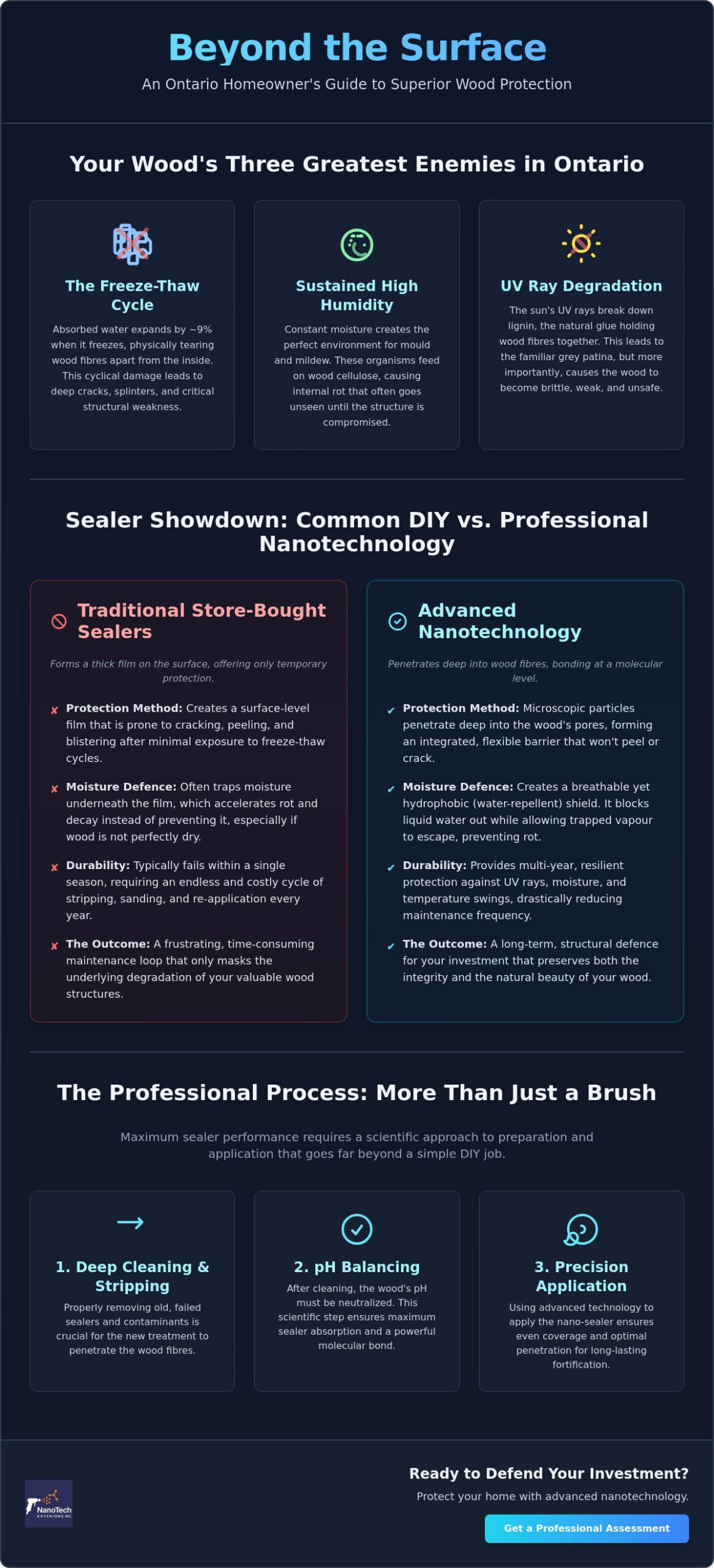
The “Freeze-Thaw” effect remains the most significant threat to your outdoor structures. During our wet autumns, unsealed wood absorbs moisture like a sponge. When temperatures drop below zero, this trapped water crystallizes and expands by approximately 9 percent in volume. This expansion physically tears the wood fibres apart from the inside out. By the time spring arrives, the wood is riddled with micro-fissures that allow even more water to penetrate during the next rain. This cycle repeats until the wood becomes soft, spongy, and unsafe.
The Golden Horseshoe region also experiences sustained high humidity, particularly during our humid continental summers. This moisture lingers on unsealed surfaces, creating an ideal environment for mould and mildew to colonize the wood grain. These organisms don’t just look unsightly; they feed on the organic matter within the wood, further weakening the structure from within. Without a proper barrier, your deck or fence becomes a buffet for decay.
The Science of Wood Decay in Canada
Wood is a complex biological material. Cedar and pressure-treated lumber are composed of microscopic cells that naturally hold moisture. However, when these cells become oversaturated, they provide the perfect breeding ground for wood-destroying fungi. Internal rot often begins deep within the board, remaining invisible from the surface until the structural integrity is completely lost. Irreversible decay typically begins when the internal moisture content of the wood remains above 20 percent for an extended period, as this is the threshold where fungal spores can actively consume the wood’s cellulose. Understanding wood finishing techniques is essential for preventing this saturation and maintaining a healthy moisture balance.
Aesthetic vs. Structural Preservation
Many homeowners view the “greying” of their deck as a purely cosmetic issue. In reality, this silver-grey patina is a sign that the sun’s UV rays have successfully broken down the lignin, the natural glue that holds wood fibres together. Once the lignin is gone, the wood becomes brittle and prone to splintering, making surfaces unsafe for bare feet. While some try to hide this damage with thick paints, this often traps moisture inside and accelerates rot. True protection requires exterior wood sealing services that penetrate the grain to block UV rays and repel water. If you want to protect your investment, exploring wood sealing Burlington Ontario can help you realize the difference between a temporary fix and a permanent defence.
Comparing Exterior Wood Sealing Technologies
Selecting the right formula for exterior wood sealing services requires moving beyond simple aesthetic preferences and into the realm of material science. Not all sealers are created equal; the chemical composition of the product determines how it interacts with wood fibres and how long it will survive an Ontario winter. Most homeowners are familiar with the basic categories of transparent, semi-transparent, and solid sealers. Transparent options allow the natural grain to remain the focal point but offer the least protection against UV-driven lignin breakdown. Solid sealers provide a “sunscreen” effect with heavy pigments, yet they often behave like paint, forming a film that is prone to peeling on high-traffic horizontal surfaces.
The chemical base of the sealer is equally critical to its performance. Traditional oil-based sealers are known for deep penetration, but they often come with high VOC levels and slow drying times that can be interrupted by unpredictable weather. Water-based alternatives have improved significantly, offering an eco-friendly profile and faster drying, though they sometimes lack the depth of penetration required for older, more porous wood. Nanotechnology represents the modern standard in wood preservation. By using microscopic particles that bond at the molecular level, these treatments create a hydrophobic barrier that repels water without changing the wood’s appearance or texture.
Why Hardware Store Sealers Often Fail After One Winter
The primary reason DIY products fail is a lack of “solids content.” Retail-grade sealers are often diluted with high levels of solvents that evaporate, leaving behind a thin, brittle layer that cannot withstand the expansion and contraction of wood. Professional-grade products typically last 3 to 5 times longer because they are engineered to penetrate the surface rather than just sitting on top. According to the National Park Service guide to wood preservation, managing moisture is the most vital step in preventing biological decay. Nanotechnology achieves this by making the wood fibres themselves water-repellent while maintaining a “breathable” structure that allows internal vapours to escape.
Choosing the Right Finish for Your Structure
Horizontal surfaces like decks endure the most environmental stress, from standing snow to constant foot traffic. These areas require penetrating sealers that won’t flake or peel under friction. Vertical surfaces, such as fences or siding, can accommodate heavier pigments for enhanced UV protection. To realize the best return on your investment, it’s essential to match the sealer technology to the age and condition of the wood. Older, weathered wood often needs the deep-reaching fortification of a penetrating treatment to restore its structural integrity. If you want to ensure your outdoor space is protected with the right technology, you can explore our specialized sealing solutions to find the perfect fit for your home.
The Professional Wood Sealing Process: Beyond the Brush
The secret to a durable finish isn’t found in the brush, but in the hours of technical preparation that occur before the sealer even arrives on site. Many homeowners assume that applying a fresh coat of product is a simple weekend task. However, professional exterior wood sealing services involve a methodical, multi-step restoration process designed to maximize the lifespan of the wood fibres. This journey begins with deep cleaning and chemical pH balancing to remove grey, UV-damaged fibres and organic growth like mould or mildew. Without this step, you are simply sealing the decay into the structure.
Mechanical preparation follows the cleaning phase. Precision sanding is a technical requirement to remove “mill glaze” on new lumber or to open the pores of older wood that has become hardened by the sun. This ensures the sealer can actually penetrate the cellular structure rather than just sitting on the surface. We also utilize moisture content testing as a non-negotiable standard. If the wood is too damp, the sealer will be pushed out as the internal water evaporates, leading to premature flaking and failure.
The Critical Importance of Surface Preparation
Applying a high-tech sealer to a dirty or damp surface is a recipe for immediate failure. We use specialized wood brighteners during the cleaning phase to restore the wood’s natural acidity and force the pores to open. This chemical reset is what allows the product to “drink” deep into the grain. While many believe a high-pressure blast is sufficient, power washing alone is rarely enough for professional results because it often shreds the wood fibres without removing the microscopic contaminants that block sealer absorption.
Application Standards for Longevity
Timing is everything when it comes to the final application. We carefully monitor weather windows, specifically avoiding high-noon applications in the peak of summer when the hot sun can cause the sealer to flash-dry before it can penetrate. Our team utilizes a combination of professional-grade spraying for uniform coverage and a manual “back-brushing” technique. This physical agitation forces the sealer deep into the grain, ensuring every nook and cranny is fortified. Throughout the process, we prioritize environmental safety by protecting your gardens, lawn, and surrounding stonework from overspray. This disciplined approach is why professional exterior wood sealing services provide a level of protection that a standard DIY effort simply cannot match.
Maintenance and ROI: Is Professional Sealing Worth It?
Homeowners often view exterior wood sealing services as a recurring expense rather than a capital investment. However, when you consider the replacement costs of cedar or pressure-treated lumber in 2026, the financial logic shifts. A neglected deck in the Golden Horseshoe can deteriorate to the point of structural failure in less than a decade. Replacing that same structure today involves significant material costs and labour fees that far exceed the price of a proactive maintenance plan. By investing in professional-grade protection, you are effectively extending the life of your wood by several decades, ensuring that your initial investment remains an asset rather than a liability.
Beyond the structural benefits, a well-maintained outdoor space significantly impacts property value in the Southern Ontario market. Curb appeal is a primary driver for resale; a vibrant, protected deck suggests a home that has been meticulously cared for. Conversely, a grey, splintered fence or deck can be a major red flag for potential buyers, often leading to lower offers or demands for replacement credits. Safety is another critical factor. Professional sealing prevents the wood from developing “soft spots” or structural weaknesses in high-traffic areas, reducing the risk of accidents and ensuring a splinter-free surface for your family.
Calculating the Long-Term Savings
The 10-year cost of DIY maintenance is deceptively high. While a bucket of hardware store sealer seems affordable, the frequent need for stripping, sanding, and reapplication every 12 to 18 months creates a heavy burden of both time and money. Professional treatments are engineered to last significantly longer, often extending the maintenance cycle to three or five years. This longevity prevents “cupping” and “warping,” where the boards twist and pull away from the frame to create dangerous trip hazards. For homeowners looking to protect their entire property, combining these efforts with concrete sealing Burlington Ontario ensures that both your wood and masonry structures are fortified against the same environmental stressors.
Signs Your Wood Needs Immediate Professional Attention
You don’t need to be a contractor to realize when your wood is in trouble. The simplest check is the “Water Bead Test.” Pour a small amount of water onto various sections of your deck; if the water soaks in immediately rather than forming distinct beads, your current seal has failed. Another early warning sign is “fuzzing,” where tiny wood fibres begin to stand up on the surface. This indicates that the lignin is breaking down and the structural integrity is beginning to fail. If your wood looks “thirsty” or dull, it is likely already absorbing moisture that will expand and cause damage during the next freeze-thaw cycle. To avoid expensive repairs, you should request a professional assessment before the next season begins.
NanoTech Exteriors: Advanced Protection for Your Home
Choosing a partner for your exterior wood sealing services shouldn’t feel like a gamble. At NanoTech Exteriors, we approach wood preservation with the same scientific rigour we apply to our roof and concrete services. Our heritage is rooted in nanotechnology, a field that allows us to offer protection at a molecular level. We don’t just apply a surface coating; we utilize treatments that penetrate deep into the wood fibres to create a permanent, hydrophobic shield. This disruptive approach to traditional maintenance is why we’ve become a trusted name for homeowners who value efficiency and long-term results.
As an authorized GoNano dealer, we provide access to exclusive, scientifically-backed sealing treatments that are not available in retail stores. This product is specifically engineered to defend against water, stains, and organic growth without altering the natural aesthetic of your wood. Because we serve the Burlington, Hamilton, and Niagara regions, we have a deep understanding of the local environmental stressors that cause premature wood failure. Our team combines this regional expertise with premium technology to ensure your outdoor structures remain resilient for years to come.
The NanoTech Difference in Wood Care
We believe that professional results require professional tools. Our team utilizes specialized application equipment designed to ensure perfectly even coverage, even on complex structures like multi-level decks or intricate privacy fences. We prioritize transparency in our pricing and take an educational approach to every project. We want you to understand exactly how our process works and why it provides superior value. Burlington homeowners often choose us for our integrated maintenance approach, realizing that protecting their wood, concrete, and roof under one professional standard is the most logical way to preserve their home’s total value.
Get Your Professional Sealing Estimate Today
Starting your restoration journey is a straightforward, low-friction process. We begin with a comprehensive local site assessment where our expert guides evaluate the current moisture content and structural health of your wood. During this consultation, we provide an honest appraisal of what your structure needs to achieve maximum longevity. You won’t face high-pressure sales tactics; instead, you’ll receive a clear, logical plan for fortification. Protect your deck and fence today—Request your free estimate from NanoTech Exteriors and gain the peace of mind that comes with scientifically-proven protection.
Fortify Your Outdoor Living Space for the Decades Ahead
Protecting your deck or fence from Ontario’s volatile freeze-thaw cycles is a matter of structural preservation rather than simple aesthetics. We have explored how professional preparation and molecular-level penetration provide a defence that standard hardware store products cannot replicate. By choosing specialized exterior wood sealing services, you move away from the exhausting yearly maintenance cycle and toward a long-term solution that preserves both safety and property value. Realizing the full lifespan of your lumber requires more than a surface film; it requires a deep-reaching barrier that remains breathable while repelling moisture.
NanoTech Exteriors brings a scientific edge to home maintenance. As an Authorized GoNano Dealer serving Burlington and Hamilton since 2026, we utilize specialized nanotechnology protective coatings to ensure your wood remains resilient against UV damage and rot. This disciplined approach eliminates the guesswork and provides the peace of mind you deserve as a homeowner. Our commitment to transparent, educational service ensures you understand the value of every treatment we apply.
Secure Your Home’s Value—Book Your Wood Sealing Assessment
Take the first step toward a worry-free outdoor season and a more durable home today.
Frequently Asked Questions
How often should I have my exterior wood surfaces sealed in Ontario?
Most exterior wood surfaces in Ontario require professional attention every two to three years to combat the effects of our intense freeze-thaw cycles. However, the exact frequency depends on the type of product used and the wood’s exposure to the elements. Advanced exterior wood sealing services that utilize nanotechnology can often extend this window, as the molecular bond is far more resilient than traditional surface coatings.
Can I apply sealer over old stain or paint, or does it need to be stripped?
You cannot apply a penetrating sealer directly over old paint or solid stains because these existing layers block the wood’s pores. For a sealer to be effective, it must reach the internal fibres of the lumber to create a moisture barrier. We require the removal of any old, flaking, or film-forming finishes through chemical stripping or precision sanding before a new protective treatment is applied.
What is the best time of year to schedule wood sealing services in the GTA?
The optimal window for wood sealing in the Greater Toronto Area is from late spring to early autumn, specifically between late May and early October. We look for consistent temperatures between 10°C and 32°C to ensure the sealer cures correctly. It is also essential to have a dry forecast for at least 24 to 48 hours to prevent moisture from interfering with the bonding process.
How long does the wood need to dry after sealing before I can use my deck?
You can typically walk on your deck in clean socks or soft shoes about 24 to 48 hours after the final application is complete. While the surface may feel dry within a few hours, the internal curing process takes longer to reach full strength. We recommend waiting a minimum of 72 hours before returning heavy patio furniture, grills, or allowing pets with sharp claws onto the newly sealed surface.
Is professional wood sealing eco-friendly and safe for my pets and plants?
Modern professional sealing treatments are designed to be environmentally responsible and safe for your household. We utilize low-VOC formulas that don’t release harmful vapours into your living space and are non-toxic to pets and gardens once dry. Our technicians also take specific precautions to shield your surrounding landscape and lawn from any overspray during the application process.
What is the difference between a wood stain and a wood sealer?
A wood stain is primarily used to change the colour of the lumber using pigments, whereas a sealer is a functional coating designed to repel water and block UV rays. While many exterior wood sealing services use products that offer both benefits, the sealer is the component that prevents structural rot and fibre breakdown. A dedicated sealer focuses on fortification rather than just changing the appearance of the wood.
Can you seal pressure-treated wood, or should I wait for it to age?
You should seal pressure-treated wood, but you must wait about 30 days after installation to allow the lumber to dry. New pressure-treated wood is often saturated with chemical preservatives that prevent a sealer from soaking in correctly. Once the wood has had time to weather and the internal moisture levels have dropped, it will be ready to “drink” the sealer for long-term protection.
How much does professional wood sealing cost compared to a DIY project?
Professional sealing carries a higher initial cost than a DIY project but provides a significantly better return on investment over a ten-year period. Retail-grade sealers often fail within 12 to 18 months in the Ontario climate, requiring you to sand and re-apply the product almost every year. Professional applications last much longer and prevent the expensive structural warping or rot that often leads to total board replacement.