What if the massive $14,000 bill for a new roof is actually a cost you can avoid for another decade? Most homeowners assume that curling or brittle surfaces mean the end of the line, but learning how to restore aging shingles is actually a matter of chemistry, not just construction. As shingles age, they lose the essential oils that keep them flexible and waterproof. When these oils evaporate, your roof becomes a ticking clock of potential leaks and lost curb appeal.
It is stressful to watch your home’s first line of defence weather another harsh Ontario winter while worrying about aggressive sales tactics from traditional roofers. We understand that you want a solution that is both logical and cost-effective. This guide will show you how to chemically replenish and protect your roof to avoid the heavy expense of a full replacement. You will discover how nanotechnology can extend your roof’s life by 10 to 15 years, allowing you to maintain your home’s value while saving up to 80% compared to traditional methods. We will walk through the science of rejuvenation and the specific steps to fortify your shingles for the long term.
Key Takeaways
- Identify the specific signs of oil loss and environmental wear that compromise your roof’s structural integrity over time.
- Master the simple “Flexibility Test” and visual inspection techniques to determine exactly how to restore aging shingles before a full replacement becomes mandatory.
- Understand the mechanics of spray-applied nanotechnology and how it fortifies the asphalt mat at a molecular level to restore pliability.
- Calculate the financial advantage of the “85% Rule” to significantly reduce maintenance costs and avoid expensive landfill disposal fees.
- Build a proactive five-year maintenance cycle designed to protect your home against the specific stressors of Southern Ontario weather.
Understanding Why Asphalt Shingles Age and Lose Integrity
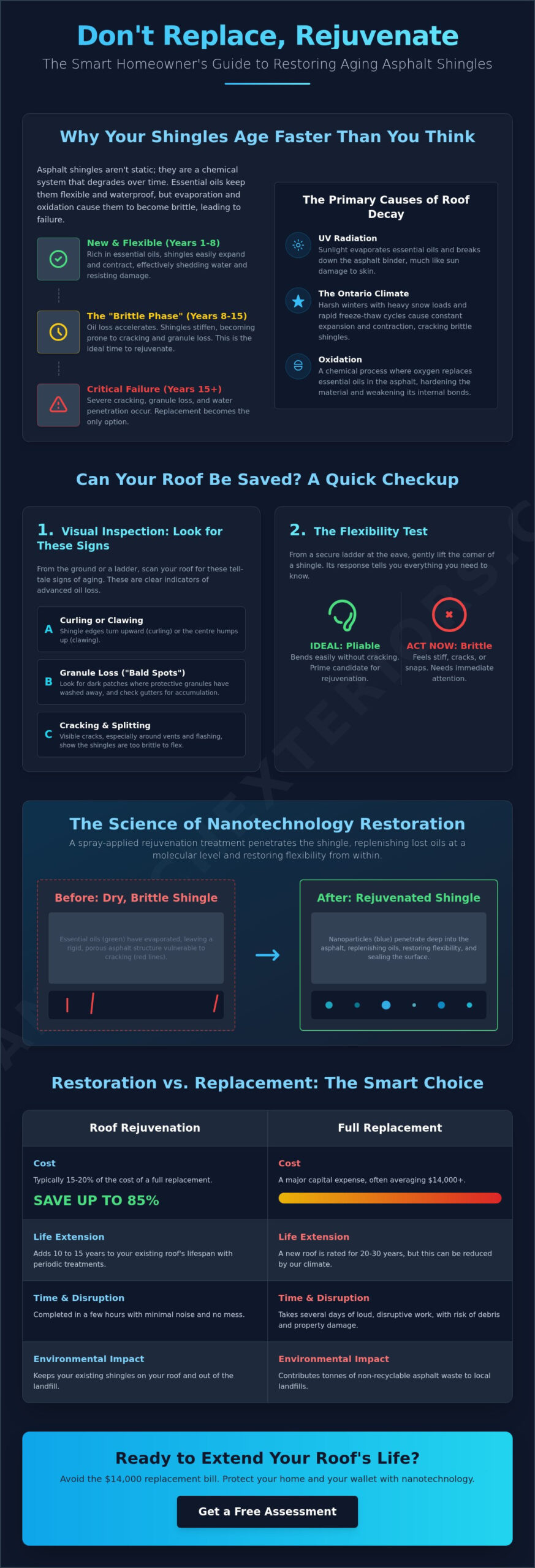
Most homeowners view their roof as a static shield, but it is actually a dynamic chemical system. To understand what asphalt shingles are made of, you have to look at the petrochemical oils that act as the primary binder. These oils are what allow the asphalt mat to remain flexible and shed water effectively. When shingles are new, they can expand and contract easily. As these oils evaporate over time, the shingles lose their pliability, leading to a cascade of structural issues that compromise your home’s protection.
The loss of these oils marks the beginning of the “brittle phase.” This is the specific point where the material can no longer handle physical stress without breaking. When a shingle becomes dry and rigid, it begins to crack under the pressure of foot traffic or simple wind uplift. This process eventually leads to granule loss. Those tiny ceramic stones are not just for colour; they protect the asphalt from the sun. Once the binder weakens, the granules fall off, leaving the asphalt exposed to even faster degradation. Learning how to restore aging shingles starts with identifying this cycle before it reaches the point of total failure.
The Impact of the Ontario Climate on Shingle Life
Residents in Burlington and Hamilton face a unique set of environmental stressors. Our region is famous for rapid temperature swings that cause significant thermal expansion stress. During a single day, your roof can heat up under direct sun and then rapidly cool during a lake-effect rainstorm. This constant “stretching” of the material is manageable when shingles are oily and flexible, but it is devastating once they have dried out. If the shingles cannot move, they crack.
Heavy snow loads add another layer of complexity. In Southern Ontario, the weight of accumulated snow puts immense pressure on the roof deck. If your shingles are in a brittle state during the winter freeze-thaw cycle, they cannot shift to accommodate this weight. This lack of flexibility is why a shingle rated for 25 years often fails by year 12 in the Golden Horseshoe. The local environment simply works faster than the manufacturer’s laboratory estimates, making it vital to understand how to restore aging shingles before the damage becomes structural.
The Chemistry of Asphalt Decay
The core reason for this breakdown is a process called oxidation. Oxidation occurs when oxygen molecules replace the essential oils within the asphalt binder, causing the material to lose its internal bond. This chemical shift is the primary cause of shingle brittleness. As the asphalt hardens, it loses its “grip” on the protective surface granules. Without those granules, UV radiation hits the asphalt directly, accelerating the evaporation of any remaining oils. It is a self-reinforcing cycle of decay that eventually leaves your home vulnerable to water penetration.
How to Assess Your Roof: Can These Shingles Be Saved?
Assessing your roof doesn’t require a contractor’s license, just a keen eye for specific patterns of wear. Before deciding how to restore aging shingles, you must determine if the asphalt mat is still structurally sound enough to receive treatment. Look for “curling,” where the edges of the shingles turn upward, or “clawing,” where the centre of the shingle humps up while the edges stay flat. These are clear indicators of advanced oil loss. If you see “bald spots” where the ceramic granules have washed away, the underlying asphalt is currently exposed to accelerated UV damage.
You can perform a simple “Flexibility Test” from a ladder at the eave. Gently lift the corner of a shingle and try to bend it slightly. If it feels pliable and moves without resistance, it is an ideal candidate for restoration. If it snaps or cracks with minimal pressure, the oxidation process is advanced. While restoration can still help at this stage, it’s far more effective to catch the shingles before they become as brittle as a cracker. If you’re unsure about your roof’s current state, a professional roof rejuvenation assessment can provide the clarity you need.
Timing is everything when it comes to maintenance. Rejuvenating your roof at year 10 or 12 is significantly more effective than waiting until year 18. At the ten-year mark, you’re replenishing oils before the brittle phase causes irreversible cracking. It’s also wise to check your attic for signs of deck rot. Surface aging is a chemical issue that is easily fixed; however, rotting plywood or mouldy insulation indicates a structural failure that restoration cannot address. For homeowners who want to take a broader approach, our guide on how to extend roof life without replacement covers the full range of proactive strategies available to Ontario homeowners.
The Homeowner’s Roof Health Checklist
- Step 1: Check your gutters. Granules look like coarse, dark sand. Excessive accumulation in the troughs means the asphalt binder is no longer holding the protective surface in place.
- Step 2: Look for “crazing.” These are tiny, spider-web-like cracks on the shingle surface. They are the first physical signs that the internal oils have evaporated.
- Step 3: Verify attachment. Shingles should still be firmly attached to the mat. If they are flapping in the wind or easily lifted, the adhesive strips have likely failed.
When Rejuvenation is NOT the Answer
Restoration has its limits. If your roofline is sagging or you have widespread interior leaks, the issue usually lies in the decking or underlayment rather than the shingles themselves. We generally follow the “20% Rule”: if more than 20% of the shingles are missing or physically destroyed, a full replacement is the safer, more logical choice. You can consult our guide on how to tell if your roof needs replacing for a more detailed breakdown of these critical warning signs.
The Science of Restoration: How Spray-Applied Nanotechnology Works
Roof rejuvenation is a precision-engineered, spray-applied treatment that utilizes nanotechnology to penetrate deep into the asphalt mat. It isn’t just a surface coating; it’s a structural intervention. By understanding how to restore aging shingles at a molecular level, we can reverse the effects of years of environmental exposure. The GoNano technology we utilize is specifically designed to carry restorative bio-oils deep into the asphalt, reaching areas that standard top-coats simply cannot access.
This process effectively restores the molecular bond between the asphalt binder and the protective ceramic granules. When the shingle is replenished, it regains its ability to hold those granules in place, which stops the “balding” process. Additionally, the treatment creates a sophisticated hydrophobic barrier. This surface tension prevents water from soaking into the shingle mat, which is the primary cause of moss growth and internal rot in Ontario’s humid summers. Burlington homeowners dealing with Lake Ontario’s humidity can learn more about how a roof treatment spray Burlington residents trust addresses these specific local challenges.
Deep-Penetration vs. Surface Sealing
Many homeowners mistake surface-level sprays for a permanent fix. However, surface sealers fail because they don’t address the core issue of internal brittleness. Think of it as a moisturizer analogy: a surface sealer is like a raincoat, while rejuvenation is like hydrating the skin from within. Scientific testing shows that nanotechnology allows these restorative particles to reach the shingle core within 30 minutes of application, ensuring the entire material is fortified, not just the top layer. It’s the difference between a temporary shine and a structural renewal.
Environmental and Safety Benefits
Choosing restoration over replacement is a significant win for the environment. We use bio-based oils that are far more eco-friendly than the petroleum-heavy alternatives used in new shingle manufacturing. These treatments are entirely safe for your pets, your landscaping, and the local Ontario water systems. Beyond the chemistry, the physical impact is massive. By extending your roof’s life by up to 15 years, you are directly reducing landfill waste, keeping tonnes of asphalt out of local disposal sites. It’s a pragmatic choice for the planet and your wallet.
Comparing Restoration vs. Replacement: Making the Strategic Choice
Deciding between a total tear-off and a chemical treatment is a strategic business decision for your home. We often refer to the 85% Rule; restoration typically costs a fraction of a full replacement, often saving homeowners up to 80% compared to the price of new materials. When you choose to learn how to restore aging shingles rather than replace them, you avoid the massive labour costs and material markups associated with new asphalt. You also sidestep the logistical headache of disposal. A typical roof replacement for every 1,000 square feet of area produces about 1.5 tonnes of waste material. In Ontario, landfill fees for asphalt shingles can reach over $135 per tonne, and bin rentals in cities like Toronto can cost up to $650 per project. These hidden costs disappear when you opt for rejuvenation.
This approach allows you to follow the roof rejuvenation vs replacement logic that prioritizes asset management over simple disposal. By adding 5 to 15 years to your roof’s lifespan, the return on investment is immediate and mathematically sound. It is a sensible way to protect your largest asset without the unnecessary financial strain of a premature replacement.
Financial Breakdown for Southern Ontario Homeowners
Thinking in terms of “cost per year” provides the clearest picture of value. A new roof has a high upfront cost that must be amortized over its expected life, which we’ve already seen is often cut short by the Golden Horseshoe climate. Rejuvenation offers a much lower entry point while extending that amortization period. For Burlington real estate, maintaining curb appeal is essential for property value. A roof that looks and performs like new without the massive price tag of a total overhaul is a clear advantage. For a deeper look at the numbers, consult our roof rejuvenation cost Canada guide.
The “Disruption Factor”
Beyond the finances, consider the impact on your daily life. A full replacement is a major construction project. It involves 2 to 3 days of heavy noise, falling debris, and massive dumpster bins blocking your driveway. Restoration is a low-impact service. The application takes only 2 to 3 hours, involves no heavy machinery, and leaves zero mess behind. Busy families in Oakville and Hamilton value this efficiency because it provides peace of mind without the logistical chaos of a traditional roofing crew. If you are ready to see if your home is a candidate, you can book a roof rejuvenation assessment today.
Implementing a Long-Term Roof Maintenance Plan in Southern Ontario
Maintenance in Southern Ontario requires a shift from a “set it and forget it” mentality to a proactive lifecycle approach. It is about timing. Understanding how to restore aging shingles is the first step, but the second is scheduling that restoration within a strategic five-year maintenance cycle. By treating your roof every five to six years, you can effectively keep the asphalt in a “perpetual youth” state, preventing the brittle phase from ever taking hold. This methodical approach ensures your home remains protected while you avoid the massive capital expenditure of a full replacement. Homeowners looking for a comprehensive strategy should also review the proven methods to extend roof life without replacement, which outlines how nanotechnology fits into a broader long-term asset management plan.
Before any nanotechnology is applied, the surface must be properly prepared. This includes professional gutter cleaning and moss removal. Moss is particularly destructive in the humid Golden Horseshoe, as it roots into the asphalt mat and holds moisture against the binder, accelerating the oxidation process we discussed earlier. A clean, debris-free surface allows the restorative oils to penetrate evenly and reach the shingle core without obstruction. This preparation is a non-negotiable part of a professional restoration service.
Seasonal Maintenance for Shingle Longevity
Spring inspections are critical for identifying ice dam damage. Ontario winters put immense pressure on the eaves; if shingles were lifted or the sealant was compromised by ice, it needs to be addressed before the spring rains. Fall preparation ensures your shingles are chemically fortified and sealed before the first freeze-thaw cycle begins. This seasonal vigilance prevents minor issues from becoming structural failures. For more localized advice on protecting your home, see our guide on roof rejuvenation Burlington Ontario.
Choosing the Right Restoration Partner
Choosing a restoration partner is about verifying technical expertise. Nanotechnology application is a precise science, so certification as a GoNano dealer is essential to ensure the treatment is applied at the correct saturation levels. You should also verify local reviews in Kitchener, Guelph, and Niagara to ensure the contractor understands the specific environmental demands of our region. A trustworthy partner focuses on education and long-term value, providing a transparent assessment rather than using high-pressure sales tactics. By mastering how to restore aging shingles through nanotechnology, you are choosing a smarter, more sustainable way to manage your property.
Proactive science is the only reliable way to protect your largest investment. By replenishing the oils your roof loses to the sun and snow, you maintain your home’s integrity for a fraction of the cost of a new roof. Schedule your free roof assessment with NanoTech Exteriors today.
Secure Your Home’s Future with Proactive Restoration
Your roof is more than just a surface; it is a structural asset that requires active management. We have detailed how petrochemical oil loss triggers the brittle phase and why understanding how to restore aging shingles is the most sensible way to stop that decay. By choosing nanotechnology, you are opting for a scientifically proven method to replenish your shingles from the inside out rather than settling for a temporary surface fix.
As an authorized GoNano dealer, NanoTech Exteriors provides a solution that saves up to 85% compared to the cost of a full replacement while extending your roof’s life by up to 15 years. This approach allows you to maintain your home’s curb appeal and structural integrity without the stress or mess of a massive construction project. It is time to move away from the traditional “tear-off” cycle and embrace a more efficient, sustainable alternative. Get Your Free Roof Rejuvenation Quote and take the first step toward long-term peace of mind. Protecting your home has never been more straightforward or cost-effective.
Frequently Asked Questions
Can I restore aging shingles myself with a store-bought spray?
No, you cannot achieve professional results with consumer-grade products. Professional nanotechnology requires specialized equipment and high-concentration bio-oils that aren’t available in retail stores. Learning how to restore aging shingles effectively involves deep-pore penetration rather than just a surface seal. Store-bought sprays often lack the molecular weight to reach the shingle core, meaning they evaporate quickly without providing long-term protection or flexibility.
How long does the roof restoration process take to complete?
A typical residential application takes between two and three hours to complete. This is one of the primary advantages over a full replacement, which can disrupt your home for several days. Our crews arrive, protect your landscaping, and apply the treatment efficiently. Because there is no tear-off or heavy construction involved, you can return to your normal routine immediately after we finish the application.
Will rejuvenation fix a roof that is already leaking?
Rejuvenation will not stop an active leak that is caused by damaged underlayment or structural issues. It is a preventative chemical treatment designed to fortify the asphalt shingles themselves. If your roof is already leaking, you likely need a specific roof repair or a full replacement. We recommend a thorough inspection to determine if the leak is a surface-level issue or a deeper structural failure before applying any treatment.
Is the spray treatment safe for my garden and pets?
The spray-applied treatment is entirely safe for your pets, plants, and the surrounding environment. We use bio-based oils that are non-toxic and biodegradable. Unlike petroleum-heavy roofing materials, these oils don’t pose a risk to Ontario’s local water systems or your garden’s soil health. You don’t need to worry about harmful fumes or chemical runoff affecting your family or your landscaping during or after the process.
Does roof rejuvenation change the colour of my shingles?
Rejuvenation does not change the colour of your shingles, but it does restore their original dark lustre. As shingles age and lose granules, they often take on a faded, grey appearance. By re-bonding the remaining granules and saturating the asphalt, the treatment brings back the rich, saturated look of a newer roof. It improves curb appeal significantly without the need for artificial dyes or pigments.
Can I apply restoration treatment to a roof with moss or algae?
You must have your roof professionally cleaned to remove moss or algae before the treatment can be applied. Moss acts as a physical barrier that prevents the nanotechnology from reaching the asphalt mat. If applied over debris, the oils cannot penetrate deeply enough to be effective. Once the surface is clean and dry, the rejuvenation treatment actually helps prevent future growth by creating a hydrophobic, water-shedding surface.
How many years of life does nanotechnology treatment actually add?
A single application adds five years of life to your roof. However, because the treatment can be repeated up to three times, you can effectively extend the lifespan of your shingles by up to 15 years. This proactive approach allows you to manage your roof as a long-term asset rather than a disposable product. It is a logical way to maximize the value of your initial roofing investment.
What is the best time of year in Ontario to restore shingles?
The ideal time for roof restoration in Southern Ontario is between late April and early November. The shingles must be dry and the ambient temperature should be above freezing for the bio-oils to penetrate the asphalt mat properly. We schedule most of our work during the warmer months to ensure the nanotechnology can reach its full saturation potential within the 30-minute absorption window.