If you think a thick layer of waterproof “roof paint” is the best way to survive a brutal Ontario winter, you might be accidentally sealing in the very moisture that will rot your decking by spring. It’s completely understandable to feel overwhelmed by the rising cost of full roof replacements in 2026, which can now reach $20,000 for a standard detached home. You want a solution that actually works, but the technical jargon surrounding roof coating vs rejuvenation often feels more like a sales pitch than science. You shouldn’t have to guess whether a treatment is a legitimate restoration or just a temporary cosmetic fix.
In this guide, we’ll demystify the material science behind these two options. You’ll discover how a molecular-level treatment can add 10 or more years of life to your asphalt shingles by restoring their essential oils rather than just covering them up. We will explore why breathability is non-negotiable for our climate, how the 2025 Ontario Building Code updates impact your choice, and why restoring internal flexibility is the only way to ensure your roof survives the next decade of freeze-thaw cycles safely and effectively.
Key Takeaways
- Identify the “shingle crisis” caused by the loss of petrochemical oils and learn how molecular bonding restores original flexibility.
- Navigate the critical differences between roof coating vs rejuvenation, focusing on why surface-level “band-aids” can trap moisture and damage your home.
- Realize how a single GoNano treatment can add up to 15 years to your roof’s lifespan, providing a smarter alternative to the high cost of full replacement.
- Apply a professional 5-step diagnostic framework to spot red flags and confirm if your shingles are still eligible for scientific restoration.
- Support Ontario’s environmental goals by choosing a sustainable solution that diverts waste from local landfills while fortifying your home against extreme weather.
Asphalt Shingle Aging and the Rise of Liquid Roof Solutions
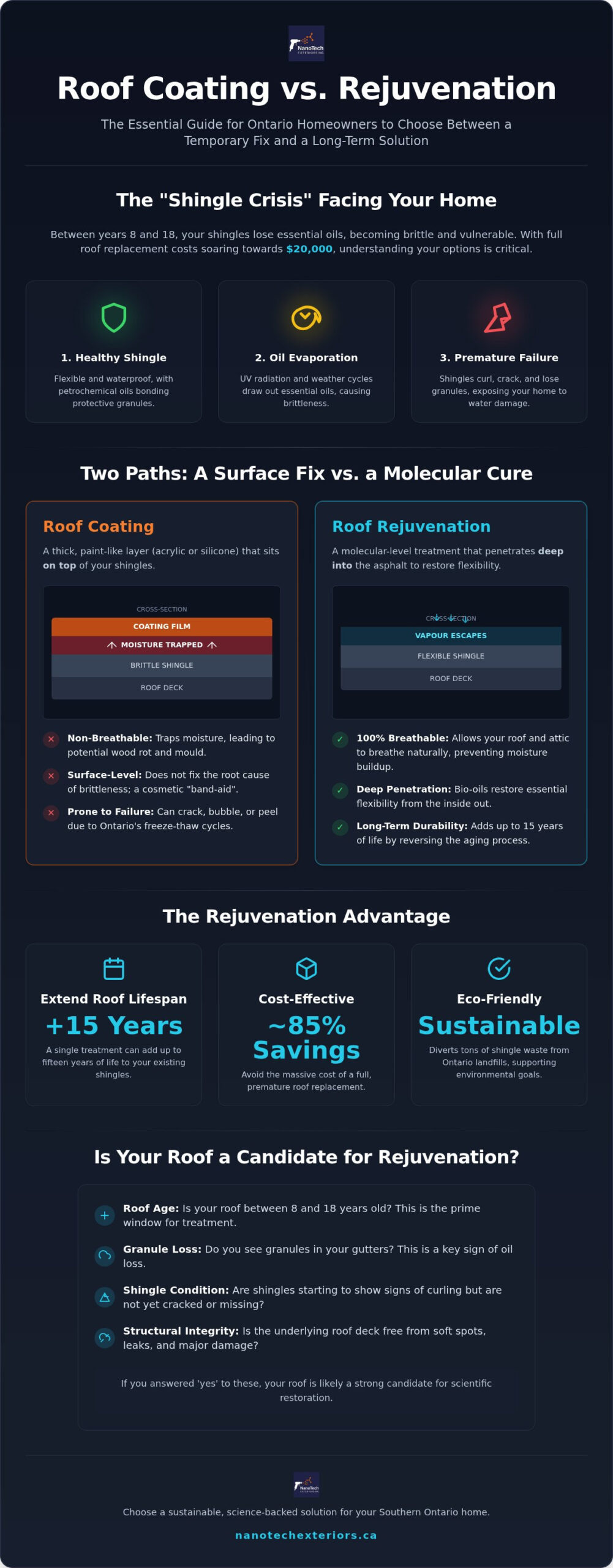
Most homeowners in Ontario realize their roof is in trouble when they see shingles curling or find heavy deposits of granules in the gutters. This typically happens between years 8 and 18 of a roof’s life, a critical period we call the “shingle crisis.” During this window, the shingles lose the petrochemical oils that keep them flexible and waterproof. Without these oils, the asphalt becomes brittle, leaving your home’s structural integrity vulnerable to water infiltration. As replacement costs for a standard home climb toward $20,000 in 2026, many are looking at liquid solutions to avoid a total tear-off. Understanding the debate of roof coating vs rejuvenation is the first step toward making a decision that protects your budget and your property.
The Chemistry of Shingle Failure
Asphalt shingles rely on bitumen, a heavy hydrocarbon that provides both waterproofing and essential flexibility. In Southern Ontario, our roofs face extreme thermal shock, swinging from 30°C summers to -20°C winters. UV radiation acts like a vacuum, drawing out the oils that bond the protective granules to the shingle surface. Once these oils evaporate, the shingles lose their ability to expand and contract during freeze-thaw cycles. This leads to micro-cracking and accelerated granule loss. When the protective granules are gone, the underlying asphalt is exposed to even more damage, creating a destructive cycle that ends in premature failure.
Why Traditional “Roof Paint” is a Risky Choice
A common misconception is that a fresh layer of “roof paint” can fix an aging roof. Historically, a roof coating was designed for flat, commercial structures where a thick, monolithic membrane is beneficial for preventing leaks on low-slope areas. However, applying these non-breathable acrylic or silicone layers to residential asphalt shingles is often a mistake. These products sit on the surface, potentially trapping moisture in your attic and roof deck. If the material cannot “breathe,” the trapped humidity can lead to mould growth or wood rot. While these coatings might improve the colour temporarily, they don’t address the underlying chemical drying of the shingle. Choosing between roof coating vs rejuvenation means deciding between a surface-level aesthetic fix and a deep restoration of the shingle’s internal chemistry.
Roof Coating vs. Rejuvenation: Understanding the Molecular Difference
To understand the debate of roof coating vs rejuvenation, you must look beyond the surface. A coating is essentially a topical layer, often an acrylic or silicone membrane, that adheres to the top of the granules. In contrast, rejuvenation is a molecular-level treatment that penetrates through the asphalt and reaches the fibreglass mat. This distinction is the difference between covering up a problem and chemically reversing it. One creates a visible, plastic-like film, while the other provides an invisible restoration that works from the inside out.
How Surface Coatings Work (and Where They Fail)
When homeowners compare roof coating vs rejuvenation, the issue of breathability is often the most overlooked factor. Coatings function by creating a physical film over the roof. While these can provide some benefit in terms of reflectivity, as noted by the EPA on Cool Roofs, they rely entirely on surface adhesion to stay in place. In Ontario, this is a major vulnerability. The constant expansion and contraction of shingles during our seasonal shifts cause these rigid films to crack, bubble, or peel over time. Most importantly, many coatings are non-permeable. This means they trap water vapour rising from your home’s interior within the roof deck. If that moisture cannot escape, it leads to wood rot, shingle “suffocation,” and eventual structural failure. It’s a surface-level fix that often creates deeper, hidden issues.
The Science of Penetrating Rejuvenation
Rejuvenation works through a completely different mechanism called molecular bonding. Instead of sitting on top, the treatment utilizes nanotechnology to carry bio-based oils deep into the shingle’s structure. This process re-saturates the brittle asphalt, restoring the flexibility that shingles lose as they age. Because it doesn’t form a film, the treatment is 100% breathable. It allows vapour to pass through naturally while still providing a hydrophobic barrier against external rain and ice. You won’t see a thick, artificial layer on your roof. Instead, you’ll have shingles that are chemically fortified to resist wind and impact. If you want to see if your roof is a candidate for this deep-level restoration, you can explore our specialized rejuvenation process to learn more about the science behind it.
Performance in the Canadian Climate: Breathability and Durability
Ontario homes face a unique set of environmental stressors that most roofing products aren’t designed to handle. While a roof in the southern United States only worries about UV degradation, a roof in Hamilton or Burlington must survive over 100 freeze-thaw cycles every year. When evaluating roof coating vs rejuvenation, durability isn’t just about how long the product lasts on a shelf. It’s about how the material behaves when the temperature drops 20 degrees in a single afternoon. In our climate, the ability to remain flexible is the only thing standing between a healthy roof and a costly leak.
Surviving the Ontario Freeze-Thaw Cycle
Thermal shock is the structural stress caused by rapid temperature fluctuations that force shingles to expand and contract beyond their physical limits. In the Golden Horseshoe, this happens constantly. Rigid surface treatments, while often highlighted by the Roof Coatings Manufacturers Association for their protective qualities on stable commercial surfaces, often fail on residential asphalt shingles. Because these coatings form a stiff film, they tend to crack when the shingle underneath shifts during a deep freeze. Rejuvenation takes a different approach by keeping the shingles pliable at a molecular level. By restoring the internal oils, the shingle retains its natural ability to move without fracturing, ensuring it remains intact even in sub-zero temperatures.
Moisture Management and Ice Dams
Breathability is the silent hero of a healthy Ontario roof. An airtight seal might sound like a benefit, but it’s often a recipe for structural rot. If a coating isn’t vapour-permeable, it traps warm, moist air rising from your attic against the underside of the shingles. This trapped heat can contribute to the formation of ice dams, where snow melts on the upper part of the roof and refreezes at the cold eaves. This process forces liquid water under the shingles and into your home. Rejuvenation avoids this risk entirely by allowing the roof to breathe. It repels liquid water from the outside while letting vapour escape from the inside. Before you commit to any treatment, it’s essential to use a checklist for telling if your roof needs replacing to ensure your shingles haven’t already suffered structural damage.
Heavy snow load also plays a role in the roof coating vs rejuvenation debate. A surface coating that has lost its adhesion due to moisture trapping will easily peel away under the weight and friction of a heavy snowpack. Rejuvenation doesn’t have a bond to lose because the treatment is absorbed into the shingle itself. During our humid summers, this internal fortification also provides a critical barrier against UV degradation, preventing the restored oils from evaporating and keeping your roof stable for years to come.
Choosing the Right Method: A Homeowner’s Diagnostic Checklist
Determining whether your home is a candidate for restoration requires a pragmatic look at the current state of your shingles. While the debate of roof coating vs rejuvenation often focuses on the products themselves, the real answer lies in your roof’s “Sweet Spot.” This is the window of time, typically between 8 and 18 years of age, where the asphalt has begun to dry out but the structural integrity remains intact. If you wait until the shingles are crumbling, no liquid intervention can save them. You must distinguish between wanting a better aesthetic and needing a structural solution that prevents a $20,000 replacement bill.
Step-by-Step Roof Self-Assessment
To help you decide, follow this five-step framework to evaluate your shingles from the ground or a sturdy ladder. If your roof meets these criteria, rejuvenation is likely your most cost-effective path. If it fails, you may need to consider a full replacement.
- The Age Factor: Is your roof at least 8 years old? This is when the manufacturing oils typically begin to evaporate in the Ontario sun.
- The Shingle Bend Test: Carefully lift the corner of a shingle. Does it feel pliable and bend easily, or does it snap like a dry cracker? Brittle shingles are the primary indicator that rejuvenation is required.
- Granule Accumulation: Check your downspouts and gutters. A small amount of grit is normal, but piles of granules suggest the adhesive oils are gone.
- Curling and Clawing: Look for edges that are turning upward (curling) or shingles that are humping in the middle (clawing). Minor curling can be stabilized, but advanced deformities often mean the fibreglass mat is damaged.
- Leak History: Restoration is a preventative measure. If you have active leaks or soft spots in the wood decking, you need a repair or replacement before any treatment can be applied.
When is a Surface Coating Actually Better?
There are specific scenarios where a surface coating is the superior choice. If you own a commercial building with a flat bitumen roof or a residential property with a metal roof, a high-quality silicone or acrylic coating provides a necessary waterproof membrane. These surfaces don’t rely on internal oils, so a topical layer makes sense. However, for residential asphalt shingles, a surface coating can be a liability because it fails to address the internal brittleness and can trap moisture. If your assessment reveals significant shingle loss or deck rot, you should consult a specialist in residential roofing in Burlington to discuss replacement options. If your shingles are simply dry and brittle, you can book a professional roof assessment to confirm if rejuvenation is the right move for your home.
NanoTech Exteriors: Sustainable Shingle Restoration in Southern Ontario
While roof coatings have specific use cases, other areas of your property require different protective measures. For homeowners interested in high-performance surface protection for their interiors, Drip Epoxy Flooring specializes in premium epoxy and polyaspartic installations for garage and basement floors.
NanoTech Exteriors functions as the authorized GoNano dealer for the Golden Horseshoe, providing a specialized alternative to traditional roofing methods. We lead with a pragmatic approach, focusing on the “Informed Innovator” mindset to solve the roof coating vs rejuvenation dilemma for local homeowners. Our mission is to restore your home’s structural integrity using nanotechnology that actually works with the shingle’s chemistry, rather than against it. We don’t believe in temporary fixes; we believe in scientific restoration that lasts.
Choosing restoration is a significant win for the environment. As Ontario transitions to standardized province-wide recycling programs in 2026, the importance of sustainable home maintenance has never been higher. By rejuvenating your shingles, you divert several tons of asphalt waste from local landfills. This isn’t just about being “green”; it’s about making a sensible, long-term decision for the community and your budget. It’s the type of forward-thinking choice that provides both financial relief and environmental peace of mind.
The GoNano Advantage for Asphalt Shingles
GoNano is not a generic “roof paint” or a surface-level film. It’s a bio-based treatment specifically engineered to integrate with shingle bitumen at a molecular level. While many surface coatings struggle to maintain adhesion through a single season, GoNano creates a bond that becomes part of the shingle itself. This scientific restoration provides more than just flexibility. It grants your roof a UL 2218 Class 4 impact rating, which is the highest industry standard for hail protection. Additionally, the treatment enhances fire resistance, adding an extra layer of safety to your property during dry Southern Ontario summers.
Every project we undertake includes a comprehensive “Roof Tune-Up.” We realize that a treatment is only as good as the surface it protects. Our team inspects the entire roof, securing loose shingles, sealing critical transition points, and addressing minor repairs before the nanotechnology is applied. This thorough preparation ensures your roof is in peak condition to receive the treatment. When combined with a 15-year lifespan extension, this process provides a level of security that a simple surface coating cannot match.
Serving Burlington, Hamilton, and the Golden Horseshoe
We are a local partner committed to the long-term health of homes in Burlington, Hamilton, Oakville, Niagara, Kitchener, Guelph, and Cambridge. Our expertise in the unique weather patterns of the Golden Horseshoe allows us to provide advice that is grounded in local reality, not generic sales scripts. We invite you to move past the confusion of technical jargon and choose a solution backed by proven results and scientific credibility. You don’t have to face the anxiety of an upcoming winter with a brittle, failing roof.
Taking the first step toward a protected home is straightforward and low-friction. You can get your free roof rejuvenation estimate today and discover how nanotechnology can save your budget while fortifying your shingles for the next decade of Ontario winters. Let us show you why the smart money in Ontario roofing is moving away from surface coatings and toward molecular rejuvenation.
Secure Your Home for the Next Decade
Understanding the science of roof coating vs rejuvenation is the difference between a temporary cosmetic fix and a genuine structural restoration. By choosing molecular rejuvenation, you ensure your shingles remain breathable and flexible enough to survive Ontario’s volatile freeze-thaw cycles. This modern approach doesn’t just cover up aging; it reverses the chemical drying that leads to failure. As an authorized GoNano dealer, NanoTech Exteriors offers a solution that saves you up to 85% compared to the high cost of a full replacement. With our 15-year transferable warranty, you gain long-term peace of mind and significantly increase your home’s resilience.
Don’t wait for the next winter storm to test your roof’s integrity. Take a proactive step toward fortification and value today. Request Your Free Roof Health Assessment to see if your shingles are ready for scientific renewal. Protecting your investment has never been more straightforward or sustainable. We are here to help you make the most informed decision for your home and your budget.
Frequently Asked Questions
Is roof rejuvenation just a type of roof coating?
No, roof rejuvenation is a molecular treatment that penetrates the shingle, whereas a coating is a topical film that sits on the surface. When comparing roof coating vs rejuvenation, the primary difference is how they interact with the asphalt. Rejuvenation restores the internal oils that keep shingles flexible. This is essential for homes in the Golden Horseshoe that face heavy snow and rapid temperature changes. It doesn’t peel or crack like a surface-applied film.
Will roof rejuvenation make my shingles look new again?
While rejuvenation isn’t just a paint, it does significantly improve the appearance of your roof. By re-saturating the shingles with bio-based oils, the treatment restores the deep, original colour of the asphalt. It won’t fix shingles that are already missing or severely curled. However, for most roofs in Oakville or Hamilton, the process results in a refreshed look that signals a healthy, flexible roofing system rather than a brittle, aging one.
Can I apply a roof coating over shingles that have been rejuvenated?
We don’t recommend applying a surface coating over rejuvenated shingles. The rejuvenation process creates a hydrophobic surface that repels liquids, which means a traditional coating won’t be able to bond effectively. In the debate of roof coating vs rejuvenation, rejuvenation is the more advanced choice because it solves the problem of brittleness from the inside. Applying a coating afterward would likely lead to peeling, moisture trapping, and wasted material.
How much longer will my roof last after a GoNano treatment?
A single GoNano treatment is designed to extend the lifespan of your asphalt shingles by up to 15 years. This is a major benefit for homeowners in Kitchener and Guelph who want to avoid the high cost of a total tear-off. By restoring the shingle’s flexibility and adding a UL 2218 Class 4 impact rating, the treatment ensures your roof can handle another decade of Ontario’s harsh weather cycles without structural failure.
Does roof rejuvenation trap moisture in my attic?
Does roof rejuvenation trap moisture in my attic?
No, rejuvenation is fully vapour-permeable, meaning it allows your roof to breathe. This is a critical advantage over many non-breathable coatings that can trap humidity in your attic and cause wood rot. Proper moisture management is vital for homes in the Niagara region, where humidity levels fluctuate. Rejuvenation keeps liquid water out while letting internal vapour escape naturally, maintaining the structural integrity of your roof deck and your home’s air quality. For a complete approach to moisture control, high-performance attic insulation from Third Coast Spray Foam can help stabilize your home’s internal environment.
Yes, the treatment is entirely safe for your surrounding environment. The formula is bio-based and won’t harm your landscaping, gardens, or pets during or after application. We take great care when working on homes in Burlington and Cambridge to ensure the process is clean and efficient. You don’t have to worry about harsh chemical runoff or toxic odours lingering around your property after the scientific restoration is complete.
Can I rejuvenate my roof if I already have a few leaks?
Rejuvenation is a preventative restoration, not a patch for active leaks. If your roof has existing leaks or structural damage, these issues must be addressed first. NanoTech Exteriors includes a professional “Roof Tune-Up” with every project to repair minor damage and seal transition points. If the leaks are indicative of a total structural failure, we will honestly advise you if a residential roof replacement is the only safe option.
How does the cost of rejuvenation compare to a roof coating?
While a simple “roof paint” might seem cheaper initially, rejuvenation offers far superior value and longevity. Professional rejuvenation costs up to 85% less than a full roof replacement and comes with a 15-year transferable warranty. It provides deep chemical restoration that generic coatings can’t match. For homeowners in the Golden Horseshoe, the long-term savings on energy and future repairs make rejuvenation the more pragmatic and cost-effective choice for protecting their investment.