What if that $15,000 quote for a full roof replacement is actually $13,000 more than you need to spend? After the relentless 2026 winter season, many homeowners in Burlington and Oakville are staring at curled shingles with a legitimate sense of dread. It’s common to fear that any visible roof damage after winter Ontario brings means your home’s first line of defence has failed. You want to protect your investment, but you don’t want to be pressured into an unbudgeted financial crisis by a contractor looking for a quick payout.
We understand the stress of managing post-winter repairs. This guide provides a clear framework to help you identify, assess, and cost-effectively manage winter-related issues specific to our Southern Ontario climate. We will help you distinguish between critical structural threats and simple cosmetic wear. You will discover how modern rejuvenation technology can extend your roof’s life for years, allowing you to avoid the massive expense of a total tear-off while still securing total peace of mind for the seasons ahead.
Key Takeaways
- Learn how to distinguish between cosmetic shingle wear and structural failures caused by the aggressive freeze-thaw cycles unique to Southern Ontario.
- Master a safe, ground-level inspection technique to spot roof damage after winter Ontario without ever needing to climb a ladder.
- Compare the financial and structural benefits of traditional repairs versus modern roof rejuvenation to avoid unnecessary replacement costs.
- Discover why the spring weather window in the Burlington and Hamilton corridor is the optimal time for applying protective shingle treatments.
- Understand how to extend your roof’s lifespan by restoring shingle flexibility with a 15-year warranty on rejuvenation services.
The Hidden Toll of Ontario Winters on Residential Roofing
The 2026 winter season across the Burlington and Hamilton corridor was uniquely punishing. While Northern Ontario typically deals with consistent, deep freezes, the Southern region suffered through a record number of rapid temperature swings. These fluctuations are more than just a weather pattern; they represent a mechanical assault on your home’s structure. Identifying roof damage after winter Ontario homeowners face is the first step in preventing a minor leak from turning into a $15,000 replacement bill.
You may notice missing shingles after a heavy storm, but the most dangerous issues are often invisible from the driveway. This “winter fatigue” is a cumulative process where the shingles lose their protective oils and flexibility. A proactive spring inspection is non-negotiable for maintaining your home’s value. It allows you to catch structural vulnerabilities before the humid Southern Ontario summer sets in, which can cause heat-related expansion and further deteriorate weakened materials.
The Freeze-Thaw Cycle: A Shingle’s Worst Nightmare
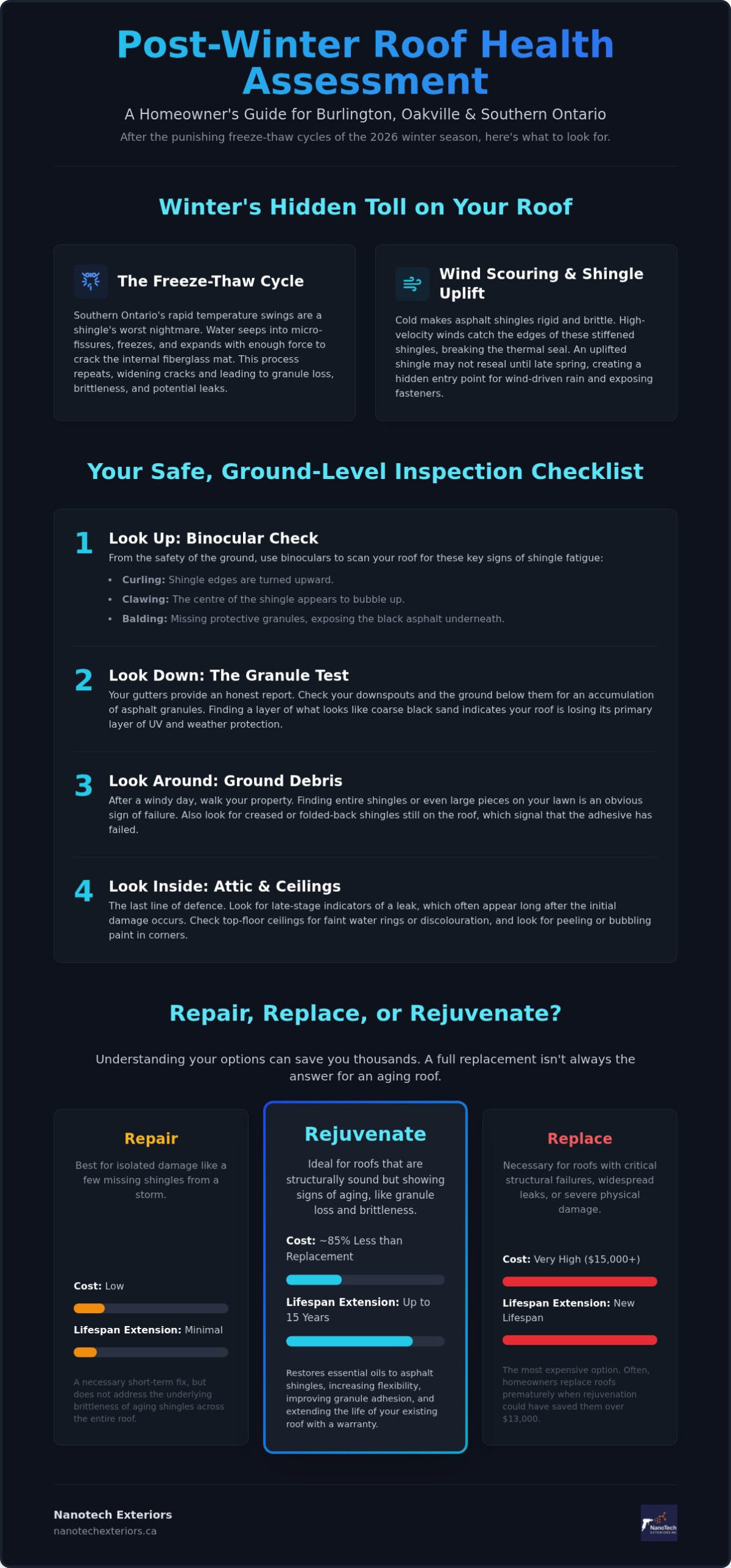
Water is relentless when it changes states. When moisture enters the micro-fissures of an aging asphalt shingle and freezes, it expands with enough force to crack the internal fiberglass matting. This process repeats hundreds of times during a typical Southern Ontario winter. Every time the temperature dips below zero, the cracks widen. This cycle is also the primary driver of ice formation at the roof’s edge. Homeowners often ask, What is an ice dam?, when they notice water backing up under their shingles. These dams trap moisture, forcing it into the roof deck where it can cause rot and mould. As the shingles become more brittle, they shed their protective granules, leaving the underlying asphalt exposed to damaging UV rays.
Wind Scouring and Shingle Uplift
Cold weather makes asphalt shingles inflexible and prone to breakage. When high-velocity winds hit the Niagara Escarpment and move through residential neighbourhoods, they catch the edges of these stiffened shingles. In the summer, shingles stay sealed together through heat-activated adhesive strips. In the winter, that bond can fail. Once a shingle is lifted by wind, it may not reseal until the consistent heat of late spring arrives. This creates a hidden vulnerability where wind-driven rain can reach the underlayment. Common signs of wind scouring include:
- Creased shingles: Shingles that have folded back but didn’t blow away entirely.
- Granule sludge: Large amounts of protective coating found in your gutters.
- Exposed nails: Lifted shingles that reveal the fasteners, creating a direct path for water.
While a few missing shingles might seem like a simple repair, they often indicate that the entire roof’s adhesive system is failing. Addressing roof damage after winter Ontario requires looking beyond the obvious gaps to ensure the entire surface is still bonded and watertight.
Identifying Critical Roof Damage: What to Look For
Critical damage isn’t always as obvious as a fallen tree limb. According to Ontario building standards, any condition that compromises the roof’s ability to shed water or maintain structural integrity is considered critical. When assessing roof damage after winter Ontario has left behind, you must look for signs that the shingle’s internal chemistry has failed. Asphalt shingles rely on bitumen oils to stay flexible; once these oils evaporate due to weather stress, the shingles become brittle and prone to failure.
Start your inspection from the safety of the ground. Use binoculars to look for “curling,” where the shingle edges turn upward, or “clawing,” where the centre bubbles while the edges stay flat. Both indicate the material is shrinking and cannot lie flush against the roof deck. Watch for “balding” shingles where the protective ceramic granules have worn away. This leaves the black asphalt underneath vulnerable to rapid UV degradation during the coming summer months.
Your gutters provide the most honest report on your roof’s health. Perform a “granule test” by checking your downspouts for asphalt sediment. If you find a layer of granules that looks like coarse black sand, your roof is shedding its primary line of defence. This shedding often accelerates after a harsh winter as ice moves across the shingle surface. If the damage seems widespread, a professional roof repair assessment can determine if the shingles are salvageable or require restoration.
Don’t forget to look inside. Water rings on ceilings or peeling paint in the corners of top-floor rooms are late-stage indicators of a leak. These signs often appear months after the initial damage occurred, as moisture slowly saturates the insulation and drywall. If you see these interior warnings, the “winter fatigue” has likely progressed into a structural vulnerability.
The Anatomy of an Ice Dam
Ice dams are a signature challenge for homeowners in the Golden Horseshoe. They form when heat escapes from your attic, melting the snow above. This meltwater runs down to the colder eaves and refreezes, creating a ridge of ice that traps subsequent runoff. To effectively prevent damage caused by ice dams, you must address attic temperature. Without proper ventilation, these dams force water under shingles, leading to rotted fascia boards and saturated roof decks.
Flashing and Chimney Leaks
Metal flashing and asphalt shingles expand and contract at different rates. During extreme cold, this physical tension often causes sealant to crack or metal to pull away from vertical surfaces. Chimneys and skylights are high-risk zones. Snow often sits against these structures for weeks; it provides a constant source of moisture that can seep through the smallest gap in the flashing. Check these vulnerable points for separation or rusted metal that could allow water to bypass your shingles entirely.
Your 5-Step Post-Winter Roof Inspection Checklist
Performing a systematic check is the most effective way to quantify roof damage after winter Ontario has delivered its worst weather. You don’t need a tool belt or a death wish to do this effectively. By following a logical progression from the ground up, you can build a comprehensive report of your home’s condition. This methodical approach helps you avoid the “storm chaser” trap and provides a clear basis for any professional discussions that follow.
- Step 1: Ground-level perimeter walk. Grab a pair of binoculars and walk the entire circumference of your property. Look for the curling and clawing mentioned earlier, but also pay attention to the alignment of your shingles.
- Step 2: Gutter and downspout audit. Check the discharge areas of your downspouts. Finding granule “sludge” or small pieces of asphalt indicates that the protective layer of your shingles is failing.
- Step 3: Attic “Daylight Test.” On a bright day, head into your attic and turn off all lights. If you see pinpricks of light coming through the roof deck, you have a direct path for water.
- Step 4: Drip edge and soffit examination. Look for water staining or peeling paint on the underside of your eaves. This often points to moisture that was trapped by ice dams during the winter.
- Step 5: Professional assessment for rejuvenation. Once you’ve identified potential issues, have a specialist verify if your shingles are candidates for nanotechnology restoration rather than a full replacement.
Safety First: Why You Should Stay Off the Ladder
Stay on the ground. Walking on a roof after a harsh winter is a gamble you don’t need to take. Post-winter shingles are often brittle; your footsteps can actually cause more damage by cracking the cold, inflexible material. Hidden soft spots in the roof deck, caused by slow leaks, can also lead to structural failure under your weight. Binoculars provide 90% of the information you need for an initial assessment without any physical risk. If your roof is too steep or you suspect significant structural rot, leave the close-up work to a licensed professional.
Documenting Damage for Insurance
If you find clear evidence of storm-related issues, documentation is your best friend. Take high-resolution photos of any lifted shingles or debris from the ground. Keep a simple log of significant weather events from the 2026 season to correlate with the changes you see. This evidence is vital if you need to prove the damage was sudden rather than a result of long-term neglect. For a deeper dive into evaluating your roof’s condition, consult our guide on How to tell if your roof needs replacing to see if your findings warrant a major intervention.
Repair, Replace, or Rejuvenate: Comparing Your Options
Once you identify roof damage after winter Ontario has left behind, you face three distinct paths. Most homeowners assume they have a binary choice: a temporary patch or a $15,000 replacement. This logic is outdated. Choosing the right intervention depends entirely on the current state of your shingles and your long-term budget goals. We advocate for the most sensible solution that provides long-term protection without unnecessary expense.
Traditional repairs are the most pragmatic choice for isolated physical trauma. If a stray branch cracked a specific section during a February gale, a targeted fix is efficient and cost-effective. However, if the issues are widespread, a full replacement may become necessary. This path is only unavoidable when structural integrity is compromised. If your roof deck is rotted or you have active leaks in multiple rooms that have saturated your insulation, a new roof is a safety requirement rather than a choice.
Roof rejuvenation serves as the modern middle ground. It is the ideal solution for shingles that are drying out and losing granules but remain structurally sound. By choosing rejuvenation, you can realize up to 85% in cost savings compared to the price of a total replacement. It is a disciplined way to protect your home and extend your roof’s life by up to 15 years without the massive financial strain of a full tear-off.
The Science of Roof Rejuvenation
Asphalt shingles fail because they lose their essential bitumen oils over time, a process accelerated by the harsh Southern Ontario climate. We use GoNano nanotechnology to restore these oils at a molecular level. This treatment creates a powerful molecular bond that forces shingles to shed water and resist UV rays more effectively. It is a sophisticated approach to material science that yields real-world protection. Beyond the financial benefits, it is an eco-friendly alternative. Rejuvenating your roof keeps thousands of kilograms of asphalt shingles out of Ontario landfills, making it the responsible choice for the environmentally conscious homeowner.
When is a Roof “Too Far Gone” for Rejuvenation?
There is a “point of no return” for every roofing system. Rejuvenation cannot fix rotted decking or structural sagging. If your inspection reveals widespread deck failure or moisture has already compromised your home’s interior, a full replacement is your only safe option. You need an honest assessment from a contractor who understands both traditional and modern methods to ensure you aren’t paying for a “quick fix” that won’t last. For a localized perspective on these treatments, consult our Roof rejuvenation in Burlington, Ontario: The Homeowner’s Definitive Guide. If you want to verify your roof’s integrity today, contact us for a professional residential roofing evaluation.
Taking Action: Southern Ontario Roof Recovery
Spring is the optimal season for addressing roof damage after winter Ontario has finally receded. The moderate temperatures of April and May create the perfect environment for asphalt shingles to regain their natural pliability. This weather window is also critical for the application of nanotechnology treatments, as the shingles must be dry and the ambient temperature must remain consistently above freezing. Waiting until the peak of summer heat can be a mistake; high UV levels and humidity can accelerate the deterioration of shingles that were already weakened by the January freeze.
Choosing a local partner in the Burlington or Hamilton area is vital for a successful recovery. Contractors who live and work in the Golden Horseshoe understand the specific wind patterns and moisture levels that affect homes along the Niagara Escarpment. We provide a specialized approach that focuses on value and longevity. By acting now, you secure your home’s exterior before the summer storm season begins, ensuring that minor winter fatigue doesn’t escalate into a structural crisis.
Preparing Your Property for Roofing Services
For homeowners who also manage secondary properties or seasonal cottages in the Muskoka region, you can check out Cardwell Property Services Inc. for expert construction and property maintenance services.
We aim to make the restoration process as efficient and non-disruptive as possible. Most rejuvenation projects are completed in a single day, requiring minimal downtime for your household. To prepare, we recommend clearing your driveway to provide our service vehicles with easy access to the roofline. Moving patio furniture or delicate planters away from the perimeter of the house is also a helpful step. For the safety of your family, please keep pets and children indoors while our technicians are on-site. Once the application is complete, the treatment is safe and requires no further maintenance from you.
The NanoTech Guarantee
We stand behind our work with a 15-year warranty on all rejuvenation services. This isn’t just a promise; it’s a commitment backed by our status as an authorized GoNano dealer. We serve homeowners across the Niagara and KWG areas with a focus on scientifically proven results rather than temporary fixes. Our goal is to provide you with total peace of mind, knowing your roof is fortified against future environmental stressors. Don’t let another season pass with an uncertain roof. Book your free post-winter roof inspection today.
Secure Your Home’s Future This Spring
Ontario’s 2026 winter was a significant stress test for every residential roof in the Golden Horseshoe. By now, you realize that ignoring the cumulative effect of freeze-thaw cycles only leads to more expensive structural failures. You have the tools to identify critical issues and the knowledge that a full replacement isn’t your only path forward. Choosing to rejuvenate your shingles instead of replacing them is the smart homeowner’s strategy for long-term value.
As a locally owned and operated team in Burlington, we help you save up to 85% compared to the cost of a new roof. Our nanotechnology restores the flexibility your shingles lost during the cold months, and we back that performance with a 15-year warranty. Effectively managing roof damage after winter Ontario requires a proactive approach backed by proven material science. Don’t wait for a minor leak to become a major disaster; take the first step toward lasting protection today.
Get Your Free Post-Winter Roof Assessment
Frequently Asked Questions
Is roof damage after winter covered by my Ontario home insurance?
Insurance coverage depends on the specific cause of the issue. Most Ontario policies cover sudden, accidental damage from windstorms or heavy hail. However, gradual “winter fatigue” or damage caused by a lack of maintenance is typically excluded. If your roof damage after winter Ontario was caused by an ice dam, some insurers may cover interior repairs but not the roof itself. It is best to review your policy with a local Burlington agent.
How much does it cost to fix a roof after a winter storm in Canada?
How much does it cost to fix a roof after a winter storm in Canada?
The cost varies significantly based on the scale of the restoration needed. Minor shingle replacements are relatively inexpensive compared to a full tear-off. For homeowners looking to maximize value, roof rejuvenation is a sensible alternative that costs up to 85% less than a total replacement. This allows you to restore the structural integrity of your shingles and extend their lifespan without the financial burden of an unbudgeted $15,000 project. For those comparing regional costs, Cleroux & Sons Roofing provides a comprehensive breakdown of pricing for the Windsor area.
Professional nanotechnology treatments require specialized equipment and authorized dealer certification to ensure a proper molecular bond. Attempting a DIY application with consumer-grade sealants often traps moisture inside the shingles, which can accelerate rot during the humid Southern Ontario summer. Professional application by a certified team ensures the treatment is even and effective. It also secures the 15-year warranty that protects your investment against future environmental stressors.
How long does a typical roof rejuvenation last in the Ontario climate?
A single application of GoNano technology is designed to extend the functional life of your asphalt shingles by up to 15 years. This treatment is specifically engineered to withstand the aggressive freeze-thaw cycles and intense UV exposure common in the Niagara and Hamilton corridor. We provide a 15-year warranty to give you total peace of mind. This long-term protection ensures your roof remains flexible and waterproof through many more Canadian winters.
What happens if I ignore minor winter roof damage until the summer?
Delaying repairs allows moisture to migrate from the shingles into the underlying roof deck and attic insulation. By the time the summer humidity arrives, trapped water can lead to rapid mould growth and structural wood rot. What began as a minor shingle issue in March can escalate into a full-scale replacement requirement by July. Addressing roof damage after winter Ontario early is the most effective way to avoid unnecessary and massive expenses.
Why are my shingles curling more after this winter than last year?
Curling occurs when asphalt shingles lose their essential bitumen oils and become dehydrated. The 2026 winter season in Southern Ontario featured an unusual number of rapid temperature swings, which accelerated this drying process. When shingles lose their flexibility, they can no longer expand and contract with the weather, causing the edges to lift or “claw.” This is a clear indicator that your roof’s primary material is failing and requires professional rejuvenation or repair.
Is nanotechnology roofing treatment safe for my family and pets?
The GoNano treatments we use are plant-based and environmentally friendly. The solution is specifically designed to be safe for people, pets, and the surrounding landscaping. Unlike traditional oil-based coatings, our nanotechnology does not produce harmful fumes or toxic runoff into your garden. Once the application has dried, which typically occurs within an hour, the treatment is completely inert and safe for your household to enjoy their outdoor spaces as usual.
Do I need a permit for roof repairs or rejuvenation in Burlington?
In most Southern Ontario municipalities, including Burlington, Hamilton, and Oakville, a building permit is not required for standard maintenance tasks like shingle repair or rejuvenation. These services are considered refurbishment of the existing structure. However, if your inspection reveals that the roof deck is rotted and requires a full structural replacement, a permit may be necessary. We can help you determine the local requirements during your initial professional roof assessment.