Most homeowners believe that a fresh coat of stain is the best way to save a weathered deck, but the truth is that traditional topical stains often do more harm than good. In Hamilton, where the freeze-thaw cycle is relentless, these surface-level coatings trap moisture against the wood fibres, leading to the very rot and peeling you were trying to prevent. If you’re tired of seeing your outdoor investment turn grey and flaky after a single season, you’re certainly not alone.
We realize how frustrating it is to invest time and money into maintenance only to face expensive replacement costs a year later. This guide to deck sealing Hamilton will show you how to move beyond temporary fixes and choose a smarter path for your property. You’ll discover how professional-grade rejuvenation treatments penetrate deep into the wood to provide a structural shield that survives the harshest winters. We’ll break down the science of wood protection, explain the impact of our local climate, and provide a clear strategy to restore your home’s curb appeal and structural safety for years to come.
Key Takeaways
- Understand how Hamilton’s high humidity and lakefront location accelerate wood rot and why standard stains fail to stop it.
- Learn why penetrating sealants outperform traditional topical stains by protecting wood from the inside out rather than just coating the surface.
- Discover the simple “Water Test” to determine if your current deck protection is failing or if your wood is at risk of structural damage.
- Professional deck sealing Hamilton services utilize nanotechnology to preserve wood fibres, helping you avoid the massive expense of a full deck replacement.
- Realize why high-pressure washing can be destructive and how proper preparation is the most critical step in a lasting restoration.
Protecting Your Investment: Why Deck Sealing in Hamilton is Critical
Living in the Golden Horseshoe means your outdoor structures face a unique set of environmental pressures. While a deck offers a perfect space for summer entertaining, it remains vulnerable to Hamilton’s specific weather patterns every day of the year. Without proper intervention, the wood fibres begin a slow process of degradation that eventually compromises the entire structure. Professional deck sealing Hamilton homeowners invest in isn’t just about aesthetics; it’s a necessary defensive measure against moisture and decay.
Hamilton Climate Stressors: Humidity and UV
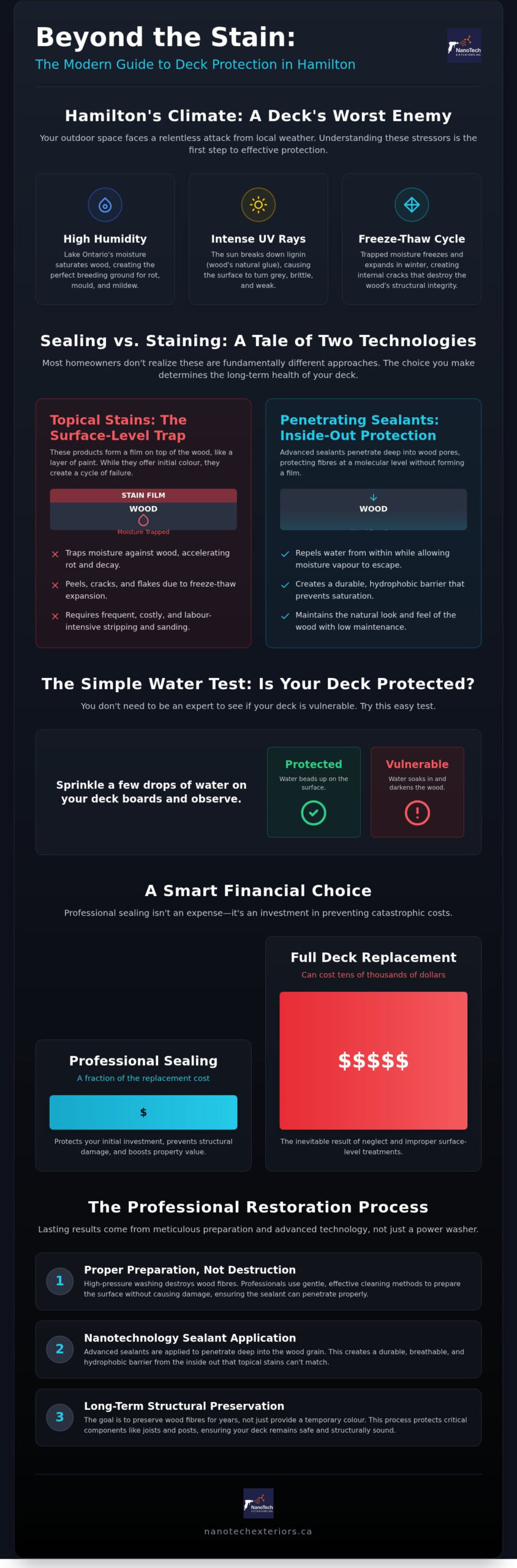
Lake Ontario creates a microclimate characterized by high humidity levels that rarely drop. This constant moisture saturates the wood, creating an ideal breeding ground for fungal growth and rot. During the summer, intense UV rays strike the surface, breaking down lignin, which is the natural glue that holds wood fibres together. This process turns the wood grey and brittle. Just as homeowners use specialized services like Mr Tint to protect their windows and interiors from solar damage, exterior wood requires a robust UV barrier to maintain its integrity. The real damage occurs during the rapid transition from a wet autumn to a freezing Ontario winter. When trapped moisture freezes inside the wood, it expands and creates internal fractures. This cycle of expansion and contraction, known as the freeze-thaw effect, eventually leads to deep cracks and structural failure.
The Economic Case for Professional Sealing
Choosing a preventative sealing strategy is a matter of basic economics. A full deck replacement in Southern Ontario can cost tens of thousands of dollars, whereas a professional rejuvenation treatment is a fraction of that expense. By sealing the wood, you protect the structural integrity of critical components like joists and posts. These elements are often the first to rot because they sit in the shade where moisture lingers longest. Beyond the financial savings, a well-maintained deck ensures the safety of your family. It prevents the warping and splintering that can lead to trips or injuries. A protected deck also retains its value, significantly boosting the curb appeal of your Hamilton property. If you plan to sell your home in the future, a pristine outdoor living space often provides a high return on investment that pays for the maintenance several times over.
Investing in protection now means you won’t be forced into a costly rebuild later. It’s a pragmatic choice that provides peace of mind, knowing your deck is fortified against whatever the Hamilton climate throws its way.
Deck Sealing vs. Staining: Which Offers Better Protection?
While many homeowners treat staining and sealing as interchangeable terms, they function in completely different ways at a material level. Choosing between them determines whether your deck looks great for six months or six seasons. Most people pick a stain based on a colour swatch at the hardware store, but the real decision is about how the product interacts with the wood’s cellular structure. Understanding the science behind these coatings is the first step toward avoiding the “peeling cycle” that plagues so many Hamilton properties.
Topical Stains: The Beauty and the Burden
Topical stains are film-forming barriers. They sit on top of the wood like a thin layer of paint or plastic. While they provide immediate, vibrant colour, they also trap moisture underneath the surface. When the Ontario winter hits, that trapped water freezes and expands, forcing the stain to detach from the wood. This creates a destructive cycle where you are forced to sand your deck back to bare wood every two years to fix the flaking. Additionally, dark topical stains absorb significant solar radiation, which increases the internal temperature of the boards and leads to premature cracking and warping.
Penetrating Sealants: Protection from the Inside Out
Advanced sealants work by entering the wood pores rather than sitting on top of them. Instead of forming a brittle film, these treatments organize at a molecular level to repel water from within. This allows the wood to “breathe,” meaning any internal moisture can escape as vapour rather than getting trapped and causing rot. Nanotechnology-based sealers are far more effective than standard hardware store oils because they create a durable bond that doesn’t wash away after a few heavy rainstorms. Hydrophobic protection is the ability of wood to shed water instantly. This prevents the saturation that leads to fungal growth and structural decay. By keeping the wood grain visible, these sealants maintain the natural aesthetic of your deck while providing a level of fortification that topical products cannot match.
In the context of deck sealing Hamilton homeowners often find that penetrating treatments offer the best balance of longevity and low maintenance. By using modern methods, you avoid the intensive labour of frequent sanding and re-staining. If you want to stop the cycle of annual repairs and protect your investment, a professional wood sealing treatment is the most logical investment for your outdoor space. This approach shifts the focus from temporary aesthetics to long-term structural preservation, ensuring your deck remains a safe and beautiful extension of your home.
The 2026 Hamilton Deck Health Check: Signs Your Wood is Failing
You don’t need a degree in material science to determine if your outdoor living space is at risk. Most structural failures start with subtle indicators that are easy to overlook if you aren’t trained to spot them. Catching these signs early is the difference between a simple rejuvenation and a total demolition. In our local climate, wood doesn’t just age; it’s actively attacked by the elements every day. A regular health check ensures that a minor maintenance issue doesn’t evolve into a five-figure replacement bill.
How to Perform a Professional Water Absorption Test
Testing the integrity of your wood’s current protection is a straightforward process. Take a tablespoon of water and pour it onto various sections of your deck. If the water beads up and remains on the surface, your current seal is still providing a functional barrier. However, if the water soaks into the wood within seconds, the fibres are completely exposed to the elements. This is a clear signal that the internal structure is vulnerable to saturation and rot.
Focus your testing on high-traffic areas, stair treads, and any sections that sit in direct sunlight. These spots experience the highest levels of friction and UV exposure, which causes protective coatings to fail sooner than in shaded or low-traffic zones. If you notice rapid soaking in these critical areas, it is time to prioritize deck sealing Hamilton homeowners use to fortify their structures. Consistency is key. If one part of the deck is drinking water while another is shedding it, your protection is uneven and failing.
Visual Red Flags Every Homeowner Should Know
UV damage is the most common silent killer of exterior wood. It manifests as “silvering” or a dull grey patina on the surface. This change in colour isn’t just an aesthetic shift; it indicates that solar radiation has stripped away the lignin that binds the wood fibres together. If the surface feels “furry” or fuzzy to the touch, the physical breakdown of the wood has already begun. You should also inspect the boards for “checking,” which are long cracks that run along the grain. This suggests the wood is severely dehydrated and losing its structural flexibility.
Structural rot is a more urgent concern. Use a screwdriver to gently press into any dark spots, especially near the ground, posts, or joists. If the wood feels soft or spongy and the tool sinks in, the integrity of the board is compromised. Much like knowing how to tell if your roof needs replacing, identifying these deck warnings early allows for targeted repairs. If you ignore these red flags, the moisture will continue to migrate deeper into the structure, eventually making the deck unsafe for use. Early detection allows us to preserve the existing wood rather than having to rebuild from scratch.
The Professional Sealing Process: Beyond the Power Washer
Many homeowners assume that a quick blast with a pressure washer is sufficient preparation for a new coat of sealer. This is the most common mistake in DIY maintenance and the primary reason why many projects fail within the first year. High-pressure water doesn’t just remove dirt; it physically destroys the soft wood fibres, creating a “fuzzy” surface that prevents proper adhesion. A professional approach focuses on chemical restoration and careful mechanical preparation to ensure the wood is actually ready to receive protection.
Step 1: Deep Cleaning and Restoration
Effective cleaning requires a balance of chemistry and patience. We avoid harsh chlorine bleach because it strips the natural colour from the wood and damages surrounding vegetation. Instead, professional treatments utilize oxygen-based cleaners that lift deep-seated dirt, mould, and greyed wood cells without compromising the structural integrity of the boards. This process reveals the fresh, healthy wood hidden beneath the weathered surface.
- pH Balancing: After cleaning, the wood’s pH must be neutralized with a brightening agent to open the pores and restore the natural wood tone.
- Airflow: Cleaning between the boards is essential. Debris trapped in the gaps restricts airflow, which is a major contributor to underside rot.
- Cellular Health: By removing the dead surface cells, we ensure the sealant bonds with live wood fibres rather than a layer of dust.
Step 2: Surface Preparation and Sanding
Once the wood is clean and dry, a light mechanical sanding is necessary. This isn’t about removing a thick layer of wood; it’s about “opening” the pores that may have closed during the drying process. For optimal deck sealing Hamilton results, we typically use a 60 to 80-grit abrasive. If the grit is too fine, it polishes the wood and prevents the sealant from penetrating. If it’s too coarse, the surface remains rough and uncomfortable for bare feet. If your deck has existing paint or solid stains, these must be completely stripped before a penetrating sealer can be applied. A sealant cannot protect the wood if it is blocked by an old, failing film.
Timing is the final critical factor. We use moisture meters to ensure the wood has reached the “perfect window” of dryness, typically below 15% moisture content. Applying sealer to damp wood traps moisture inside, which leads to immediate failure. If you want a result that lasts for five to seven years rather than five to seven months, trust a professional wood sealing expert to handle the technical details of the restoration process. Doing it right the first time is always more efficient than fixing a failed DIY attempt.
NanoTech Exteriors: Advanced Wood Preservation for Hamilton Homes
NanoTech Exteriors isn’t just another local contractor with a brush and a bucket. We’ve spent years identifying why traditional deck maintenance fails in the Golden Horseshoe and have sourced the specific technology required to fix it. Our approach to deck sealing Hamilton properties focuses on the long-term health of the wood rather than just a temporary change in colour. By treating the wood as a technical material that requires breathability and internal fortification, we provide a solution that outlasts hardware store alternatives by several seasons. We don’t just paint surfaces; we preserve structures.
The NanoTech Difference in Wood Sealing
We don’t believe in the “one size fits all” approach of topical stains. Instead, we utilize high-performance, penetrating treatments that bond with wood at a molecular level. As an authorized dealer for GoNano technology, we provide a nanotechnology-based sealant that protects wood for 5 to 7 years. This is a significant leap forward from traditional oils that often wash away after a single heavy rainstorm. We realize better results because our process prioritizes the structural integrity of the wood fibres. Our service area is focused locally, allowing us to provide responsive, expert care to homeowners in Hamilton, Burlington, and Oakville who want a smarter way to maintain their property.
Integrated Exterior Care
Your deck is only one part of your home’s exterior ecosystem. At NanoTech Exteriors, we take a holistic view of property maintenance. Our expertise in exterior wood sealing services extends to fences, gazebos, and pergolas, ensuring every wooden structure on your lot is equally protected. We also apply this same scientific rigour to your other surfaces. Just as we preserve your deck, we can protect your driveway and concrete from the same freeze-thaw cycles that threaten your wood. From roof rejuvenation to foundation-level sealing, our goal is to eliminate the stress of constant repairs and the fear of premature replacement costs.
If you’re ready to stop the cycle of annual sanding and peeling, it’s time to choose a path grounded in material science. Request your professional deck assessment from NanoTech Exteriors today. We’ll provide a clear, honest evaluation of your deck’s health and show you how our advanced sealing techniques can secure your outdoor investment for the next decade.
Securing Your Deck’s Future Against the Ontario Climate
Protecting your outdoor living space requires more than a weekend project with a hardware store stain. You’ve seen how Hamilton’s unique humidity and freeze-thaw cycles can destroy wood fibres from the inside out. By shifting from temporary topical coatings to high-performance penetrating sealants, you can stop the cycle of annual peeling and avoid the massive expense of a full deck replacement. Proper restoration is a technical process that demands precise pH balancing and moisture control to be effective.
As an authorized GoNano dealer, NanoTech Exteriors provides the specialized deck sealing Hamilton homeowners need to ensure five to seven years of protection. We utilize nanotechnology treatments to fortify your wood, ensuring it survives the harshest seasons in Burlington, Oakville, and across our local area. It’s time to trade constant maintenance for long-term peace of mind. Get a Free Deck Sealing Estimate in Hamilton and let us restore the safety and curb appeal of your property. Your deck is a valuable investment that deserves professional preservation.
Frequently Asked Questions
How often should I have my deck sealed in Hamilton?
Standard topical products usually require reapplication every 12 to 24 months due to Hamilton’s harsh freeze-thaw cycles. However, our nanotechnology-driven treatments are designed to protect wood for five to seven years. This significantly reduces the frequency of maintenance and the risk of structural rot. You can monitor your deck’s health with the “Water Test” mentioned earlier to determine exactly when the protective barrier has been compromised and requires deck sealing Hamilton homeowners trust for longevity.
What is the best time of year to seal a deck in Ontario?
The ideal window for deck maintenance in Ontario is between late May and early October when temperatures consistently stay above 10 degrees Celsius. Successful application requires a 48-hour dry period before and after the treatment. We avoid high-humidity days or periods of direct, scorching midday sun; these conditions can cause the sealer to dry too quickly on the surface instead of penetrating deep into the wood fibres for a lasting bond.
Is it better to stain or seal a new pressure-treated deck?
New pressure-treated lumber should be allowed to dry until its moisture content is below 15%, which typically takes several months. Once dry, we recommend a penetrating sealant rather than a topical stain. While stains provide colour, they don’t offer the deep hydrophobic protection needed to prevent the warping and checking common in new wood. Sealing preserves the structural integrity from the start, avoiding the peeling cycle associated with surface-level coatings.
Can you seal a deck that has already been stained or painted?
Yes, but the existing coating must be completely removed through chemical stripping or mechanical sanding. A penetrating sealer cannot reach the wood pores if it is blocked by old paint or a film-forming stain. This preparation phase is the most labour-intensive part of the restoration process. Once the bare wood is exposed and pH-balanced, we can apply an advanced treatment that provides much longer-lasting protection than the previous topical product ever could.
How long does the professional deck sealing process take?
A professional project typically spans two to three days, depending on the weather and the current condition of the wood. The first day involves deep cleaning and restoration to remove greyed cells and organic growth. The wood then requires at least 24 to 48 hours of dry time to reach the optimal moisture level. Finally, the application of the sealant itself usually takes a few hours, followed by a 24-hour curing period before foot traffic.
Will sealing my deck make it slippery when wet?
Penetrating sealants do not make a deck slippery because they don’t create a plastic-like film on the surface. Unlike topical stains that can become slick when wet, these treatments live inside the wood pores. If you have specific concerns about high-traffic stairs or pool surrounds, we can discuss specialized non-slip additives. These provide extra traction without compromising the protective qualities or the natural look of the wood grain for your outdoor space.
What is the difference between a water-based and oil-based sealer?
Traditional oil-based sealers often use natural oils that can inadvertently act as a food source for mould and mildew in Hamilton’s humid climate. Modern water-based treatments, particularly those using nanotechnology, offer superior penetration and durability. These advanced formulas are eco-friendly, dry faster, and don’t leave a sticky residue. They focus on creating a molecular bond with the wood fibres to repel water while still allowing internal moisture vapour to escape naturally.
How much does professional deck sealing cost in Hamilton?
The total investment for deck sealing Hamilton properties varies based on the square footage, the current condition of the wood, and the amount of preparation required. While DIY materials might seem cheaper initially, professional application ensures the wood is properly cleaned and pH-balanced for maximum longevity. Investing in high-quality sealing is a pragmatic way to avoid the massive cost of a full deck replacement, which is significantly more expensive than a preventative maintenance treatment.