A fresh coat of surface stain might change the colour of your boards, but it does nothing to stop Southern Ontario’s brutal freeze-thaw cycles from tearing wood apart from within. When planning fence sealing and staining Guelph homeowners frequently battle store-bought coatings that blister, flake, and peel within twelve to twenty-four months. It’s deeply frustrating to invest hard-earned time into DIY treatments only to watch water penetrate the grain, leaving you uncertain whether to seal, restain, or completely replace the structure.
You deserve an outdoor perimeter that stands strong against heavy snow and seasonal dampness without demanding constant weekend maintenance. Discover how professional fence sealing and staining protects your Guelph property against harsh Southern Ontario weather while enhancing curb appeal. In this 2026 guide, we examine local fence bylaws, explain why deep-penetrating hydrophobic barriers outperform traditional surface films, and outline the exact steps required to extend your boundary fence’s lifespan by a decade or more.
Key Takeaways
- Understand why film-forming paints peel prematurely and how penetrating treatments stop trapped water from degrading timber.
- Discover the critical moisture and temperature benchmarks required before booking professional fence sealing and staining Guelph services.
- Learn the professional five-step restoration sequence that protects wood grain from intense seasonal dampness and UV breakdown.
- Evaluate modern low-VOC hybrid formulations to choose the right balance of natural timber aesthetics and long-term durability.
- See how science-backed wood sealing shields residential fencing against costly structural repairs without repeated scraping or sanding.
Fence Staining vs Sealing: Understanding the Core Differences for Wood Protection
Homeowners often use the terms interchangeably, but staining and sealing accomplish two fundamentally different protective tasks. Stains primarily introduce colour pigments into or on top of timber fibres to reduce surface UV degradation. Wood sealers, by contrast, focus on cellular hydrophobicity, repelling liquid moisture before water saturates the internal grain. When planning fence sealing and staining Guelph properties need solutions engineered around moisture dynamics rather than superficial cosmetic cover-ups. If water enters the grain and cannot evaporate, structural rot quickly follows.
Surface Stains and Film Coatings Explained
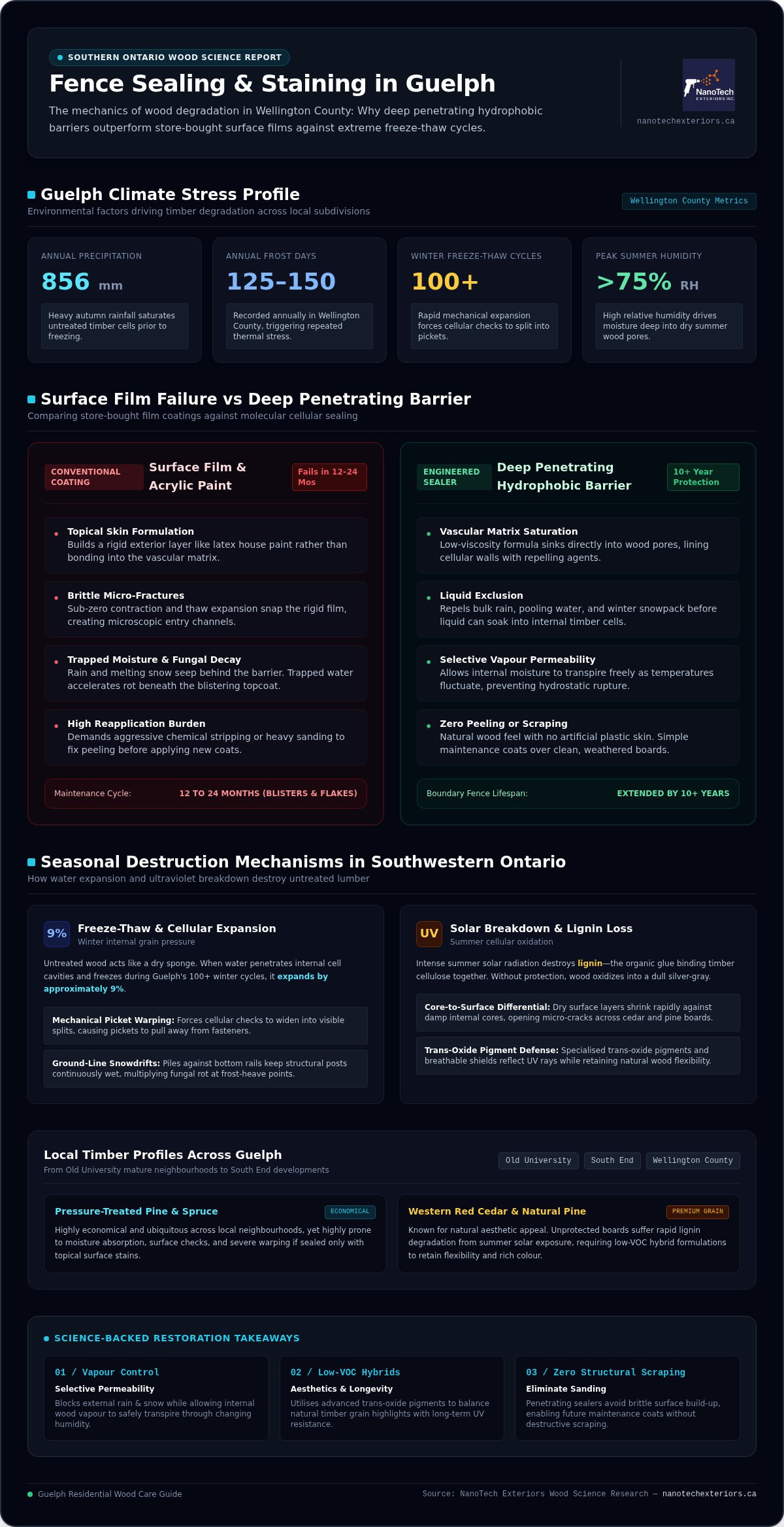
Solid and heavy acrylic stains build a rigid film over the wood, behaving much like exterior latex house paint. While they offer opaque coverage, they do not bond within the deeper cellular matrix of the lumber. During winter, exterior wood constantly contracts in sub-zero cold and expands during sudden thaws. This continuous movement causes brittle surface films to develop micro-fractures. Once rain or melting snow seeps behind that barrier, the moisture becomes trapped against the wood pulp. Fungal decay accelerates underneath, while the topcoat blisters and flakes. Fixing this damage demands aggressive chemical stripping or heavy sanding before you can ever reapply a fresh coat.
Deep Penetrating Sealers and Moisture Barriers
True penetrating wood sealers take the opposite engineering approach. Instead of forming a topical skin, these low-viscosity treatments sink directly into the vascular network of the lumber, lining the pores with water-repelling agents. The wood grain remains natural to the touch, with no artificial plastic layer to blister or peel over time. Crucially, microscopic sealers establish selective vapour permeability:
- Liquid Exclusion: They stop bulk rain and melting snow from soaking into timber cells.
- Vapour Breathability: They allow trapped internal moisture to transpire safely as humidity and temperatures change.
This breathability prevents hydrostatic pressure from rupturing the timber cells from within. For durable fence sealing and staining Guelph residential properties benefit far more from penetrating formulations. They eliminate the exhausting routine of scraping failing paint and allow straightforward maintenance coats directly over clean, weathered boards.
Why Guelph Weather Requires Specialised Fence Protection Strategies
Guelph receives an average of 856 mm of annual precipitation, subjecting residential boundary fences to aggressive seasonal transitions. Between prolonged autumn rainfall, over 100 winter freeze-thaw cycles, and summer relative humidity climbing beyond 75%, local timber faces constant structural stress. Untreated boards act like dry sponges. When water settles into internal cell cavities and freezes, it expands by approximately 9%, fracturing wood grain from the inside out. For successful fence sealing and staining Guelph homeowners must treat these microclimates as structural challenges, not simple cosmetic updates.
The Impact of Freeze-Thaw Cycles on Wood Grain
Rapid temperature swings in Wellington County wreak havoc on exterior lumber. With roughly 125 to 150 frost days recorded annually, exterior boards cycle repeatedly through saturation, freezing, and thawing. This continuous mechanical expansion forces cellular checks to open into visible structural splits, causing pickets to warp and pull away from their fasteners. Snowdrifts piled against bottom rails keep structural timber wet for months, accelerating fungal rot along the ground line where frost-heave stress is highest.
UV Degradation and Graying in Southwestern Ontario
Summer brings a different destructive force. High solar exposure breaks down lignin, the organic glue binding timber cellulose together. As this natural bonding agent deteriorates, lumber loses its vibrant colour and oxidizes into a dull silver-gray. Micro-cracks develop across unprotected cedar and pine as dry surface layers shrink against damp internal cores. Incorporating specialised trans-oxide pigments or breathable moisture shields reflects ultraviolet radiation while maintaining wood flexibility through intense July heat.
Common Fence Woods Across Guelph Subdivisions
Residential properties in Guelph, from mature neighbourhoods in the Old University district to recent developments in the south end, primarily feature two lumber types that react differently to local weather:
- Pressure-Treated Pine and Spruce: Highly economical, yet arrives from mills saturated with chemical preservatives and slick mill glaze. It requires two to six months of drying before internal moisture drops enough to absorb protective treatments.
- Western Red Cedar: Prized for natural tannin resistance against rot, but vulnerable to surface checking, UV degradation, and extractive bleeding if left unsealed under heavy snowfall.
Achieving a durable barrier requires tailored treatments matched to your lumber species. If you want to fortify your perimeter against severe Southern Ontario seasons, explore advanced wood sealing from NanoTech Exteriors for long-term structural defense.
How to Seal and Stain a Fence in Guelph: The Professional 5-Step Process
Protecting perimeter lumber isn’t a quick weekend spray job. It requires an exacting, five-stage protocol to guarantee lasting adhesion and structural defence. Skipping foundational prep leads directly to flaking finishes and premature fungal rot. When executing durable fence sealing and staining Guelph properties need a systematic approach: inspecting the framework, washing away organic growth, balancing timber pH, confirming dry lumber cores, and applying breathable protective agents under calibrated conditions.
Surface Preparation and Chemical Neutralisation
Blasting softwood cedar or spruce with raw high pressure shreds delicate wood fibres, creating permanent surface furring. Instead, professional prep relies on eco-friendly, oxygenated cleaners to break down grey oxidized lignin, mold, and mildew under controlled low pressure. Next, technicians apply an oxalic acid brightener to neutralise alkaline cleaning residues and restore the timber’s natural pH. This chemical reset opens cellular pores, removes dark extractive staining, and creates an absorbent substrate for uniform treatment.
Moisture Testing and Application Windows
Coating damp lumber is the primary reason store-bought finishes fail. Trapped liquid blocks protective resins from sinking into the wood grain, causing the top layer to haze, blister, and peel. Certified crews use digital pin-style moisture metres to verify that internal timber moisture reads below 15% across both sunny and shaded fence runs. Application also requires specific environmental windows: consistent ambient temperatures between 10°C and 30°C, with zero rain forecast for 24 to 48 hours to allow deep bonding.
Precision Application and Back-Brushing Techniques
The application stage pairs pneumatic spray equipment with deliberate manual back-brushing. Spraying delivers even, rapid distribution across pickets, but back-brushing is what forces the formulation deep into the open vascular grain. Crews pay close attention to exposed end-grain post tops and joint intersections where standing moisture naturally pools. Discover how professional exterior wood sealing services maximize longevity across outdoor structures, ensuring your boundary fence withstands Southern Ontario weather extremes without constant re-treatment.
Evaluating Fence Sealers and Stains: Buyer Decision Guide
Selecting the right protective finish requires looking beyond the sample chips at local hardware centres. The right choice balances aesthetic goals against long-term maintenance cycles and chemical durability. For effective fence sealing and staining Guelph homeowners must weigh resin formulation, pigment opacity, and active biocides to safeguard their boundary fencing from premature degradation.
Oil-Based vs Waterborne Sealing Formulations
Traditional oil-modified alkyds offer deep natural saturation, yet solvent-heavy options carry pungent odours and lingering environmental footprints. Modern waterborne penetrating hybrids solve this problem by utilizing emulsified oils suspended in water, easily meeting Canada’s strict architectural VOC regulations under CEPA 1999. These hybrids deliver the deep absorption of traditional oils while drying rapidly without leaving toxic runoff around vegetable patches or perimeter gardens. They wear away gradually without forming brittle surface shells, meaning you won’t have to strip or heavily sand the timber before applying subsequent coats.
Selecting the Right Opacity and Colour Tint
Pigment density determines both the final appearance and the level of solar defense. Formulations generally fall into three transparency tiers:
- Clear Sealers: Ideal for highlighting pristine cedar grain, though standard retail variants require frequent reapplication unless reinforced with advanced UV blockers.
- Semi-Transparent Finishes: Strike an optimal balance by depositing trans-oxide pigments that reflect solar heat while allowing the wood’s organic character to show through.
- Semi-Solid Finishes: Offer substantial pigmentation that masks severe weathering, dark water stains, or uneven tones on older pressure-treated boards.
If your fence borders shaded gardens or dense tree canopies, ensure the formulation includes commercial-grade biocides to prevent green algae from establishing roots within the timber fibres.
Evaluating Warranty and Protection Longevity
Broad manufacturer warranties often look impressive on a bucket, but Southern Ontario’s intense seasonal shifts quickly expose weak chemical bonds. A dependable test for re-treatment is the surface splash method: if water soaks immediately into the grain instead of beading, cellular protection has lapsed. It’s best to treat your property as an integrated envelope, pairing perimeter timber care with routine checks on critical structures like residential roofing to head off exterior decay early. Book a specialized wood evaluation with NanoTech Exteriors to fortify your property against upcoming seasonal wear.
Why Choose NanoTech Exteriors for Your Guelph Fence Sealing and Staining
Outdoor wood represents a major financial investment that requires rigorous preservation rather than temporary cosmetic fixes. Traditional contractors often treat fence staining like any generic exterior paint job, rolling thick coatings over damp boards without diagnostic testing. NanoTech Exteriors approaches exterior maintenance through material science. For dependable fence sealing and staining Guelph property owners turn to our certified team to secure long-term structural integrity while avoiding premature replacement expenses.
Advanced Exterior Protection Standards
Our restoration protocols replace guesswork with measured performance. We evaluate every boundary fence using calibrated moisture verification before any treatment begins, ensuring internal saturation levels have dropped below 15%. This disciplined approach eliminates the common frustrations of uneven lap marks, overspray runs, and peeling topcoats. During application, our crews systematically protect your peripheral assets:
- Interlocking Pavers and Concrete: Masking masonry to block unintentional chemical contact or discoloration.
- Landscaping and Plantings: Shielding sensitive perimeter gardens and turf from overspray.
- Neighbouring Property: Using targeted spray barriers to prevent drift across adjoining boundary lines.
Comprehensive Property Care and Multi-Surface Protection
A well-maintained property functions as an interconnected system. The same harsh climate driving moisture into your perimeter pickets also degrades your driveway, patio, and shingles. NanoTech Exteriors provides high-performance protection across multiple exterior surfaces, combining advanced wood sealing, concrete sealing, and residential roofing expertise. If your roof shingles show signs of granule loss or brittleness, evaluate proactive roof rejuvenation treatments to restore essential oils. You can also assess early structural wear across your building envelope with our practical roof replacement checklist.
Book Your Guelph Exterior Wood Consultation
Extending the service life of your fence starts with honest, data-backed advice. Our specialists conduct comprehensive on-site assessments across Guelph and surrounding Southwestern Ontario communities, providing transparent evaluations on whether your boards require maintenance treatment or targeted structural repairs. When you are ready to fortify your property against upcoming seasonal swings, request a professional quote from NanoTech Exteriors to reserve your project slot.
Protect Your Guelph Property with Science-Led Wood Preservation
Safeguarding residential timber against Southern Ontario’s damp autumns and aggressive freeze-thaw cycles requires more than a cosmetic surface tint. Lasting structural resilience comes from breathable, deep-penetrating moisture barriers that stop water absorption at the cellular level. When you invest in science-backed fence sealing and staining Guelph properties avoid the frustrating cycle of blistering coatings, internal fungal rot, and premature timber replacement.
As an authorized provider of advanced surface protection treatments across Southern Ontario, NanoTech Exteriors follows a disciplined multi-step preparation standard verified by digital moisture testing. Beyond advanced wood sealing, our specialised exterior treatments protect concrete flatwork and residential roofing systems from Canadian weather extremes. You don’t have to spend your weekends scraping failing finishes or worrying about winter water damage. Protect your exterior wood with NanoTech Exteriors and enjoy genuine peace of mind with an exterior boundary built to endure.
Frequently Asked Questions
How often should a wooden fence be sealed and stained in Guelph?
Standard topical stains usually require maintenance coats every two to three years, whereas advanced penetrating sealers protect lumber for five to seven years. The local climate dictates this frequency due to high humidity, seasonal precipitation, and intense freeze-thaw cycles. Testing your fence annually with a water splash test indicates whether moisture beads up or absorbs. If water soaks directly into the wood pores, it’s time to arrange professional fence sealing and staining Guelph services.
Can you stain or seal a brand-new pressure-treated fence immediately?
No, you shouldn’t seal or stain brand-new pressure-treated lumber right away. Fresh boards leave the mill saturated with liquid preservatives and protective chemicals, creating high internal moisture content and slick mill glaze. Coating green lumber traps water inside, preventing proper penetration and causing products to fail prematurely. Allow new pressure-treated fencing to weather and dry for two to six months until a digital moisture metre confirms levels have dropped below fifteen percent.
What is the best time of year to stain and seal an exterior fence in Southern Ontario?
Late spring through early autumn provides the ideal window for fence treatments across Southwestern Ontario. Optimal application conditions require consistent ambient temperatures between 10°C and 30°C, paired with low humidity and zero rainfall for at least twenty-four to forty-eight hours post-application. Applying treatments during the scorching midday sun of mid-summer can dry products too quickly before they penetrate, while late autumn introduces morning frost risks that compromise curing.
Why do big-box store fence stains often peel off after just one winter?
Retail finishes peel because they rely on heavy acrylic resins that form an inflexible surface film over the timber. When winter moisture inevitably seeps behind that topical coating, Ontario’s rapid freeze-thaw cycles cause the trapped liquid to expand and pop the paint film off the wood. Unlike deep-penetrating formulas that bond within cellular pores, rigid retail coatings can’t accommodate seasonal wood contraction, resulting in extensive cracking and flaking after a single season.
Will professional fence sealing protect against grey discolouration and mold growth?
Yes, professional sealing treatments stop grey discolouration and biological growth by eliminating the moisture and solar exposure that fuel them. Unprotected wood turns silver-grey when ultraviolet light degrades surface lignin. Quality penetrating sealants incorporate trans-oxide pigments to reflect UV radiation, alongside commercial-grade biocides that prevent mold, mildew, and green algae from taking root in damp grain. This dual defense keeps your fence structurally sound while maintaining its natural curb appeal.
How long does a fence need to dry before and after sealing application?
A fence needs twenty-four to forty-eight hours of dry weather following a power wash before treatment, and another full twenty-four to forty-eight hours to cure afterward. Technicians verify internal moisture sits strictly below fifteen percent before starting application. After treatment, keeping pets, yard irrigation, and foot traffic away from the perimeter allows deep-penetrating agents to polymerize completely, ensuring a durable, streak-free barrier against external moisture.
Can an old, grey, weathered fence be restored without replacing the boards?
Yes, most weathered fences can be completely revitalized as long as the underlying posts and rails remain structurally sound. Professional restoration removes dead surface wood fibres using oxygenated cleaners and specialized wood brighteners rather than damaging high pressure. This process resets timber pH and restores warm natural wood tones. Once restored, applying professional fence sealing and staining Guelph solutions shields the revived lumber, extending its service life by a decade or more.