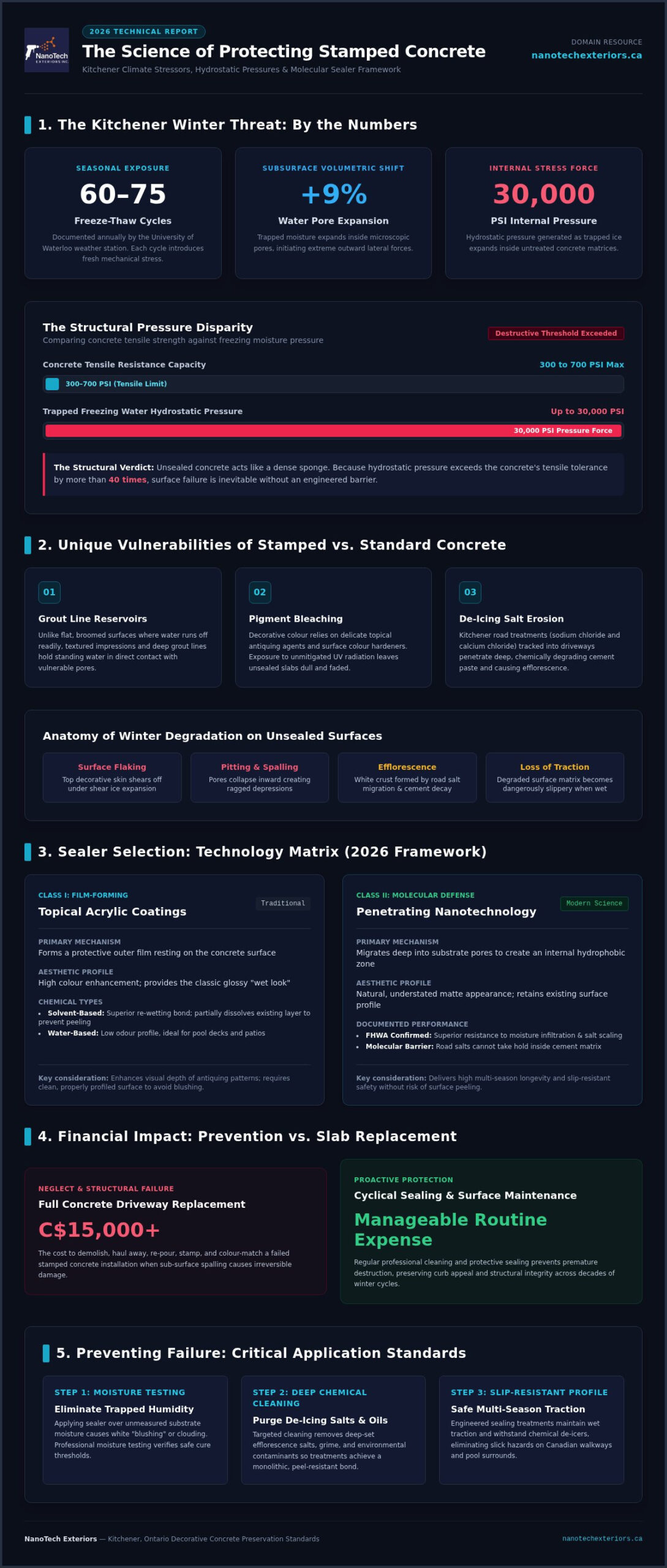
Did you know that your driveway faces over 60 freeze-thaw cycles every single winter in Kitchener? As water enters the pores of your concrete and expands by 9% in volume, it creates internal pressure that can reach 30,000 psi. This force is more than enough to cause the surface of unsealed decorative concrete to flake, pit, and scale. If you’ve noticed your once-vibrant patio looks dull or feels dangerously slippery when wet, you aren’t alone. It’s frustrating to invest in a premium aesthetic only to watch the Canadian climate strip away its beauty.
At NanoTech Exteriors, we understand that you want a solution that works without the hassle of a yearly resealing project. This 2026 guide to sealing stamped concrete Kitchener homeowners can rely on will show you how to restore that “like-new” colour and protect your investment against the harshest winter stressors. We’ll examine the shift toward molecular nanotechnology, explain how to navigate modern VOC regulations, and provide a clear framework for choosing a finish that remains both stunning and slip-resistant for years to come.
Key Takeaways
- Understand how Kitchener’s aggressive winter weather and de-icing salts degrade unsealed surfaces, leading to permanent structural damage and faded colours.
- Learn the technical differences between topical coatings and penetrating treatments to choose the best option for sealing stamped concrete Kitchener driveways and patios.
- Identify the critical preparation steps, such as professional moisture testing and deep cleaning, that prevent common DIY failures like white blushing or peeling.
- Discover the long-term financial benefits of regular maintenance, which can prevent the need for a full C$15,000+ driveway replacement.
- Explore how modern nanotechnology treatments offer a more durable, non-slip alternative to traditional acrylic sealers for multi-season protection.
Why Sealing Stamped Concrete is Non-Negotiable in Kitchener’s Climate
Kitchener’s climate is notoriously brutal on decorative surfaces. The region experiences between 60 and 75 freeze-thaw cycles every single winter, according to data from the University of Waterloo weather station. This isn’t just a weather statistic; it’s a direct threat to your property. Unsealed concrete acts like a dense sponge, absorbing moisture into its microscopic pores. When that trapped water turns to ice, it expands by 9% in volume. This expansion creates internal hydrostatic pressure that can exceed 30,000 psi. Because stamped concrete usually has a tensile strength of only 300 to 700 psi, the math simply doesn’t work in your favour. The result is inevitable surface pitting, spalling, and flaking.
Beyond the physical pressure, the aesthetic components of your driveway are under constant attack. Stamped concrete relies on delicate antiquing agents and colour hardeners to achieve its premium look. Without a protective barrier, UV rays bleach these pigments, leaving your expensive installation looking dull and washed out within just a few seasons. Consistent sealing stamped concrete Kitchener homeowners invest in isn’t just about maintaining curb appeal; it’s a structural necessity for survival in Southern Ontario.
The Freeze-Thaw Threat in Southern Ontario
Stamped concrete is significantly more vulnerable to winter damage than standard broomed finishes. The deep grout lines and textured impressions that give the concrete its character also serve as perfect reservoirs for standing water. Unlike flat surfaces where water runs off easily, these depressions hold moisture exactly where it can do the most damage. If you neglect preventative maintenance, the cost of repair escalates quickly. While a professional seal is a manageable maintenance expense, full removal and replacement of a failed driveway can easily exceed C$15,000.
Salt Damage and Chemical Erosion
Kitchener streets are heavily treated with sodium chloride and calcium chloride de-icers throughout the winter. When you pull your vehicle onto your driveway, you’re tracking these aggressive chemicals directly onto your decorative finish. These salts don’t just sit on the surface; they migrate into the slab, causing a “whitening” effect known as efflorescence and chemically degrading the concrete’s cement paste.
To stop this erosion, you need a salt-impenetrable barrier. Homeowners must typically choose between topical and penetrating concrete sealers to address these threats. While topical coatings provide that classic “wet look,” modern penetrating treatments work at the molecular level to ensure road salt can’t gain a foothold. Expert sealing stamped concrete Kitchener services provide the specialized application needed to ensure these chemicals stay on the surface where they can be safely washed away, rather than eating your investment from the inside out.
Types of Concrete Sealers: A 2026 Buyer’s Framework
Choosing the right chemical barrier for sealing stamped concrete Kitchener driveways involves a balance between material science and aesthetics. In 2026, homeowners generally choose between two primary technologies: topical coatings and penetrating sealers. Topical coatings, like acrylics, form a protective film on the surface that enhances the depth of the concrete’s colour. Penetrating sealers, however, migrate into the pores to create a hydrophobic zone within the substrate. While topical options offer the classic “wet look,” Federal Highway Administration research on concrete sealers confirms that penetrating systems provide superior resistance to moisture infiltration and chemical scaling in harsh environments.
Your choice often depends on the desired finish. High-gloss topical sealers provide a vibrant, reflective shine that makes stamped patterns stand out, while matte finishes offer a natural, understated appearance. For most residential applications in Southern Ontario, the decision comes down to the specific environment and the current condition of the concrete.
Solvent-Based vs. Water-Based Acrylics
Solvent-based acrylics are the traditional choice for Kitchener driveways because they offer the best colour enhancement and durability. These products have a “re-wetting” capability, meaning a new application partially dissolves the existing layer to create a monolithic, peel-resistant bond. This makes future maintenance much simpler. Water-based sealers are becoming more popular for pool decks and patios due to their low odour and eco-friendly profile. They don’t provide the same “pop” as solvent-based versions, but they offer excellent breathability, which is vital for slabs with high moisture vapour emission rates.
Tinted Sealers for Colour Restoration
When UV rays have bleached the original antiquing agents from your stamped pattern, a clear coat won’t restore the lost pigment. Tinted sealers are translucent coatings infused with high-grade pigments designed to re-infuse faded surfaces with rich charcoals, slates, or earth tones. Unlike solid stains that mask the texture, these products preserve the natural look of the stone pattern while hiding minor imperfections. A tinted sealer is a sophisticated, cost-effective alternative to full concrete replacement for slabs that are structurally sound but visually exhausted.
Selecting the correct chemistry ensures your exterior surfaces remain resilient against the next decade of Ontario winters. If you’re ready to fortify your property, reaching out to an expert concrete sealing partner is the most reliable way to ensure a high-performance finish.
The Professional Sealing Process: Avoiding Common Mistakes
Achieving a flawless finish when sealing stamped concrete Kitchener properties requires more than just a bucket and a roller. Most homeowners underestimate the technical complexity of the preparation phase. While a garden hose might remove surface dust, it can’t reach the deep crevices of a slate or cobblestone pattern where organic debris and old resins hide. Professional results start with industrial-grade pressure washing and, crucially, moisture testing. If the foundation isn’t perfectly clean and dry, the most expensive sealer on the market will fail within months.
Preparation: The Foundation of a Lasting Seal
Moisture is the primary enemy of a successful application. In Kitchener’s humid summers, a concrete slab might look dry on the surface while holding significant water within its pores. If you apply a sealer too early, that trapped vapour will emulsify the resin, creating a permanent, milky white haze known as blushing. We require a strict 24 to 48 hour dry window after cleaning before any product touches the surface. During this time, we also address minor hairline cracks. If you don’t repair these small fractures first, they’ll act as entry points for water and salt, undermining the new seal from beneath.
Precision Application and Finishing
When it comes to the application itself, the “less is more” rule is vital. Homeowners often think a thicker coat provides better protection, but over-application is a recipe for disaster. Thick layers of acrylic sealer trap air, leading to unsightly bubbling and premature delamination. Professional contractors typically use high-solids content sealers, ranging from 25% to 30%, applied in two thin, uniform coats. This ensures the material bonds correctly without suffocating the concrete.
We prefer high-pressure spraying over traditional rolling for stamped surfaces. Rolling often leads to “puddling” in the low spots of the texture, which creates an uneven, blotchy appearance. Spraying ensures a consistent micron thickness across both the peaks and valleys of the pattern. Engineering research into concrete sealers and surface treatments highlights how these uniform applications are essential for creating an effective barrier against chloride penetration and moisture ingress.
Finally, safety is a non-negotiable component of our process. Stamped concrete becomes notoriously slick when wet or icy. We integrate a micronized polymer anti-slip additive into the final coat. This creates a subtle, invisible texture that provides essential traction during Ontario’s wet seasons without compromising the visual clarity of the finish. This methodical approach ensures sealing stamped concrete Kitchener projects stay beautiful, durable, and safe for multiple seasons.
Calculating the Real ROI of Professional Sealing
Sealing stamped concrete Kitchener homeowners often view as a cosmetic upgrade is, in reality, a critical financial safeguard. The logic is simple and compelling. A full demolition and replacement of a failed stamped concrete driveway in Southern Ontario typically starts at C$15,000 and can climb significantly higher based on square footage and pattern complexity. By contrast, a professional maintenance cycle costs a small fraction of that amount. Regular sealing can double the lifespan of stamped concrete, effectively pushing a massive replacement expense decades into the future.
Beyond preventing structural failure, high-quality protection directly impacts your property’s resale value. Curb appeal is the first thing a potential buyer sees. A vibrant, well-maintained entrance suggests a home that has been cared for with discipline. There is also an immense “peace of mind” factor in knowing your exterior surfaces won’t pit or crumble during the next aggressive freeze-thaw cycle. You’re not just buying a coating; you’re buying the relief of avoiding unnecessary stress and expense.
DIY vs. Professional Sealing Costs
The “big-box” store sealers found at retail outlets might seem budget-friendly, but they often lack the solids content and UV inhibitors required for our local climate. DIY projects frequently incur hidden costs, such as pressure washer rentals, specialised cleaners, and the risk of application errors that require expensive chemical stripping to fix. A professional application provides 3 to 5 years of protection, whereas retail products often fail after a single season. This proactive approach mirrors other essential home maintenance tasks, such as knowing how to tell if your roof needs replacing, where professional oversight prevents minor issues from becoming catastrophic failures.
Long-Term Maintenance Strategies
Maintaining your new seal doesn’t require constant labour. We recommend a simple rinse with a garden hose every few weeks to remove abrasive grit and road salt residue that can act like sandpaper under foot traffic. To check the integrity of your protection, perform the “water bead test” once a year. If water soaks into the concrete and darkens it rather than forming distinct beads on the surface, your barrier is compromised. Scheduling a professional inspection every 24 to 36 months ensures you catch wear patterns before the underlying pigment is exposed to the elements.
If you want to secure your property’s value with a high-performance barrier, request a professional concrete sealing assessment today.
Why NanoTech Exteriors is Kitchener’s Trusted Sealing Partner
NanoTech Exteriors doesn’t just offer standard maintenance. We act as your “Informed Innovator” in the Kitchener-Waterloo region. Our team understands that the sealing stamped concrete Kitchener homeowners invest in requires a deep knowledge of material science and local environmental stressors. We don’t believe in quick fixes that peel after one winter. Instead, we focus on high-performance, durable solutions that prioritize the structural integrity of your outdoor structures. We position ourselves as sensible advocates for your property, ensuring you avoid the stress of premature concrete failure.
Our expertise isn’t limited to stone and cement. We view exterior protection as a holistic discipline. This specialized concrete care is the perfect companion to our professional exterior wood sealing. Whether we’re treating a cedar deck or a slate-patterned driveway, our goal remains the same: fortification, renewal, and long-term value. We’ve built our reputation across Southern Ontario by delivering results that are grounded in logic rather than high-pressure sales tactics.
The NanoTech Advantage: Beyond the Surface
We prioritize restoration and longevity over superficial shine. This means we take the time to educate every homeowner on why specific sealers are chosen for their unique slab. Our process leverages advanced protective treatments, including nanotechnology-inspired platforms like the one that earned multiple offers on CBC’s Dragons’ Den. These treatments penetrate the substrate at a molecular level rather than just sitting on the surface like a plastic film. This scientific rigor ensures your property remains resilient against the 60 plus freeze-thaw cycles that Kitchener experiences annually. We provide transparent communication from the initial inspection to the final walkthrough, giving you total peace of mind.
Ready to Protect Your Kitchener Home?
Taking the first step toward safeguarding your investment is straightforward and efficient. We offer a free, no-obligation estimate for your concrete project. During your initial consultation, our expert guides will perform a thorough site assessment. We check for failing old sealers, surface spalling, and subsurface moisture levels. We’ll then provide a clear, phased plan tailored to your property’s specific needs. Our methodical pacing mirrors the efficiency of our service, ensuring your project is handled with precision and care.
Book your Kitchener concrete sealing assessment today and discover how a smarter approach to protection can save you thousands in future repairs.
Fortify Your Home Against the Next Ontario Winter
Your stamped concrete is a significant investment that deserves more than a temporary fix. Kitchener’s 60 plus annual freeze-thaw cycles and aggressive road salts will eventually compromise any unsealed surface. By choosing a professional approach that utilizes high-performance materials and scientific application, you’re effectively doubling the lifespan of your driveway or patio. We focus on restoration and longevity so you don’t have to face the stress of an expensive replacement project. Protective maintenance is the most logical way to safeguard your property’s value.
NanoTech Exteriors serves homeowners across Kitchener, Waterloo, and Cambridge with specialized Southern Ontario weather protection. As an Authorized GoNano Dealer, we provide the technical expertise and advanced treatments needed to ensure your property remains stunning and structurally sound. Don’t wait for the first signs of spalling or colour loss to take action. We’re ready to help you restore your home’s curb appeal with the most reliable sealing stamped concrete Kitchener has to offer.
Get Your Free Concrete Sealing Estimate today and experience the peace of mind that comes with a scientifically backed solution. Your property is in expert hands.
Frequently Asked Questions
How often should I seal my stamped concrete in Kitchener?
Most homeowners should plan for a maintenance cycle every two to three years if using traditional topical acrylics. If you opt for advanced penetrating nanotechnology treatments, protection can last between five and ten years. Factors like heavy traffic and exposure to Kitchener’s winter road salt will influence this timeline. We recommend performing a simple water bead test annually to check if your barrier is still performing as intended.
Will sealing my driveway make it slippery during Ontario winters?
High-gloss sealers can become slick when wet or icy, but professional application prevents this issue. We integrate a micronized polymer grit into the final coat to create a non-slip finish. This additive provides essential traction during Southern Ontario’s slushy winter months without clouding the clarity of your decorative pattern. It ensures your driveway remains safe for foot traffic even during the most aggressive freeze-thaw cycles.
Can you restore the colour of faded stamped concrete?
We can absolutely bring back the original vibrancy of your installation using translucent tinted sealers. These products re-infuse faded charcoals, slates, and earth tones that have been bleached by UV exposure. Unlike solid stains, these tinted treatments preserve the natural variations of the stone pattern while hiding minor surface imperfections. It’s a highly effective way to achieve a “like-new” look without the expense of a full replacement.
How long does it take for concrete sealer to dry before I can drive on it?
You can typically walk on the surface within four to twenty-four hours depending on the humidity and temperature. However, you should wait a minimum of forty-eight to seventy-two hours before driving your vehicle onto the fresh seal. This allows the resin to fully cure and harden against the weight and friction of tires. Rushing this process can lead to permanent tire marks or delamination of the newly applied protective layer.
Is it better to use a water-based or solvent-based sealer?
Solvent-based sealers are generally superior for driveways because they offer better colour enhancement and a stronger bond through “re-wetting” capabilities. They are the industry standard for sealing stamped concrete Kitchener homeowners prefer for maximum durability. Water-based options are excellent for pool decks or patios where low odour and breathability are the priorities. Our team helps you select the specific chemistry that matches your slab’s exposure and moisture levels.
What happens if I don’t seal my stamped concrete?
Neglecting your seal leads to inevitable structural and aesthetic decay. Water enters the concrete pores, freezes, and causes the surface to flake or pit. Additionally, unsealed antiquing agents will wash away, leaving the surface dull and porous. Over time, road salts will chemically degrade the cement paste, leading to deep cracks that eventually require total demolition. Proactive maintenance is the only way to avoid these high-cost repairs and maintain your home’s value.
Can you seal concrete that was installed many years ago?
We regularly protect older slabs that haven’t been maintained in years. The process involves a deep industrial cleaning and, in some cases, stripping away old, failing resins that have turned white or started to peel. Once the original surface is restored and dried, we apply modern protective treatments to fortify the concrete against future damage. It’s never too late to start a maintenance program that halts further deterioration and restores stunning curb appeal.
What is the best time of year to seal concrete in Kitchener?
The ideal window for sealing stamped concrete Kitchener projects is between late May and early October. Temperatures need to be consistently between 10°C and 25°C for the sealer to bond correctly. We avoid application during high humidity or when rain is forecast within twenty-four hours. Scheduling your service during these stable weather windows ensures the longest-lasting results and prevents common application errors like bubbling or blushing caused by moisture.